Posts

Showing posts from November, 2026

Billionaire Nassef Sawiris Just Seized 67% of OCI — Egypt's Richest Man Tightens His Grip Ahead of the Orascom Merger

Nassef Sawiris — Egypt's richest man, now controlling 67.45% of OCI after his family's cash offer went unconditional

Egypt's richest man just tightened his grip on a corporate empire. Billionaire Nassef Sawiris will now control 67.45% of OCI N.V. after his family investment company, NNS Holding, declared its cash offer for the Dutch-listed group unconditional — clearing the final hurdle before OCI is folded into Orascom Construction.

The €4.10 Cash Offer That Broke the Deadlock

NNS, the Cyprus-based Sawiris family vehicle, offered €4.10 ($4.59) in cash for every OCI share it did not already own. The offer closed on November 17 and was declared unconditional on November 18. There was no minimum acceptance level, so NNS was always going to buy whatever shares were tendered once regulators signed off — and family members holding about 9.07% of OCI had committed not to sell into it.

The bid was launched in late June to break a deadlock over the merger, after some OCI investors balked at taking Orascom shares. NNS crossed 55% of OCI in July through market purchases priced just below the offer, and held about 57.5% by late August. The unconditional declaration lifts that to 67.45%.

What Happens Next: Delisting, Then a New Orascom

OCI shareholders approved the combination with Orascom Construction on October 30, with 99.85% of votes cast in favour. Under the deal, OCI moves nearly all its assets into a subsidiary and hands it to Orascom in exchange for 97.2 million new shares, distributed at 0.4634 Orascom share for each OCI share. OCI's final day of trading on Euronext Amsterdam is expected to be November 26, with delisting the following day; shareholders should receive their Orascom shares from around December 8, and OCI will then be liquidated. The two companies must complete the deal by December 30.

Because NNS now owns a larger slice of OCI, it will receive a bigger share of the new Orascom stock — lifting the Sawiris family's grip on the enlarged company, which will be renamed Orascom and run infrastructure, construction and investment divisions. Sawiris himself is set to become its non-executive chairman.

The Man Behind the Move

Sawiris, 65, is the youngest son of Onsi Sawiris, who founded the Orascom business in 1950. He built OCI into one of the world's largest nitrogen fertilizer producers before selling most of its plants. He also chairs Adidas AG, where he owns close to 6%, and co-owns Aston Villa Football Club. Forbes estimates his net worth at $9.6 billion, making him Egypt's richest person — and after this week, one of the most powerful industrial owners in the region.

Source: Billionaires.Africa (Nov 18, 2026); Wisevoter; Securities.io. This is a fan/commentary summary of reported news; all figures are the sources' estimates. Portrait image is an AI illustration.

Billionaire Brad Gerstner Is Betting $5 Billion on the Anthropic IPO — His Biggest IPO Order Ever

Brad Gerstner — the billionaire Altimeter Capital founder betting $5 billion on the Anthropic IPO, the biggest IPO order his firm has ever placed

While Wall Street argues about whether the AI boom is a bubble, billionaire investor Brad Gerstner is putting his money where his mouth is — $5 billion of it. The Altimeter Capital founder wants to invest $5 billion in Anthropic's blockbuster IPO, a bet more than five times larger than any IPO order his firm has ever placed.

"A Cornerstone Compounder"

In an interview with CNBC, Gerstner left no doubt about his conviction. "I think this is a cornerstone compounder for a long period of time. It's where the trade is going. I think they are going to benefit the most and so we want to continue to be a major shareholder of Anthropic," he said.

He believes Anthropic and OpenAI will scoop up most of the economic value created by the AI revolution — and he is backing that belief with the biggest cheque of his career. Anthropic, the company behind the Claude assistant, is pricing its offering on Wednesday, November 18, with shares set to begin trading on the Nasdaq on Thursday, November 19, under the ticker ANT. The company is selling 825 million shares at $70 to $78 apiece, valuing it at up to $1.4 trillion — potentially the biggest IPO in history. Demand has been so strong that the offering was reportedly six times oversubscribed, according to Bloomberg.

A Track Record Worth Following

Gerstner's conviction carries weight because his track record is extraordinary. Altimeter made Meta its largest investment in 2012, when the stock traded at about $17 a share after its IPO; Meta's market cap is now about $1.6 trillion. The firm backed Snowflake before its public debut, entering at an enterprise value of about $175 million — Snowflake went public in September 2020 at a valuation of about $70 billion and now commands a market cap of close to $100 billion.

Altimeter first invested in OpenAI in September 2024 with $250 million, and has participated in funding rounds since. With Anthropic, the firm was in from the Series F round, which raised $13 billion at a $183 billion post-money valuation, and again in the Series G, which raised $30 billion at $380 billion. It also participated in Anthropic's latest pre-IPO round, which valued the company at $965 billion.

The Numbers Behind the Bet

The bet is not without risk. Anthropic's third-quarter revenue growth moderated to 47% sequentially after expanding 144% the quarter before, and the company posted a $23.3 billion net loss. It holds commitments totalling $900.9 billion through 2045, with about $70.7 billion due within the next 12 months — though it had $146.6 billion in available liquidity as of September 30.

But the growth is staggering: revenue for the first nine months of 2026 reached $33.24 billion, up 1,206% from a year earlier, and customers spending more than $100,000 a year jumped to 11,900 from just 950. Net revenue retention hit 900% in the third quarter — existing customers are spending nine times more than they did a year ago. Gerstner is betting that is the kind of compounding no smart money can afford to ignore.

Source: Barchart (Nov 18, 2026), reporting Gerstner's CNBC interview; Bloomberg. This is a fan/commentary summary of reported news; all figures are the sources' estimates. Portrait image is an AI illustration.

Elon Musk Just Became a Part-Owner of CNN and CBS — and HBO Still Plans to Air the Film That Roasts Him

Elon Musk — now a Skydance shareholder and part-owner of CNN and CBS, as HBO vows to still air the critical Musk documentary

Elon Musk just bought his way into Hollywood — and the studio he now partly owns is about to stream a film that takes him apart. Skydance chief executive David Ellison confirmed on Wednesday that the world's richest man is a shareholder in the newly merged media giant, calling the investment "an honor and a privilege."

The Confirmation at DealBook

Speaking at The New York Times DealBook Summit in Manhattan, Ellison was asked about reports that Musk had put roughly $1 billion into Skydance after its $111 billion takeover of Warner Bros. Discovery closed on October 6. Ellison confirmed the stake but not the amount, praising Musk as "the greatest entrepreneur of our time" and adding: "He doesn't invest in a lot of companies. So to have his vote of confidence and to have him as a shareholder is an honor and a privilege."

The deal makes Musk a part-owner of CBS News, which came with Paramount, and CNN, which came with Warner Bros. Discovery — along with HBO, Showtime, MTV, Comedy Central and Nickelodeon, now all under one corporation. His father Larry Ellison personally guaranteed $47 billion in equity financing for the merger.

The Film That Still Airs

Here is the twist: HBO Max will still stream Alex Gibney's four-hour documentary "Musk" in the first quarter of 2027, despite its subject now being a shareholder. The film features interviews with Musk's first wife Justine, his father Errol, Ashley St. Clair and AI pioneer Geoffrey Hinton — and Musk has publicly criticised it.

"We believe in independence. We don't believe in censorship of any kind and we have that deal with A24 and of course we'll honor it," Ellison told the summit. Asked whether the investment could grow into a Starlink partnership, he said there is no agreement yet — though former Warner Bros. Discovery chairman John Malone has predicted a content-distribution deal with SpaceX worth as much as $8 billion to $10 billion.

The timing is awkward for the studio: Skydance shares opened on Wednesday down 42% from their October 6 merger debut, and the company carries more than $80 billion in debt. Musk's vote of confidence may be exactly what it needs — even if the film it is about to air is not.

Source: TheWrap (Nov 18, 2026), reporting the NYT DealBook Summit; CNBC/Semafor (Oct 2026). Portrait image is an AI illustration.

Baywatch Star Erika Eleniak's $1 Million OnlyFans Payday Saved Her From Eviction

Erika Eleniak — the Baywatch star whose $1 million OnlyFans payday saved her from eviction

Baywatch icon Erika Eleniak has opened up about the money troubles that nearly cost her home — and the unlikely $1 million payday that saved it. The 57-year-old actress says she went from an eviction notice to a seven-figure turnaround in a matter of months.

From Eviction Notice to $1 Million

Speaking on Tuesday's episode of the "Miss Understood" podcast, Eleniak said she was facing serious financial hardship before she launched her OnlyFans profile in August. Other jobs, she admitted, didn't seem "beneath" her — but they simply "weren't going to pay the rent." At one point, she received an eviction notice.

The subscription platform changed everything. TMZ reported she was earning $10,000 a week within weeks of launching, and by early November she had banked nearly $300,000 in just three months — putting her on pace to make roughly $1 million in her first year on the platform.

The Baywatch Comeback

Eleniak played lifeguard Shauni McClain on Baywatch from 1989 to 1992, becoming one of the show's original stars. She says she joined OnlyFans after years of fan requests, and now counts more than 1,100 subscribers. The comeback doesn't stop there: she is set to reprise her Baywatch role in a guest appearance on Fox's upcoming Baywatch reboot, scheduled to premiere January 6, 2027.

It's a reminder that even a '90s television icon can hit hard times — and that Eleniak turned a platform many dismissed into a lifeline, on her own terms.

Source: Page Six (Nov 18, 2026), reporting TMZ. Portrait image is an AI illustration.

Russian Billionaire's Ex-Wife Demands £600 Million in Britain's Biggest-Ever Divorce Trial

Vladimir Potanin — his ex-wife Natalia Potanina is demanding £600 million in Britain's biggest-ever divorce trial over his $29.7 billion fortune

Natalia Potanina, 65, walked into London's High Court on November 18 to open what could become Britain's biggest divorce trial ever — a claim for a share of her ex-husband Vladimir Potanin's $29.7 billion fortune, or £600 million to cover her "reasonable needs" if that claim fails.

The £600 Million Ask

The fallback figure alone would smash Britain's divorce record. Potanina is asking for £150 million to buy a London home, £441 million as a maintenance fund and another £10 million for other expenses. The current record is the £554 million awarded in 2021 to Princess Haya bint Al Hussein against Dubai ruler Sheikh Mohammed bin Rashid Al Maktoum. And if her main claim succeeds — a share of Potanin's fortune itself — the payout could run into ten figures.

Three Decades, One Fortune

The couple married in 1983 and divorced in Russia in 2014 after nearly three decades together. Potanina argues the wealth built during the marriage was a joint effort — she raised their three children and ran the household while her husband built his business empire. Russian courts awarded her a share of the couple's assets, but she says the settlement excluded much of Potanin's wealth, including his interests in mining giant Norilsk Nickel and assets held through trusts. She says she has received about £30.9 million since the divorce — less than 1% of the wealth amassed during the marriage. Potanin's side puts the figure at around $84 million; she says it was closer to $41.5 million.

Why London, Why Now

Potanin built his fortune after the collapse of the Soviet Union and holds a significant stake in Norilsk Nickel, one of the world's largest producers of palladium and nickel. His wealth has nearly doubled since 2018, according to Forbes. Potanina is pursuing her claim under Part III of the Matrimonial and Family Proceedings Act, which lets people divorced overseas seek further relief in England if they can show sufficient links and an inadequate foreign settlement. A court initially blocked her case in 2019, but the Court of Appeal later ruled she had a meaningful connection to England. The trial before Justice MacDonald is scheduled to run 15 days — but even a win may be hard to collect, with much of Potanin's wealth held in Russia and other jurisdictions. He was sanctioned by the UK in 2022 and argues the dispute was already resolved by the Russian courts.

Source: NDTV, reporting the Financial Times (November 18, 2026). Portrait image is an AI illustration.

Prem Watsa Sells His $370 Million IIFL Stake to Fund the $5.6 Billion IDBI Bank Takeover

Prem Watsa — Fairfax sold its entire IIFL Finance stake for $370 million to fund the $5.6 billion IDBI Bank takeover

Canadian billionaire Prem Watsa is cashing out to go bigger. His Fairfax Financial has sold its entire stake in Indian lender IIFL Finance in a $370 million block deal — and every dollar is earmarked for the biggest acquisition in the company's history.

A Clean Exit at a Premium

Fairfax sold more than 56 million IIFL Finance shares on November 18 at a floor price of 611 rupees each, valuing the deal at about 34.54 billion rupees ($370 million), according to a Reuters report citing a source with direct knowledge of the transaction. The sale ends Fairfax's 13.64% holding in the lender — a complete exit. IIFL shares jumped as much as 6.5% to 678.10 rupees after the deal was done.

The $5.6 Billion Prize

The money is headed straight for IDBI Bank. Fairfax was named the winning bidder for a 60.72% stake in the state-backed lender, valued at about 528.78 billion rupees ($5.6 billion) — the largest investment in Fairfax's history. The group plans to turn IDBI into a major universal bank, combining its lending and deposit operations with insurance distribution through Go Digit and investment banking and wealth management through its other Indian interests.

What's Next

The IDBI Bank acquisition still requires regulatory and government approvals, with Fairfax previously indicating that it expects the deal to close early next year. Watsa — often called Canada's Warren Buffett — has spent decades building Fairfax into a global insurance and investment group, and the IIFL sale shows how far he is willing to go to rearrange his portfolio for the one deal that matters most.

Source: Billionaires.Africa, reporting Reuters (November 18, 2026). Portrait image is an AI illustration.

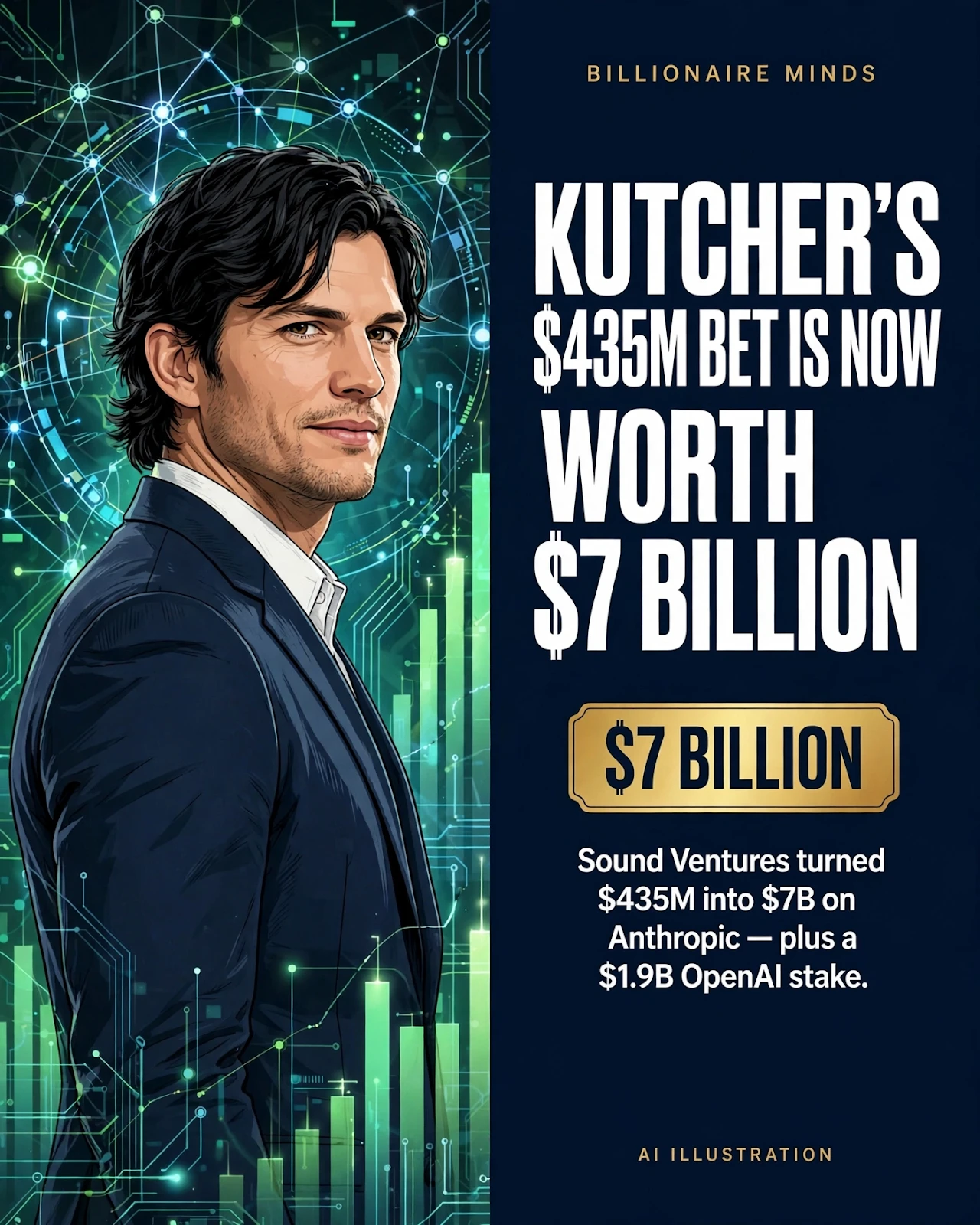
Ashton Kutcher Is About to Join the Billionaires' Club — His $435 Million Anthropic Bet Is Now Worth $7 Billion

Ashton Kutcher — his $435 million Anthropic investment is now worth about $7 billion as the AI company prices its $1.4 trillion IPO

Ashton Kutcher is one IPO away from the billionaires' club. The Hollywood star's venture capital firm, Sound Ventures, turned a $435 million bet on Anthropic — the AI company behind Claude — into a stake now worth about $7 billion, and the AI giant is pricing its blockbuster IPO today.

Anthropic is expected to price its offering on Wednesday, November 18, with shares set to begin trading on the Nasdaq on Thursday, November 19, under the ticker ANT. The company is selling 825 million shares at $70 to $78 apiece, raising as much as $64.35 billion and valuing Anthropic at up to $1.4 trillion on a fully diluted basis — potentially the biggest IPO in history. Demand has been so strong that the offering was reportedly six times oversubscribed, according to Bloomberg.

From $435 Million to $7 Billion

According to Bloomberg, Sound Ventures owns 0.5 percent of Anthropic — a stake that could deliver a potential 1,500 percent increase when the AI giant goes public. Newsweek puts the current value of the firm's $435 million investment at about $7 billion.

It would be the biggest win yet for an actor who has quietly become one of Hollywood's most successful tech investors, with a reported net worth of more than $200 million.

Hollywood's Quietest Tech Investor

Kutcher co-founded A-Grade Investments in 2010 with billionaire Ron Burkle and Guy Oseary, the longtime manager of Madonna and the Red Hot Chili Peppers. The group backed Spotify, Uber and Airbnb early, reportedly growing about $30 million into roughly $250 million.

He and Oseary then launched Sound Ventures in 2015 as the successor fund — and its Anthropic bet is now the firm's defining win.

The Catch: He Won't Pocket $7 Billion

Before anyone crowns a new billionaire, there is a catch. Sound Ventures manages money for outside investors, so the profits would be split among several parties — Kutcher would not instantly receive the full $7 billion.

He also stepped down from his partner role at Sound Ventures in July, though he remains a senior advisor. The Wall Street Journal reported the move was partly driven by different views on which startup stages to target: the firm wanted to back more established companies, while Kutcher prefers early-stage startups.

One of the Few Actors in the Club

If the numbers hold, Kutcher would join a very small group. As of 2026, the only billionaires in the film industry, according to Forbes, are Tyler Perry, Jerry Seinfeld and Arnold Schwarzenegger. Musicians have had an easier path — Jay-Z at $2.8 billion and Taylor Swift at $2 billion lead the richest-musicians list, with Paul McCartney joining them at $1.4 billion just last week.

For the "That '70s Show" star turned venture capitalist, the Anthropic IPO could be the moment Hollywood's quietest tech investor finally joins the club he has been circling for fifteen years.

Sources: Page Six, reporting Newsweek and Bloomberg; MarketPulse; NY Post; The Motley Fool; Economic Times. This is a fan/commentary summary of reported news; all figures are the sources' estimates. Image: AI illustration.

Bill Gates Would Be the World's No. 2 Richest Man — If He'd Never Given a Dollar Away

Bill Gates would be the world's second-richest person at $464 billion if he had never donated — Warren Buffett $363 billion, MacKenzie Scott $82 billion, per Forbes True Net Worth

What if the world's biggest givers had kept every dollar? Forbes has an answer — and it would rewrite the entire rich list. In its hypothetical "True Net Worth" ranking, the magazine adds back the value of everything a billionaire has donated, and the results are staggering: Bill Gates would be the second-richest person on the planet, sitting on roughly $464 billion.

The $464 Billion "What If"

Forbes introduced the True Net Worth calculation in April 2026. The method is simple: take a billionaire's current fortune, then add back the estimated present-day value of the company shares they gave away — and treat cash donations as money that could have been invested and grown at market rates. It is a hypothetical exercise, not a real ranking, but it reveals just how much wealth the great philanthropists have handed away. For Gates, decades of giving to the Gates Foundation — roughly $100 billion in total — would have compounded into a fortune second only to Elon Musk's.

Buffett and Scott: The Giving Gap

Warren Buffett would be worth around $363 billion under the same math — far richer than his actual fortune suggests, yet still behind Musk. MacKenzie Scott, who has made a habit of giving away billions with almost no strings attached, would hold about $82 billion if she had never donated. Both figures underline the same point: the world's most famous givers have quietly surrendered fortunes that would dwarf most countries' budgets.

Musk Still on Top — Even After Giving

Even in the adjusted ranking, Elon Musk stays No. 1, with an estimated $858 billion if his own donations were added back — a reminder that the gap at the top is enormous. Larry Page and Sergey Brin also feature in the adjusted list. The message of the exercise is blunt: philanthropy at this scale is not a rounding error. It is the difference between being rich and being the richest person alive — and Gates, Buffett and Scott chose to give it away.

Source: The Economic Times, reporting Forbes' True Net Worth ranking. Image: AI illustration.

Sergey Brin Compares California to Soviet Russia — and He's Spent $57 Million Fighting the Billionaire Tax

Sergey Brin — the Google co-founder compares California's proposed billionaire tax to Soviet Russia

Google co-founder Sergey Brin has broken his silence on California's proposed billionaire tax — and his comparison is striking. The man who fled the Soviet Union as a six-year-old says the Golden State is heading down the same road, and he has already spent $57 million trying to stop it.

In a rare statement to the New York Times, Brin said: "I fled socialism with my family in 1979 and know the devastating, oppressive society it created in the Soviet Union. I don't want California to end up in the same place."

The 5% Tax That Sparked a Billionaire Exodus

The proposal is a one-time, 5% tax on the wealth of California residents with assets worth at least $1.1 billion. The union behind it says it has collected nearly 1.6 million signatures — almost twice the 875,000 needed — and has submitted them to election officials to get the measure on the November ballot.

Supporters say the money is needed to compensate for federal healthcare funding cuts, with about 90% earmarked for public health services. But opponents — including Democratic Governor Gavin Newsom — warn that driving billionaires out of the state will do more harm than good for California's economy and budget.

$1 Trillion Has Already Left

The exodus is already underway. Billionaires worth a combined $1 trillion have fled California as the wealth tax inches closer to the ballot. Google co-founder Larry Page, worth $281.9 billion, has moved or axed more than 45 California companies and bought a mansion in Miami. Brin himself, worth $260.1 billion, has terminated or moved 15 California companies and snapped up property in Florida and Nevada. Meta CEO Mark Zuckerberg, worth $231.4 billion, is also leaving.

PayPal co-founder Peter Thiel was among the first to go — and has donated $3 million to the fight against the tax. Oracle founder Larry Ellison, worth $217.9 billion, sold his Pacific Heights mansion on Billionaire's Row for $45 million. Car loan magnate Don Hankey called the tax "ridiculous" before leaving, former Uber CEO Travis Kalanick confirmed his move, and DoorDash co-founder Andy Fang called the proposal "stupid."

Not Every Billionaire Agrees

Some of California's richest residents are openly critical but staying put. Mercor co-founder Brendan Foody called parts of the proposal "insane" but says he must stay because his employees and customers are in San Francisco. LinkedIn co-founder Reid Hoffman called it "badly designed" and "horrendous" for innovation, while Anthropic co-founder Dario Amodei described it as "poorly designed" and Vinod Khosla called it "very dumb" — but none of them has announced plans to leave.

And one prominent voice breaks ranks entirely: Nvidia CEO Jensen Huang, the seventh-richest person in the world at $180 billion, has said he is "perfectly fine" with the proposed tax.

For Brin, though, the fight is personal. He arrived in America as a refugee from Soviet socialism — and he is spending a fortune to make sure California never becomes the place his family escaped.

Source: Forbes (Nov 18, 2026), reporting the New York Times. Portrait image is an AI illustration.

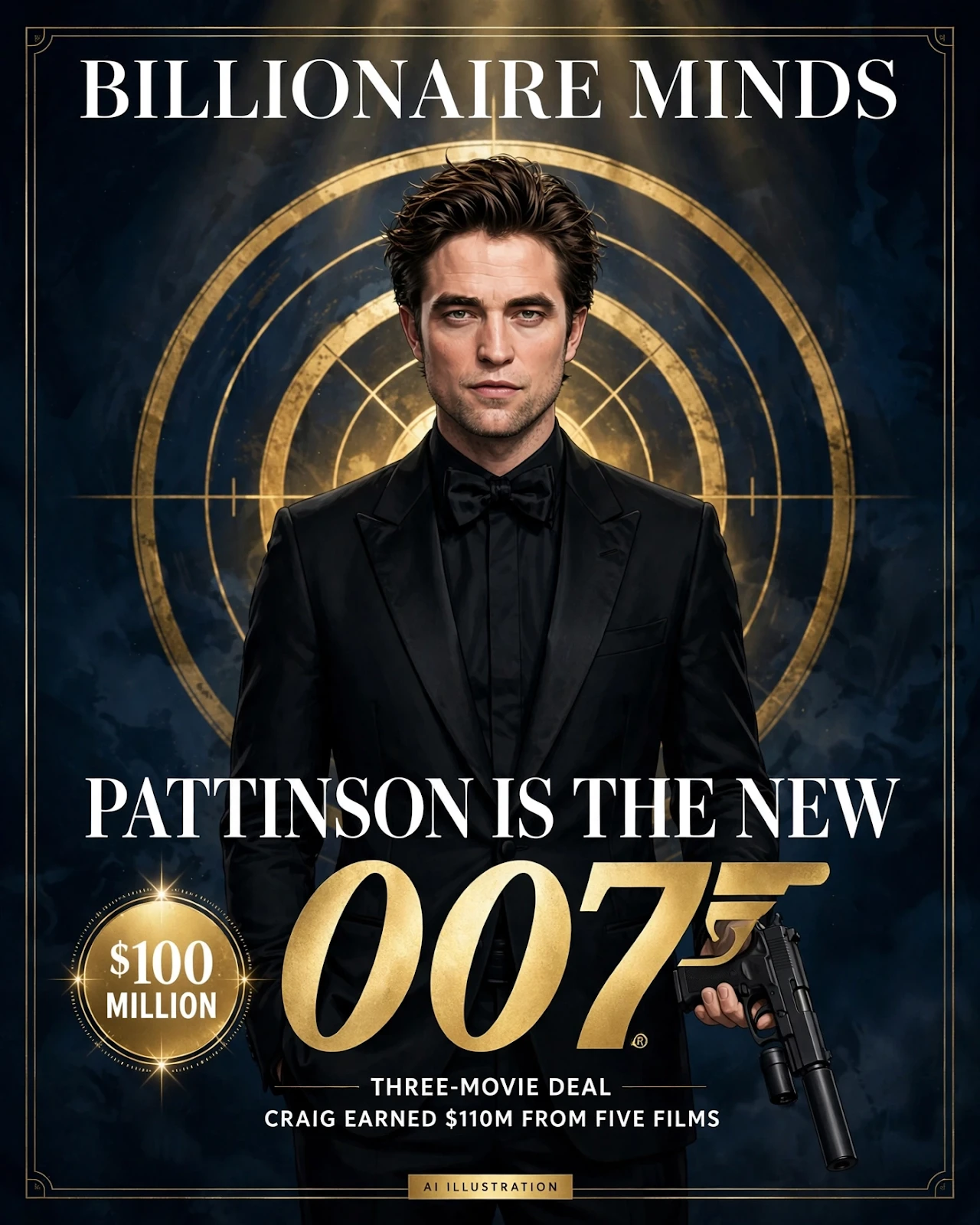
Jeff Bezos Personally Picked Robert Pattinson as the New James Bond — 'He Is James Bond'

Jeff Bezos in a tuxedo — the Amazon founder personally picked Robert Pattinson as the new James Bond

Amazon MGM Studios announced on Monday that Robert Pattinson, 40, will be the next James Bond — and on Tuesday, Amazon founder Jeff Bezos revealed he chose him personally. Speaking at Semafor's Silicon Valley & The World conference in California, the world's second-richest man said he was "heavily involved" in the casting of the world's most famous fictional spy.

"We ran a really tight process and we made the final decision on Friday," Bezos said on stage, a day after the announcement set Hollywood alight.

Too Famous for 007?

Bezos admitted he and director Denis Villeneuve were initially "slightly biased" against Pattinson — because he was already too famous. The Bond role has traditionally been star-making, and the team wondered whether they should pick somebody a little more unknown.

Then came the screen tests. Amazon narrowed a large group down to five finalists — Callum Turner, Josh O'Connor, Jack Lowden, Nicholas Hoult and Pattinson — and had each perform three scenes in full costume on sets. "But in the screen test, it was so obvious. He is James Bond," Bezos said.

Amazon's $1 Billion Bond Empire

The casting is the biggest move yet in Amazon's takeover of the 007 franchise. Amazon bought the storied studio MGM in 2022 for $8.5 billion, then spent roughly another $1 billion last year to secure creative control of Bond from longtime rights holders Michael Wilson and Barbara Broccoli.

Pattinson's film — directed by Villeneuve — will be the first Bond adventure under Amazon MGM Studios' creative stewardship, and it is not expected in cinemas before 2028.

A Billionaire's Hollywood Play

For Bezos, worth $376.6 billion on Forbes' real-time list, the Bond casting is the most personal flex yet of Amazon's Hollywood ambitions. At the same Semafor event, he also weighed in on the Nvidia succession drama, saying that if the board is not bringing Jensen Huang back, "I wouldn't hire an outsider" — an outside CEO at a complex company is a last resort.

The message from the world's second-richest man is clear: when Amazon spends billions on a franchise, its founder picks the star himself.

Source: AP via Rappler / Indian Express / Dawn; Business Today; Malay Mail (Nov 18, 2026). Portrait image is an AI illustration.

Shah Rukh Khan's $1.78 Billion KKR Gets a New American Owner as Jay Mehta Sells a $400 Million Stake to Ares

Shah Rukh Khan's Kolkata Knight Riders — Jay Mehta sells a $400 million stake to Ares Management, valuing the IPL team at $1.78 billion

Shah Rukh Khan's Kolkata Knight Riders are getting a new American owner. Co-owner Jay Mehta is selling half of his stake in the three-time IPL champions to US investment giant Ares Management in an all-cash deal worth about $400 million — a transaction that values the franchise at a staggering $1.78 billion.

According to multiple sources cited by Cricbuzz, Mehta is transferring a 22.5% stake — exactly half of his 45% holding — to Ares, the Los Angeles-based firm that already owns stakes in Chelsea FC, the Miami Dolphins and Inter Miami. The deal is understood to be close to completion, pending formal approval from the Board of Control for Cricket in India (BCCI).

A $1.78 Billion Valuation

The price tag puts KKR among the most valuable franchises in world cricket. The $1.78 billion valuation lines up almost exactly with Sportico's recent independent valuation of $1.738 billion — and matches the $1.78 billion price paid for Royal Challengers Bengaluru, while sitting just above the $1.65 billion Rajasthan Royals deal.

The BCCI also stands to cash in. Under its rules, the board is entitled to 5% of the transaction value — roughly $20 million — and will carry out due diligence on Ares before giving the sale its formal approval.

Shah Rukh Khan Keeps Control

Bollywood's biggest star is not going anywhere. Shah Rukh Khan will keep his 55% majority stake in the franchise he has owned since 2007, when he joined Mehta and his actress wife Juhi Chawla to buy the team through Kolkata Knight Riders Sports Pvt Ltd in the IPL's first franchise auction.

Under their ownership, KKR have won the IPL three times — in 2012, 2014 and 2024 — and reached the final again in 2021. After the sale, Mehta and Chawla will hold 22.5% between them, while Ares takes the other 22.5%.

Ares' Growing Sports Empire

For Ares, KKR is the latest stop in a rapid global sports shopping spree — and not its first in cricket. The firm already co-owns Trent Rockets in England's The Hundred alongside Cain International.

American money has been pouring into the IPL since CVC Capital bought Gujarat Titans in 2022. Blackstone and Bolt Ventures have since invested in Royal Challengers Bengaluru alongside the Aditya Birla Group, and CVC sold Gujarat Titans to the Torrent Group last year while keeping a 33% minority stake.

The message from the market is clear: an IPL franchise is no longer just a cricket team — it is a billion-dollar asset, and the world's biggest investors want in.

Source: Cricbuzz (Nov 18, 2026); CricTracker; Sportico. Portrait image is an AI illustration.

Razon Barely Stays a Trillionaire as ICTSI Sheds ₱620 Billion From Its July Peak

Enrique Razon — the Philippines' richest man, barely holding on to trillionaire status as ICTSI sheds ₱620 billion

Enrique "Ricky" Razon Jr. is still a trilyonaryo — but only just. The Philippines' richest man has watched his flagship ports operator lose nearly a third of its value since July, and his fortune is now clinging to the trillion-peso mark.

Forbes estimated Razon's fortune at $16.7 billion as of November 17 — roughly ₱1.07 trillion. Just three months ago, he topped the 2026 Forbes Philippines rich list with a record $21.8 billion. That is a $5.1 billion slide in a single quarter, driven almost entirely by the sell-off in International Container Terminal Services Inc. (ICTSI), the company he chairs.

The ₱620 Billion Slide

ICTSI has shed about ₱620 billion in market value since July 20, when its shares closed at ₱1,027 and gave the company a record capitalisation of ₱2.07 trillion. By November 17, the stock was trading at ₱718 — a 30% decline that left ICTSI worth ₱1.45 trillion.

Razon is not standing by idly. The port operator has kept buying back its own shares through the downturn, repurchasing 400,000 shares for ₱290.72 million on November 16 at prices between ₱710 and ₱745. Cumulative buybacks now total 86.93 million shares worth ₱16.53 billion since the programme began in September 2015.

Still the Philippines' Most Valuable Company

Even after the rout, ICTSI remains the Philippine stock market's most valuable listed company — worth more than twice as much as the Sy family's SM Investments Corp., which had a market capitalisation of ₱662.03 billion.

And the business itself is far healthier than the share price suggests. ICTSI's nine-month profit jumped 20% to $899 million, with revenue up 24% to $2.9 billion, as newly added terminals in South Africa and Indonesia delivered. Razon's fortune is also cushioned by investments in gaming, energy and water infrastructure, helping keep him above the trillion-peso line even as ICTSI's share price falls.

For now, the richest Filipino keeps his trilyonaryo crown — but the margin has never been thinner.

Source: Bilyonaryo (Nov 18, 2026); Forbes; Inquirer. Portrait image is an AI illustration.

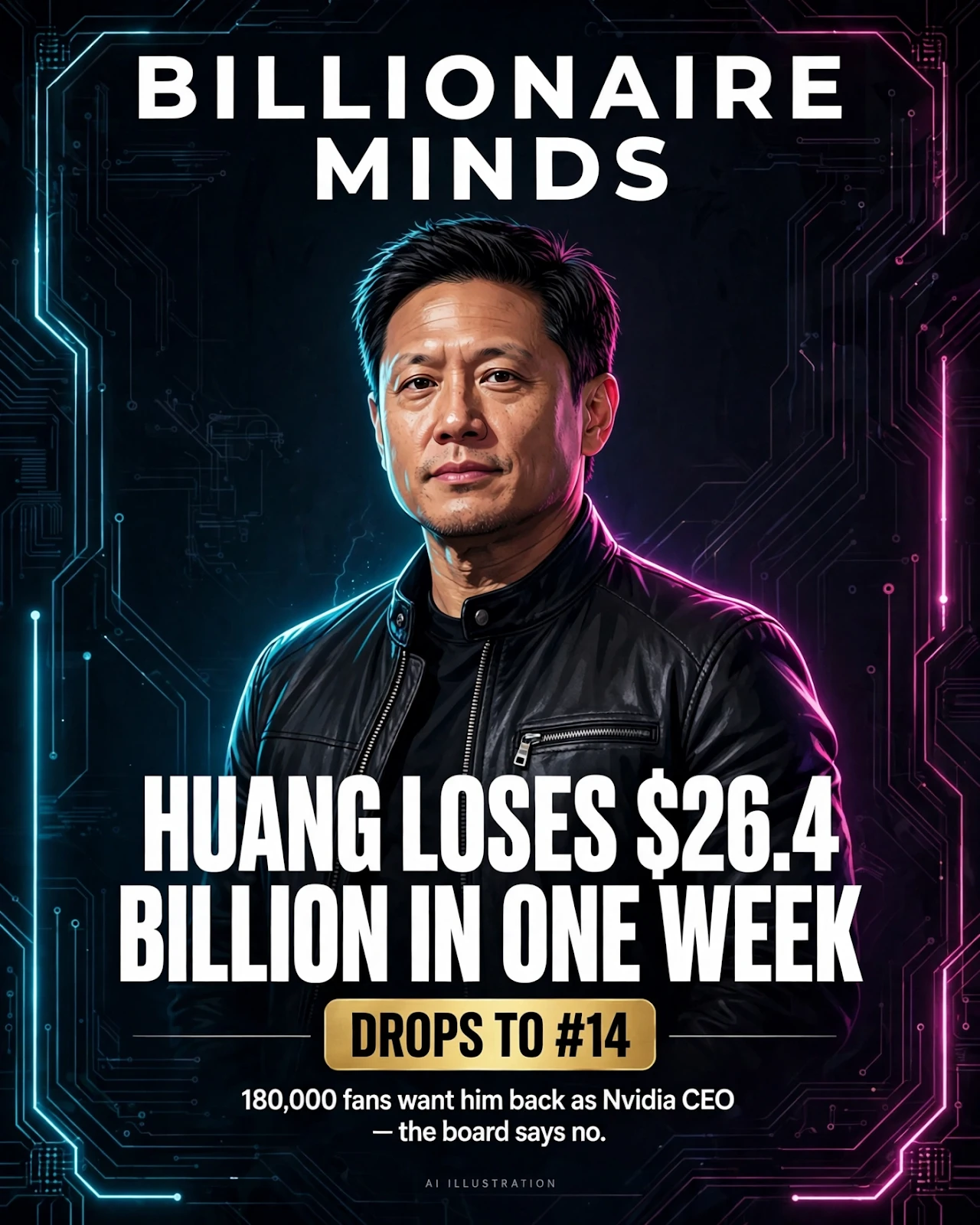
Nvidia's Board Just Said No to Jensen Huang — Even Trump Couldn't Bring Him Back

Jensen Huang — Nvidia's board rejected the billionaire founder's offer to return as CEO

Jensen Huang offered to come back. Nvidia's board said no — unanimously, in public, and on the company's biggest earnings call of the year.

Hours after Huang posted on X that he would be "honoured" to return as CEO if the board decided it served shareholders, employees, the company and America, board chairman Harvey Jones opened Nvidia's third-quarter earnings call on Tuesday with a blunt verdict: "The Nvidia board unanimously accepted his resignation and does not intend to reinstate Jensen as CEO."

It was a stunning rebuke — not just of Huang, but of the campaign to bring him back. President Donald Trump had backed his return. Elon Musk, Epic Games founder Tim Sweeney and Y Combinator's Garry Tan had signed an open letter urging reinstatement. A petition demanding his comeback had gathered 180,000 signatures. None of it moved the board.

The $136 Billion Founder Who Offered to Return

Huang, 63, resigned on November 12 after admitting to extramarital affairs, including one with a Chinese businesswoman reported to be a suspected intelligence asset. The board launched an independent investigation, and the fallout erased roughly $751 billion in Nvidia's market value in days. Huang's own fortune fell $26.4 billion in a week to about $136 billion, dropping him to 14th on Forbes' real-time rich list.

In his first public comment since resigning, Huang acknowledged "serious mistakes" in his personal life and pledged to cooperate with the board's investigation. He has also agreed to testify before congressional committees on December 1, with Nvidia general counsel Tim Teter scheduled to appear the next day.

"We've Got This" — Nvidia Moves On Without Its Founder

Interim CEO Colette Kress, Nvidia's chief financial officer of 13 years, used the same earnings call to insist the company is not standing still. "Our roadmap is on track, and our ambition has never been greater," she told investors, closing with a rallying call: "We've got this."

The numbers backed her up. Nvidia reported third-quarter revenue of $115.8 billion — up 103% from a year earlier — and Kress raised the growth outlook for the 2028 financial year to around 75%, up from about 70%. The board has hired executive search firm Heidrick & Struggles to find a permanent successor, and set up a new national security and export control oversight committee.

Jones said the board wants to install a permanent CEO "as quickly as possible, but we won't expedite the CEO before finding exactly the right person." For now, the message from Nvidia's boardroom is clear: the company that Huang built over 33 years will go forward without him — and it is in no hurry to look back.

Source: CNN (Nov 17, 2026); The Business Times; South China Morning Post. Portrait image is an AI illustration.

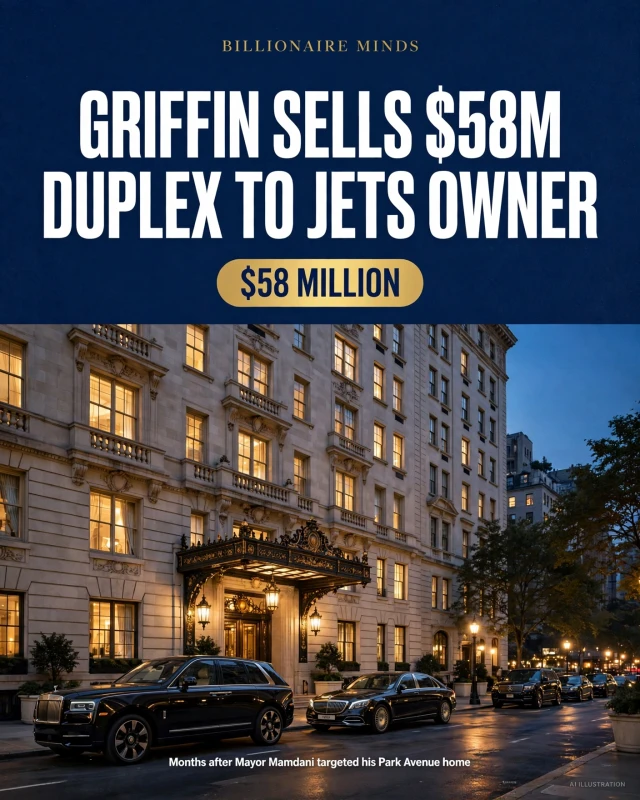
Ken Griffin Sells His $58 Million Park Avenue Duplex to Jets Owner Woody Johnson — Months After Mayor Mamdani Targeted Him

Ken Griffin sells his $58 million Park Avenue duplex to New York Jets owner Woody Johnson, months after Mayor Mamdani targeted his home

One billionaire's Park Avenue duplex just changed hands — to another billionaire. Hedge fund titan Ken Griffin has sold his sprawling duplex at 740 Park Avenue to New York Jets owner Woody Johnson for $58 million, in an off-market deal first reported by the Wall Street Journal on November 17.

One Billionaire to Another

The roughly 8,500-square-foot residence spans two floors in one of the Upper East Side's most exclusive cooperative buildings, with five bedrooms, three fireplaces and a grand staircase foyer. The buyer is no ordinary house-hunter: Johnson is the Johnson & Johnson heir whose net worth stands at $13.5 billion, according to the Bloomberg Billionaires Index. The limestone building at 740 Park Avenue, developed around 1930 by James T. Lee — the grandfather of Jacqueline Kennedy Onassis — holds only about 30 apartments.

A $13 Million Profit in One Year

Griffin bought the same duplex in 2025 for $45 million from Julia Koch, the widow of billionaire industrialist David Koch. The $58 million sale price is roughly 29% higher — a $13 million gain in about a year, before transaction costs or improvements. Griffin wished the buyer well in a statement to the New York Post: "I wish Woody and his family many happy years in one of New York's great residences."

The Mamdani Factor

The timing is hard to ignore. In April 2026, New York Mayor Zohran Mamdani posted a video outside Griffin's Manhattan penthouse promoting a new tax on luxury second homes — a measure described as raising about $500 million a year. Mamdani had made taxing the city's wealthiest property owners a signature issue, singling out Griffin, the Citadel founder, by name. The sale comes just months after that very public targeting.

Griffin Isn't Leaving New York

Despite the sale, Griffin has not exited the city. He still owns the apartment Mamdani featured in his video, and he retains an adjacent unit at 740 Park Avenue that he bought earlier this year for $38 million. His planned $6 billion Manhattan office tower, however, has given way to a bigger bet on Citadel's Miami expansion. For Johnson, the purchase caps a billionaire property shuffle of his own — he recently sold his duplex at 834 Fifth Avenue to billionaire Leonard Blavatnik.

Source: Wall Street Journal, New York Post and Bloomberg Law, November 17, 2026. Image: AI illustration.

Billionaire Leo KoGuan's $1.3 Billion Ultimatum — No Huang, No More Nvidia Money

Stylized illustration of billionaire Leo KoGuan before a glowing microchip and city skyline — his $1.3 billion ultimatum to Nvidia's board over Jensen Huang's return

One of Nvidia's biggest individual shareholders just drew a line in the sand. Singapore-based billionaire Leo KoGuan — who has about $1.3 billion invested in the chipmaker — says he will not buy another share of Nvidia while Jensen Huang is out as CEO. "No further investment without Jensen," the 71-year-old told Bloomberg in a text message.

The Letter Demanding Huang's Return

KoGuan has been defending Huang publicly on X, calling him "the supreme creator" and arguing that his contributions to artificial intelligence should carry more weight than his personal mistakes. He has now joined Tesla CEO Elon Musk and Epic Games founder Tim Sweeney in signing an open letter urging Nvidia's board to reinstate Huang. Huang stepped down on November 12 following revelations about extramarital relationships, including one involving a suspected Chinese spy. The board, however, has said it does not intend to bring him back — even as Nvidia just posted a $115.8 billion quarter without him.

Who Is Leo KoGuan?

KoGuan is the founder and chairman of SHI International, one of the world's largest privately held IT solutions providers, with around 7,000 employees, more than 17,000 customers and $16 billion in gross sales. He and his then-wife Thai Lee bought a struggling New Jersey software reseller for less than $1 million in 1989 and built it into SHI; Lee is now president and CEO, with an estimated $8 billion fortune of her own. KoGuan first appeared on Forbes' Singapore rich list in 2022 and ranked ninth in September 2026 with an estimated net worth of $8.2 billion. Beyond SHI, he became one of Tesla's largest individual shareholders, holding 6.3 million shares plus options on another 1.8 million by September 2021 — a stake worth more than $7 billion at the time. In March 2026 he disclosed buying 2 million Nvidia shares in two transactions. His wealth has also funded major Singapore real estate, including a S$62 million penthouse bought from British billionaire James Dyson in 2020 and a roughly S$100 million boutique hotel acquired in 2025.

A Shareholder Standoff

KoGuan's ultimatum sets up a direct clash between Nvidia's board and one of its most prominent backers. The board has closed the door on Huang's return, yet a billionaire who has poured $1.3 billion into the company is now publicly refusing to invest another dollar until the man he calls "the supreme creator" is back in charge. With Musk and Sweeney also pressing for reinstatement, the pressure on the board is only growing — and the next move belongs to the shareholders.

Source: VnExpress International, November 18, 2026, reporting Bloomberg. Image: AI illustration.

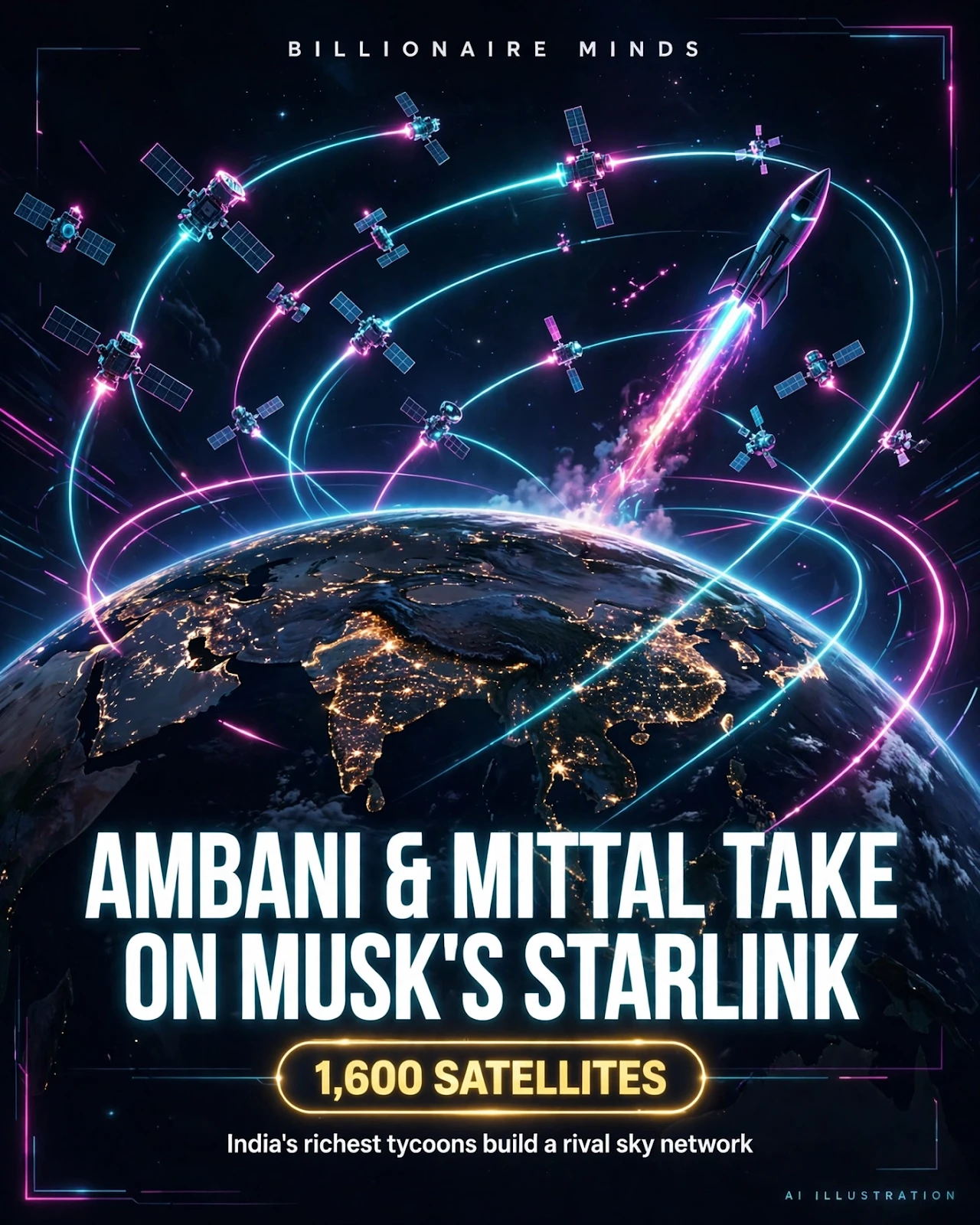
Ambani and Mittal Just Declared War on Musk's Starlink — a 1,600-Satellite Rival

Stylized illustration of satellites orbiting Earth — Ambani and Mittal take on Musk's Starlink with a 1,600-satellite rival network

Two of India's richest men are taking the fight to Elon Musk — in orbit. Mukesh Ambani's Reliance Industries is planning a 1,600-satellite low Earth orbit constellation to rival Starlink, while telecom tycoon Sunil Mittal is backing Eutelsat's OneWeb as the independent alternative. The billionaire space race just got a lot more crowded.

Ambani's 1,600-Satellite Plan

Reliance is in talks with Indian satellite manufacturers, technology startups and larger industrial groups, offering to fund the infrastructure needed to scale up production. India currently produces fewer than 15 satellites a year — the constellation would need output of around 200 a year. The plan combines domestic manufacturing with imports, including at least 400 satellites from the US. Reliance is discussing procurement with two US companies and evaluating suppliers in Europe, while ruling out China as a source. A test mission is targeted for September 2027, with wider deployment from early 2028; completion has slipped from 2030 to 2035.

Mittal's OneWeb Bet

Meanwhile, Sunil Mittal is backing Eutelsat Communications' OneWeb, which is building a global satellite-internet network independent of both the US and China. "Countries can't rely on another country," Mittal told Bloomberg TV. OneWeb has around 650 satellites — far fewer than Starlink — and Bharti Airtel, India's second-largest telecom operator, was an early investor in 2015, joining the UK government in a $1 billion rescue in 2020 and investing another $500 million since.

The Gap They Have to Close

The commercial gap remains substantial. Starlink serves at least 13.6 million customers worldwide and generated more than $5 billion in connectivity revenue in the three months ended September. Eutelsat's LEO business, including OneWeb, generated just €70.9 million ($81.5 million) in the same period. Amazon is also developing a network of thousands of satellites. For Ambani and Mittal, the stakes go beyond broadband — satellite networks are increasingly vital for remote connectivity, communications and military operations, making control a matter of strategic autonomy. Starlink's planned India entry remains subject to regulatory and security scrutiny, strengthening the case for homegrown alternatives.

Source: BusinessToday, November 18, 2026. Image: AI illustration.

Billionaire Ray Dalio's Bridgewater Dumps Union Pacific and Slashes Its Biggest Bet — the $4 Billion S&P 500 Stake

Ray Dalio's Bridgewater dumps Union Pacific — the fund exits railroads and trucks and slashes its $4 billion S&P 500 bet

Ray Dalio's Bridgewater Associates just made one of its boldest portfolio moves in years — and the filing tells the whole story. The hedge fund founded by the billionaire sold its entire stake in railroad giant Union Pacific, walked away from truckmaker Paccar, and slashed the biggest single bet in its portfolio: a nearly $4 billion position in the S&P 500 itself.

The Railroad Exit

Bridgewater's quarterly 13F filing with the US Securities and Exchange Commission shows the firm held about 514,300 Union Pacific shares — worth roughly $139.9 million — at the end of June. By September 30, the position was gone entirely. Paccar went the same way: about 946,100 shares worth $113.6 million at the end of June, zero by the end of the quarter. Together, the two fully exited positions were worth around $253.5 million.

The Biggest Cut of All

The largest change in the filing was not a single stock at all. Bridgewater cut its holding in the SPDR S&P 500 ETF Trust — the fund that tracks the benchmark US index — sharply enough to reduce the portfolio's weighting by about 5.9 percentage points. The ETF had been Bridgewater's largest US equity holding: about 5.3 million shares worth $3.97 billion, or 16.3% of a stock portfolio valued at roughly $24.4 billion. At the same time, the firm opened new positions in utility Dominion Energy and oil producer Occidental Petroleum, and added to its chipmaker Qualcomm stake.

Dalio Steps Back

Dalio, 77, started Bridgewater from his New York apartment in 1975 and built it into the world's largest hedge fund. He handed control to the firm's board in 2022 and has since sold down his stake and left the board, leaving him with no formal role. He remains one of the most widely followed voices in finance — and he has spent recent weeks warning about the size of US government debt, comparing it to plaque building up in an artery, while promoting gold as a hedge against it. Forbes lists him among the world's billionaires.

The filing is a snapshot, not a diary: it shows what Bridgewater held on September 30, not when it traded or why. But the direction is unmistakable — Dalio's fund is pulling back from the index and from America's railroads at the same time.

Source: Billionaires.Africa, reporting Bridgewater Associates' Q3 2026 Form 13F filing with the SEC.

Image: AI illustration. This is a commentary post based on public reporting.
Nvidia Doubles Sales Without Huang — $115.8 Billion Quarter and a $130 Billion Guide as the Board Closes the Door on His Return

Nvidia doubles sales without Jensen Huang — $115.8 billion revenue in its first quarter under interim CEO Colette Kress

Nvidia just delivered its first earnings report without Jensen Huang — and the numbers barely noticed he was gone. Revenue for the quarter ended October 25 more than doubled to $115.8 billion, up 103% from a year ago and roughly $6.7 billion above what Wall Street expected. Adjusted earnings hit $2.68 a share against a $2.47 forecast, and net income more than doubled to $65.3 billion.

The data-center business did the heavy lifting: $107.6 billion, up 110%, with sales to AI clouds and enterprise customers up 195%. New Vera Rubin systems began shipping in the quarter and added nearly $20 billion of revenue on their own. Shares rose about 2.4% in after-hours trading after the release.

A $130 Billion Guide — and No Way Back for Huang

The outlook was even louder than the quarter. Nvidia guided fourth-quarter revenue to $130 billion, comfortably above the roughly $125 billion analysts expected, in a quarter that includes an extra week. Interim CEO Colette Kress — who is also chief financial officer — told investors "the momentum is real" and raised the fiscal 2028 growth outlook to about 75%.

Then came the line that closed the book on the saga of the past week. Board chair Harvey Jones told the earnings call the board does not intend to reinstate Huang, ending the campaign to bring the founder back after his November 12 resignation. The message from Nvidia's first post-Huang quarter is blunt: the machine prints money with or without him.

Source: Motley Fool / MLQ.ai / Zacks / BeInCrypto

Image: AI illustration. This is a commentary post based on public reporting.

Billionaire Stanley Druckenmiller Dumps Google for SpaceX — Sells Every Alphabet Share in a $120 Million Exit

Stanley Druckenmiller — billionaire sells every Alphabet share and buys into SpaceX

One of Wall Street's most closely watched billionaires just swapped one AI giant for another. Stanley Druckenmiller's Duquesne Family Office sold every single Alphabet share it owned in the third quarter — all 336,300 of them, worth more than $120 million — and used the moment to buy into Elon Musk's SpaceX instead.

The moves surfaced in Duquesne's Form 13F, filed with the SEC on Monday, November 16. The Alphabet exit is striking because Druckenmiller had only bought the Google parent's stock one quarter earlier. Three months in, the whole position was gone.

The SpaceX Bet

On the other side of the trade, Duquesne opened a new position of 202,125 SpaceX shares, worth about $30.5 million at the end of September. SpaceX went public in June at $135 a share with a valuation of roughly $1.77 trillion, and Druckenmiller's move puts the legendary investor on the same side of the AI trade as Musk — just in a different company.

Druckenmiller has said artificial intelligence "might be a little overhyped now, but underhyped long term" — a view that fits a portfolio rotating toward the companies he believes will win the long game.

Gold, Chips and a 94% Cut

The Alphabet exit was not the filing's only surprise. Duquesne slashed its Taiwan Semiconductor stake by 94%, from 589,680 shares to just 32,700, and opened three new gold-miner positions totalling about $129 million in Newmont, Barrick and Agnico Eagle. It also nearly tripled its Seagate holding and added first-time stakes in Palantir and AppLovin.

The filing is a snapshot, not a diary: it shows what Duquesne held on September 30, not when it traded or why. But the direction is unmistakable — out of Google, into SpaceX, gold and data storage, with the biggest bet still on molecular diagnostics firm Natera at about $1.3 billion.

Source: Motley Fool / TradingView / Benzinga / MLQ.ai

Image: AI illustration. This is a commentary post based on public reporting.

Billionaire David Hoffmann Offers Just $37 Million for 342 Radio Stations — Townsquare's Board Is Expected to Say No

David Hoffmann — billionaire offers $37 million for Townsquare Media's 342 radio stations

Missouri-born billionaire David Hoffmann has made one of the boldest lowball offers in media history: just $37 million in cash for all of Townsquare Media — the company behind 342 radio stations across 74 American markets.

Hoffmann's family company sent an unsolicited letter to Townsquare's board on Monday, offering $2.03 per share. That is roughly a 50% premium over the stock's $1.35 intraday price — but the shares have lost about two-thirds of their value in the past month, closing at just $1.28 on Monday and leaving the whole company worth only around $25 million on the market.

The $467 Million Problem

The headline price is not the real price. Townsquare carries $467.5 million in debt against just $4.6 million in cash, so any buyer would be taking on close to half a billion dollars of obligations. Hoffmann's letter puts the enterprise value at roughly $490 million and warns the company could face insolvency without a restructuring.

Hoffmann already owns 112,941 Townsquare shares bought on the open market. His letter says he has stopped buying shares in favour of bidding for the whole company.

The Board Is Expected to Say No

Townsquare chief executive Bill Wilson told trade publications the board "feels that it does not reflect the underlying value of the company" and expects to reject the offer once its review is complete.

The bid is Hoffmann's second big radio move this year. In June he agreed to pay $20 million for six Audacy stations in St. Louis, including the legendary news-talk station KMOX. If the Townsquare deal ever closed, his media empire would stretch to 193 newspapers and 360 radio stations.

Source: Radio & Television Business Report / Radio Ink

Image: AI illustration. This is a commentary post based on public reporting.
Musk Taunts Bezos After SpaceX's Historic Starship Flight — and a Rocket Failure Just Wrecked 40 of Amazon's Satellites

Elon Musk and Jeff Bezos in a stylized space-race face-off — Musk taunts Bezos after SpaceX's Starship flight while a rocket failure destroys 40 Amazon satellites

Elon Musk is not letting a historic weekend in space slide — and he used it to take a very public swipe at Jeff Bezos. Hours after SpaceX pulled off its most ambitious orbital feat yet, Musk went on X and asked the question no one at Blue Origin wanted to hear: if throwing money at rockets was all it took, why can't Bezos' billions buy a reliable launch?

The jab landed on Sunday, November 15, and it came with receipts. The same morning, a rival rocket carrying Amazon's own satellites failed minutes after liftoff — destroying 40 of them.

Starship's Historic Flight Set the Stage

On November 13, SpaceX's Starship flew its 15th test flight. Ship 42 entered orbit, deployed 26 next-generation Starlink V3 satellites, completed multiple orbits around Earth, and returned to its Texas launch site roughly 22.5 hours after liftoff on November 14 — an unprecedented orbital engineering feat, and arguably SpaceX's biggest accomplishment to date.

Musk wasted no time. When a critic on X argued that anyone could build reusable rockets simply by throwing enough money at the problem, Musk dismantled the argument by pointing straight at Bezos and Blue Origin.

"Let's take this gentleman's argument at face value that anyone can throw money at rockets and get something like Starship, Falcon, or Dragon," Musk wrote on Sunday. "Perhaps he can explain to everyone how SpaceX is able to catch giant starships from orbit with chopsticks and deliver 85% of all Earth payload to orbit with Falcon, while Blue Origin, which started before SpaceX and was funded by the immensely wealthy Jeff Bezos, is not yet able to launch reliably? I am genuinely curious."

Bezos Had a Head Start — and Billions More

The numbers back up Musk's taunt. Bezos founded Blue Origin in September 2000 — nearly two years before Musk established SpaceX in May 2002 — and has personally funnelled billions of dollars from Amazon stock sales into the venture. Despite the head start, SpaceX's Falcon fleet now hauls around 75% of global orbital tonnage, according to industry data cited by FourWeekMBA.

Musk didn't stop with Bezos. In the second half of his Sunday post, he aimed at Washington's legacy aerospace contractors: "And why is it that Boeing and Lockheed Martin, despite receiving several times more government funding than SpaceX, are so far behind?"

NASA's own numbers tell the story. In 2014, the agency awarded Boeing $4.2 billion to develop the Starliner crew capsule and SpaceX $2.6 billion to develop Crew Dragon. A decade later, SpaceX routinely ferries astronauts to the International Space Station, while Boeing has grappled with propulsion failures and more than $1.85 billion in Starliner charges, according to CNBC.

The Rocket Failure That Proved Musk's Point

Hours before Musk posted, a United Launch Alliance Vulcan Centaur rocket — the Boeing-Lockheed joint venture — malfunctioned within 10 minutes of liftoff on Sunday morning and failed to reach orbit, destroying all 40 commercial satellites aboard, according to Space.com.

Those 40 lost satellites belonged to Amazon's Leo network, previously known as Project Kuiper — Amazon's $10 billion-plus low-Earth-orbit broadband network designed to go head-to-head with SpaceX's Starlink, according to GeekWire.

Bezos is determined to diversify Amazon's launch options rather than rely solely on Musk's Falcon 9 rockets to deploy a planned 3,236-satellite constellation. That is why Amazon secured the largest commercial launch procurement in aerospace history, with contracts from ULA and Blue Origin — including 38 missions on ULA's Vulcan rocket. Sunday's mishap happened on the very first of those 38 contracted Vulcan flights.

What This Means for the Billionaire Space Race

The failure leaves Amazon's satellite broadband rollout bottlenecked by the exact launch struggles Musk just called out. SpaceX, meanwhile, keeps expanding its commercial grip on low Earth orbit — a dominance that underpins the company's roughly $1.9 trillion valuation and Musk's position as the world's richest person, worth around $890 billion by Forbes' real-time estimates, with Bezos second at about $377 billion.

For Bezos, the weekend was a brutal reminder that in the space race, billions in capital no longer buy a technological moat. For Musk, it was the perfect stage to say so out loud.

Image: AI illustration. This article is commentary on publicly reported events.
Source: TheStreet — "Elon Musk calls out Jeff Bezos over SpaceX rivals"

Australia's Richest Woman Keeps Buying Musk's SpaceX — Even as Her Fortune Drops $19 Billion

Gina Rinehart, Australia's richest woman, keeps buying Elon Musk's SpaceX even as her fortune falls $19 billion to $28 billion

Gina Rinehart is not flinching. Australia's richest person just added to her company's holdings in Elon Musk's SpaceX and in US defense stocks — even as her own fortune has fallen about $19 billion from its February peak to roughly $28 billion.

Hancock Prospecting, the closely held iron ore company Rinehart chairs, increased both positions in the three months to September 30, Bloomberg reported on November 16. The purchases extend a steady shift by Hancock this year toward space, defense, mining and energy companies in the United States.

The Musk Bet Keeps Growing

SpaceX is already Hancock's biggest US holding. Rinehart backed the rocket and satellite company at its June 12 initial public offering, calling it "a significant investment" without giving a figure. Hancock's filing for the second quarter later showed 8 million SpaceX shares worth $1.37 billion at the end of June.

That filing showed Hancock's US-listed portfolio at $5.71 billion on June 30, up 72% from three months earlier and spread across 42 securities. The company also doubled its holding in Trump Media & Technology Group during that quarter.

A Bigger Push Into US Defense

Hancock moved into US defense shares in the first quarter, buying stakes in Lockheed Martin, Northrop Grumman, RTX and L3Harris Technologies, along with cybersecurity company CrowdStrike and gold producer Newmont. Those purchases were worth about $133 million together. It sold its entire holding in Chilean lithium producer SQM in the same period.

Rinehart, 72, inherited Hancock Prospecting from her father, Lang Hancock, in 1992, when it was heavily indebted. She rebuilt it into one of Australia's most profitable private companies, largely through the Roy Hill iron ore mine in Western Australia's Pilbara region. Her US portfolio is a small part of a fortune that rests mainly on iron ore — but it is the part she is growing fastest.

Source: Billionaires.Africa, reporting Bloomberg

Sam Bankman-Fried's $500 Million Bet Would Be Worth $35 Billion This Week — But He's in Prison

Stylized illustration of Sam Bankman-Fried behind prison bars — his $500 million Anthropic bet would be worth $35 billion at this week's IPO

This Thursday, Anthropic — the AI company behind the Claude chatbot — is expected to start trading on the Nasdaq at a valuation approaching $1.4 trillion. It would be one of the biggest IPOs in Wall Street history. And one early investor should have been heading into the greatest Thanksgiving of his life.

His name is Sam Bankman-Fried. In late 2021, his trading firm Alameda Research put $500 million into a little-known AI research startup, buying roughly a 13.5% stake. Had those shares survived the collapse of FTX, they would be worth about $35 billion at the top of Anthropic's IPO price range. Instead, Bankman-Fried is serving a 25-year prison sentence in California — and the shares are long gone.

The $35 Billion That Slipped Away

The math is stark. FTX's bankruptcy estate sold the entire Anthropic position in 2024 for a combined $1.34 billion — roughly two-thirds of the stake went for $884 million in March 2024, with the rest following later. After Anthropic's 10-for-1 stock split in September 2026, that same position would equal about 445.4 million shares. At the IPO range of $70 to $78 a share, it would be worth $31.2 billion to $34.7 billion — a 70-fold return on the original $500 million.

The New York Times reported on November 16 that Bankman-Fried has repeatedly expressed frustration with the administrators who sold the stake, and he even cited the Anthropic investment in a long-shot appeal to the Supreme Court in September. The Financial Times puts the missed value even higher, at roughly $37 billion.

Who Got the Bargain Instead

The buyers of the bankruptcy sale got one of the great bargains in investing history. Quant trading giant Jane Street — fittingly, the first place Bankman-Fried ever worked — was among the firms that picked up the shares at what Fortune called firesale prices. Amazon, which has poured $18 billion into Anthropic since 2023, and Google, with a $33 billion commitment, are among the giants riding the IPO to a windfall.

Anthropic is set to price its shares on Wednesday, November 18, and begin trading Thursday, November 19, under the ticker ANT. The deal is already oversubscribed, with orders several times the 825 million shares on offer.

The Fine Print on the $35 Billion

One honest caveat: the $35 billion is a thought experiment, not money that was ever Bankman-Fried's to keep. The stake belonged to FTX and Alameda entities, and any value would have gone to the bankruptcy estate and creditors — and Bankman-Fried was convicted in March 2024 on seven counts of fraud and conspiracy, with a roughly $11 billion forfeiture order standing. His convictions were upheld by a federal appeals court in June 2026.

Still, the irony is hard to beat: the man once called crypto's golden boy made what may be the single greatest venture bet of the decade — and the only person who will not see a cent of it is the man who made it.

Source: Celebrity Net Worth, reporting The New York Times and Anthropic's IPO filings. The portrait image on this post is an AI-generated illustration.
Jay-Z's Duetti Just Raised $665 Million to Buy Up Independent Music — Roc Nation's Catalog Bet Hits $1.3 Billion

Stylized illustration of hip-hop mogul Jay-Z in a tailored suit before a wall of vinyl records — Jay-Z's Roc Nation-backed Duetti raised $665 million

Duetti Inc., the music investment company backed by Jay-Z's Roc Nation, has secured $665 million in fresh financing to buy up more independent music catalogs — the latest sign that song royalties have become one of Wall Street's favourite alternative assets.

The deal, announced on Tuesday, takes Duetti's total funding past $1.3 billion since the company was founded in 2022, and it is the biggest music-rights financing of its kind this year.

A $450 million securitization anchored by Carlyle

The centrepiece of the package is a $450 million asset-backed securitization anchored by global investment firm Carlyle. Viola Credit added $165 million of credit capacity, and a $50 million side facility came from Flexpoint Ford and Truist Bank. Barclays arranged the deal alongside Truist.

It is Duetti's third asset-backed securitization in two years — and more than five times the size of its first deal in 2024, a sign of how fast institutional money is moving into music royalties.

From $1.3 billion raised to 50,000 songs

Duetti has now made more than 1,600 catalog investments and owns over 50,000 masters and compositions representing the works of more than 3,000 recording artists. The company says it has partnered with artists, songwriters and other rights owners from over 50 countries.

Unlike the big catalog buyers chasing superstar estates, Duetti focuses on independent artists, buying portions of catalogs rather than full ownership, then managing and marketing the rights and earning from streaming and licensing.

Why billionaires and Wall Street want song rights

Music royalties pay out every time a song is streamed, licensed or played — steady, recurring income that does not move with the stock market. Carlyle's head of asset-backed finance, Akhil Bansal, said independent music royalties can generate "recurring, diversified cash flows" that suit asset-backed financing.

Jay-Z, hip-hop's first billionaire with a Forbes-estimated $2.8 billion fortune, founded Roc Nation in 2008 and has built a business portfolio spanning music, sports, entertainment and investments. Duetti, backed by Roc Nation and investment firm The Raine Group, is his latest bet on music as an asset class.

What happens next

Duetti says the new capital will "significantly accelerate the pace and breadth" of its investments across genres, geographies and types of music rights — as competition for valuable song catalogs intensifies, with private equity groups including Carlyle, Blackstone and Apollo all increasing their exposure to music royalties.

Source: Music Business Worldwide / PRNewswire, November 17, 2026. Image: AI illustration.
After Huang's Shock Exit, Investors Ask the $1 Trillion Question: Who Replaces Musk and Zuckerberg?

Stylized illustration of two tech founders back to back under a neon question mark — who replaces Elon Musk and Mark Zuckerberg after Jensen Huang's Nvidia exit

Jensen Huang's shock departure from Nvidia has done more than wipe billions off the chipmaker's value. It has forced investors to ask a question Silicon Valley's most powerful companies have spent years avoiding: what happens if Elon Musk or Mark Zuckerberg suddenly aren't there?

Huang built Nvidia into the world's most valuable company and then walked away after an investigation into his relationships with employees and a suspected Chinese intelligence asset. His exit has put a spotlight on a problem facing every founder-led giant — succession planning.

The question nobody at Tesla or Meta wants to answer

Tesla, SpaceX and Meta remain heavily dependent on their founders, and their own financial disclosures admit it. SpaceX warned investors in its filing ahead of its public listing that losing Musk — through death, disability or another circumstance — could disrupt its management structure and affect its ability to execute its business strategy. The company cautioned that finding a replacement with Musk's combination of skills and experience could be a lengthy and uncertain process, with no assurance it could find a suitable successor in time, or at all.

Ross Gerber, an investor in SpaceX who has previously raised concerns about Tesla's succession planning, believes the Nvidia episode could be particularly unsettling for Musk. "This Jensen thing is probably the biggest fear that Elon has," Gerber told The Washington Post.

Musk's $1 trillion pay deal has a succession clause

There is another twist. Tesla's massive compensation package for Musk — potentially worth $1 trillion and designed to keep him involved through the middle of the next decade — requires him to develop a succession planning framework to qualify for its final two award tranches. But a requirement to plan is not the same as having a ready replacement, and Tesla has not publicly demonstrated a clear succession framework.

Zuckerberg holds the votes — and no public plan

Meta faces the same problem. Its filings warn that Zuckerberg becoming unavailable could have a materially adverse impact on operations, and he holds a majority of the company's voting power — giving him decisive influence over shareholder decisions, including the appointment of directors. Yet Meta's filings do not disclose a succession plan for the chief executive position.

The other side: Apple proved founders can be replaced

A founder's departure does not automatically mean collapse. Apple continued to expand after Steve Jobs died in 2011, with Tim Cook leading it through a period of substantial growth, and Microsoft, Amazon and Alphabet have all moved beyond their founders as chief executives. As Dipal Dutta, CEO at RedoQ, told NDTV: "Technology companies are often driven by the vision of their founders. For long-term success, this inspiration must be sustainable."

The stakes are enormous. Tesla, Meta and Nvidia collectively employ at least 200,000 people and account for almost 10 per cent of the S&P 500's market value, while SpaceX is valued at nearly $1.9 trillion. For investors, the question is no longer hypothetical — it is the $1 trillion question.

Source: NDTV, reporting The Washington Post. Image: AI illustration.
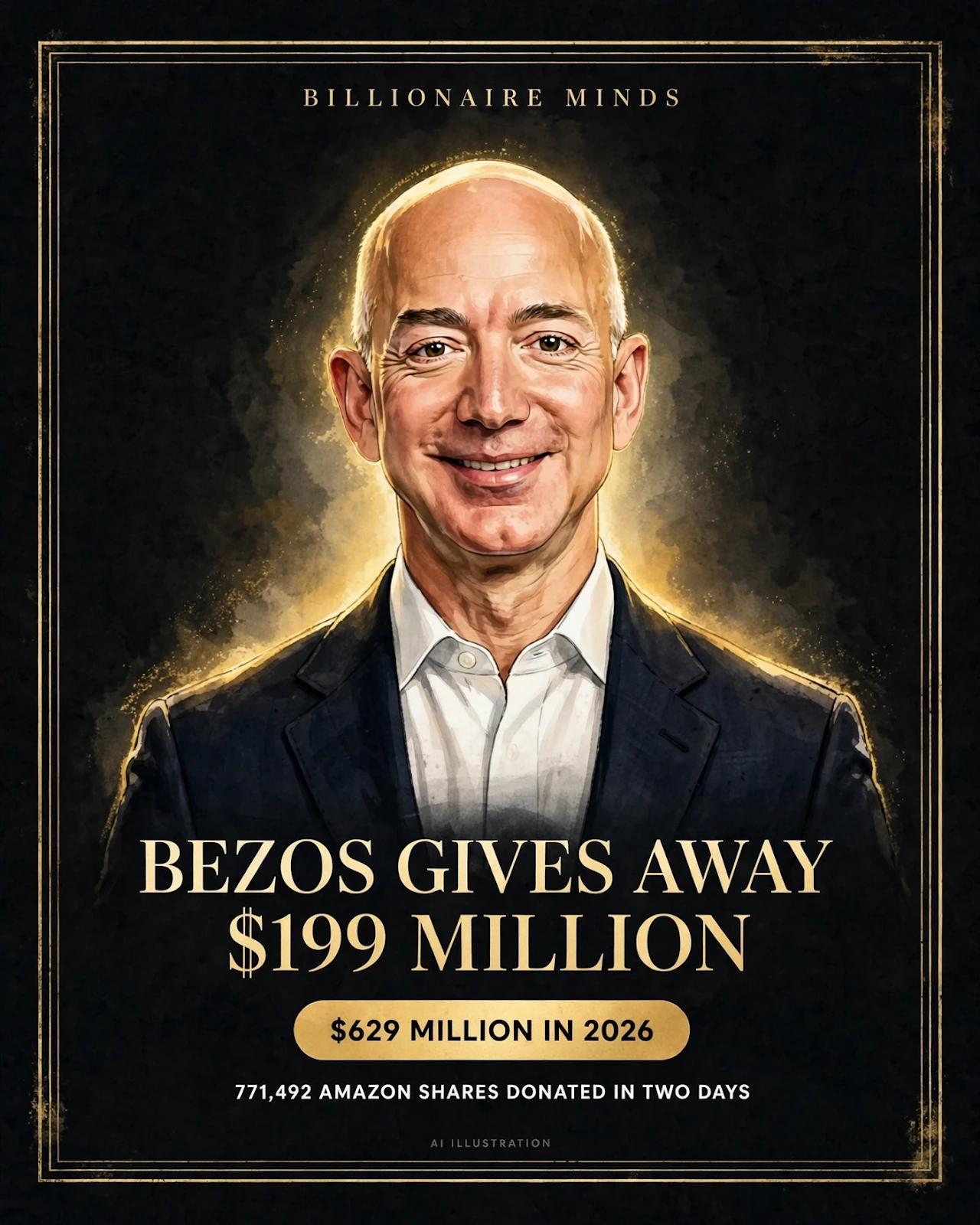
Jeff Bezos Donates $199 Million in Amazon Shares — His 2026 Giving Now Tops $629 Million

Jeff Bezos — the Amazon founder donated $199 million in Amazon shares, taking his 2026 charitable giving past $629 million

Jeff Bezos just gave away another fortune — and barely dented his own. The Amazon founder donated 771,492 Amazon shares worth roughly $199 million to non-profit organisations this week, according to documents filed with the US Securities and Exchange Commission on Monday.

It is the third round of stock donations from the world's second-richest person this year — and it takes his 2026 charitable giving past $629 million.

$199 Million in Two Days

The filings show Bezos transferred 674,088 shares on Thursday, November 12, and another 97,404 shares the following day. The shares were valued at approximately $198.9 million, based on Amazon's closing share price of $257.75 on Monday.

An SEC Form 144 confirmed that the Bezos Earth Fund Foundation received the 97,404 shares transferred on Friday. The foundation supports projects that tackle climate change and protect the environment.

$629 Million Given Away in 2026 Alone

The latest contribution follows two earlier rounds of charitable donations from Bezos this year. In May, he donated 1,253,797 Amazon shares, while another 415,580 shares were transferred to non-profit organisations in August.

Combined with the November transactions, the donations total at least 2.44 million shares, valued at approximately $629.1 million at Monday's closing share price.

Forbes reported Tuesday that the latest donations represented about 0.09 per cent of the Amazon shares Bezos directly owned before the transfers. Despite the donations, he retained 878.55 million Amazon shares, valued at approximately $226.4 billion at Monday's closing price.

Still the World's Second-Richest Person

Forbes estimated his net worth at $376.7 billion as of Monday evening, making him the world's second-richest person behind Tesla chief executive Elon Musk.

Bezos has made several major commitments to charitable causes, particularly environmental protection, education and support for homeless families. In 2020, he pledged $10 billion through the Bezos Earth Fund to tackle climate change and protect nature by 2030. The fund has awarded approximately $2.4 billion in grants so far.

He also established the Day One Fund in 2018 to support homeless families and provide early childhood education in underserved communities. In 2025, its Day 1 Families Fund awarded $102.5 million to 32 organisations.

According to Forbes, Bezos and his wife, Lauren Sánchez Bezos, had donated an estimated $4.7 billion to charitable causes by the end of 2025.

Source: GazetteNGR, reporting SEC filings and Forbes. The portrait image on this post is an AI-generated illustration.
Ramaphosa Tells Musk to 'Give Back' to South Africa — the R12 vs R1 Schooling Gap Behind the Starlink Standoff

South African President Cyril Ramaphosa challenges billionaire Elon Musk to give back to South Africa — apartheid spent R12 on Musk's schooling for every R1 on his own, while Starlink stays locked out

South Africa's president has a message for the world's richest man: remember where you came from — and give something back. Speaking in California on Monday, Cyril Ramaphosa told ABC News that Elon Musk owes much of his success to the education he received growing up in South Africa, and that the billionaire should help develop the country he left at 17.

The R12 vs R1 line

Ramaphosa put it in stark numbers. "When the apartheid government spent R12 on his education, it spent R1 on my education," he said, arguing Musk has never fully grasped what apartheid did to Black South Africans. "I have met Elon Musk in the past, and I've been awed by his brilliance, but also I would like to chat to him about him remembering his country, because even as one is a citizen of a new country, you should still be loyal to your old country." His message to Musk in the room: "What you've become today is from your own origins, where you were initially educated... he should be one of those who would say, I would like to contribute to the development of South Africa and give back to this country."

Why Starlink still can't launch in South Africa

The clash sits on top of a long-running business standoff. Starlink still has no licence to operate in South Africa: the law requires individual licence-holders to have at least 30% ownership by historically disadvantaged groups, and SpaceX has refused to give up a 30% stake in its local operation. Musk has called the ownership rules "openly racist ownership laws." Communications minister Solly Malatsi has pushed an alternative — equity-equivalent investment instead of a share transfer — and Starlink has offered to connect 5,000 rural schools, but the regulator says changing the rules needs an act of parliament, and a business lobby group took the dispute to court on November 9. A meeting between Ramaphosa and Musk was discussed during the president's Silicon Valley visit — but their diaries did not line up.

Source: ITWeb. The portrait image above is a stylized AI illustration, not a photograph of Cyril Ramaphosa or Elon Musk.

Billionaire Tony Elumelu Just Bought $70 Million More of Seplat Energy — His Stake Is Now Worth $1.6 Billion

Tony Elumelu — the Nigerian billionaire just bought $70 million more of Seplat Energy, lifting his stake to 22.05%, now worth $1.6 billion

Nigerian billionaire Tony Elumelu is doubling down on the company at the heart of his oil empire. His investment vehicle, Heirs Energies, has bought another 5,888,341 shares in Seplat Energy Plc for about N98 billion — roughly $70 million — taking the Heirs Holdings Group's total holding to 22.05% of Nigeria's biggest listed oil producer.

A $1.6 Billion Bet on Nigerian Oil

The purchase lifts Elumelu's total Seplat holding to a value of about $1.6 billion. It is the second major top-up in two months: Heirs Energies bought a similar tranche of around $70 million on September 30. Seplat's shares have been on a tear — closing at N16,241.90 on Monday, nearly triple the N5,809 they traded at the end of 2025.

From Largest Shareholder to Chairman

Elumelu's Seplat journey began on December 31, 2025, when Heirs Energies agreed to buy the entire 20.07% stake held by French oil group Maurel & Prom for about $500 million, making Heirs the company's largest single shareholder. He joined Seplat's board as a non-executive director in January 2026, and in June the company announced he will become Chairman on January 1, 2027.

Why It Matters

With the stake now above 22% and the chairmanship weeks away, Elumelu is moving from investor to operator-in-chief of one of Africa's most valuable energy companies — a bet that Nigeria's oil story still has a long way to run.

Sources: Billionaires.Africa and Nairametrics (November 17, 2026). Image: AI illustration.

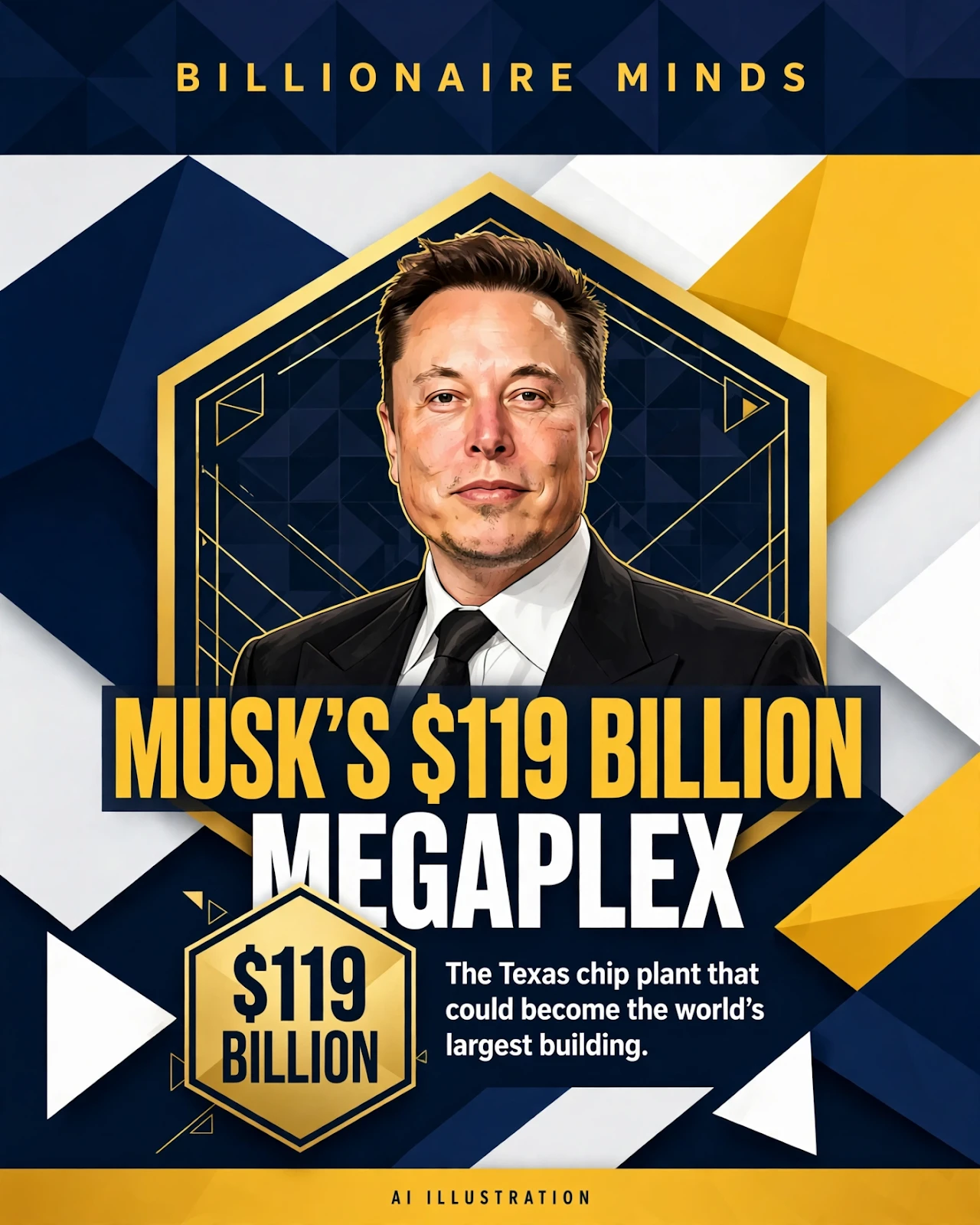
Elon Musk's $119 Billion Texas Megafactory Could Become the World's Largest Building

Elon Musk — his $119 billion Terafab chip plant in Texas could become the world's largest building

Elon Musk is building something so big it could dwarf the largest building on Earth. The project is called Terafab — a joint venture between SpaceX and Tesla — and it is rising in a quiet corner of rural Texas, about 70 miles northwest of Houston.

If it is finished as planned, the industrial complex would cover 100 million square feet. Architectural Digest has reported that would make it more than five times larger than China's New Century Global Centre, one of the largest buildings in the world.

A $119 Billion Bet on Chips

The goal is to make the advanced chips that artificial intelligence, self-driving cars, humanoid robots and space technology will need in the years ahead — all under one roof, including logic chips, memory and advanced packaging. The chips would supply Tesla's autonomous vehicles, its Optimus robots and SpaceX's space programmes.

Texas Governor Greg Abbott's office announced on August 6 that the first phase alone would involve more than $16.8 billion of investment and create about 3,000 jobs. The full ambition is far larger: tax incentive filings reported by local broadcaster KBTX put total investment at about $119 billion across four phases, with construction running until 2036 and more than 4,000 direct jobs. Those figures are projections — not money already spent.

Why Texas, Why Now

Reuters reported in October that Musk is aiming for volume production by the third quarter of 2028. Musk himself called that timeline highly ambitious and said it was uncertain whether it could be met.

Land acquisition has moved fast. KBTX reported on November 10 that WIT TECH LLC, a company linked to the project, now holds more than 10,000 acres in the county, up from about 7,700 acres in August. A Musk-linked company has also bought a water pumping station on the Navasota River.

The public incentives behind the project have drawn close scrutiny. The Houston Chronicle reported that two local school districts gave preliminary approval in July to property tax deals worth an estimated $1.66 billion in future tax relief, phased in through 2046. A separate agreement with Grimes County requires SpaceX to invest at least $5 billion by 2030 and create 1,800 permanent jobs by 2035 — though the company can walk away at any time with 30 days' written notice, with a maximum penalty of $60 million.

The Pushback

Hopes for jobs have come with local concerns about water, power, roads, the environment and the rural way of life. County Judge Joe Fauth has said the plant will not draw on groundwater, instead using recycled surface water from the Gibbons Creek Reservoir and generating its own power, separate from the state grid. Some community groups are still pressing for stronger safeguards and greater transparency.

The fight over transparency has reached the courts. In September, SpaceX sued the Texas attorney general and Grimes County to block the release of certain records, and on November 9 it amended its petition to also challenge the release of documents requested by KBTX.

Texas politics adds a new layer of uncertainty. In the November 3 election, Democrat Gina Hinojosa defeated Abbott and will take office in January as the state's first Democratic governor since 1995. She campaigned against corporate incentives, but has since struck a more conciliatory tone, saying she could have a strong working relationship with Musk "on our terms" — while calling for strict rules on water, power and community rights for data centres.

Whether Terafab ends up the world's largest building or not, one thing is clear: the world's richest man is betting $119 billion that the future of AI will be built in rural Texas.

Source: Geo TV. Image: AI illustration.

Ashton Kutcher's $435 Million Anthropic Bet Is Now Worth $7 Billion — and He Also Owns a Piece of OpenAI

Ashton Kutcher — Sound Ventures turned a $435 million Anthropic bet into a $7 billion stake

The internet is calling Ashton Kutcher one of the biggest winners of this week's historic Anthropic IPO — and the numbers behind the celebration are very real. On Monday, a Polymarket post announcing that the venture firm Kutcher co-founded had turned a $435 million investment into a position worth roughly $7 billion racked up more than half a million views within hours.

The $435 Million Bet That Became $7 Billion

According to Bloomberg, Sound Ventures — the firm Kutcher launched in 2015 with Madonna's longtime manager Guy Oseary — owns roughly 0.5% of Anthropic. At the AI company's proposed $1.4 trillion IPO valuation, that stake would be worth an astonishing $7 billion. The firm first invested $35 million in Anthropic's 2023 Series C round, when the company was valued at roughly $5 billion, and later added another $400 million across further rounds — $435 million in total, for a paper gain of about $6.565 billion.

He Also Owns a Piece of OpenAI

Anthropic isn't Sound Ventures' only enormous AI holding. The firm also owns a roughly 0.15% stake in OpenAI, worth about $1.875 billion at OpenAI's $1.25 trillion valuation after its $11 billion raise on November 6. Combined, Sound Ventures' Anthropic and OpenAI holdings could be worth nearly $9 billion — on a combined investment of more than $835 million.

But Kutcher Won't Pocket $7 Billion Himself

Here's the catch the viral posts skip: Sound Ventures manages money for outside investors, so the $7 billion belongs to the firm's funds, not to Kutcher personally. Under a standard 20% carried-interest arrangement, the general partners' share of the profits would be roughly $1.6 billion across both holdings — and Kutcher's personal slice could be anywhere from about $161 million to $536 million, depending on his share of that pool. There's one more twist: Kutcher left his general partner role in May 2026 to start a separate deep-tech investment business, so what he actually keeps depends on the exit deal he struck. Even so, with a net worth already estimated at around $500 million — built on early Uber, Airbnb and Spotify bets that turned $30 million into $250 million — the actor-turned-investor has pulled off one of Hollywood's greatest second acts.

Source: Celebrity Net Worth, reporting Bloomberg figures on Sound Ventures' Anthropic and OpenAI stakes. Figures are paper valuations at proposed IPO prices, not cash in hand.

Jensen Huang Just Lost $26.4 Billion in a Week — Now 180,000 People Want Him Back as Nvidia CEO

Jensen Huang — the former Nvidia chief lost $26.4 billion in a week, dropping to No. 14 on Forbes' list, while 180,000 fans petition for his return as CEO.

Jensen Huang's fortune took another hit on Monday. The former Nvidia chief lost $6.1 billion in a single day as the chipmaker's shares slid about 4%, taking his net worth to $135.8 billion — down $26.4 billion in a week. Huang stepped down as CEO last Thursday after an investigation into his relationships with employees and a suspected Chinese intelligence asset.

A Brutal Week on the Forbes List

The slide has been relentless: minus $7.4 billion last Monday, minus $8.4 billion on Tuesday, a $5.9 billion recovery on Wednesday, then minus $8.2 billion on Thursday and minus $3.1 billion on Friday. His fortune is down 16.3% from $162.2 billion on November 9, and he has slipped six places on Forbes' ranking, landing at No. 14, behind Walmart heiress Alice Walton.

180,000 People Want Him Back

Yet while the market keeps punishing him, a campaign is demanding his return. The "Stand With Jensen" petition had attracted more than 180,200 signatures by Monday, with Elon Musk, Replit CEO Amjad Masad and Epic Games CEO Tim Sweeney listed among its supporters. It also claims more than 8,800 signatories as Nvidia employees and over 94,000 as shareholders — though those affiliations are self-reported and unverified.

The Board Says No — for Now

The campaign has not changed the board's position. Three people familiar with the matter told Reuters that Nvidia is not considering bringing Huang back. Nvidia reports its third-quarter earnings today — its first under new CEO Colette Kress, after guiding to revenue of about $108 billion.

Sources: The Economic Times, The Sunday Guardian Live. The portrait image above is a stylized AI illustration, not a photograph of Jensen Huang.

Robert Pattinson Is the New James Bond — the $100 Million Star Takes Over 007 in a Three-Movie Deal

Robert Pattinson — the $100 million star is the new James Bond, taking over 007 from Daniel Craig in a three-movie deal.

The search for the next James Bond is over. Amazon MGM Studios announced on Monday, November 16, that Robert Pattinson will be the new 007, succeeding Daniel Craig in the 26th official Bond film. The 40-year-old Twilight and The Batman star will headline the first Bond adventure under Amazon MGM's creative control, directed by Dune filmmaker Denis Villeneuve, with a script by Peaky Blinders creator Steven Knight and producers Amy Pascal, David Heyman and Tanya Lapointe.

A Three-Movie Deal — and a $100 Million Payday in Waiting

Pattinson did not just land one film. Puck's Matthew Belloni reported on November 13 that the actor had signed a deal to star as 007 in three movies if he was chosen — and his payday is expected to be higher than his predecessors'. Celebrity Net Worth estimates Pattinson's fortune at about $100 million in 2026, built on Twilight, The Batman and a reported $12 million Dior deal. For comparison, Daniel Craig earned an estimated $85–110 million across his five Bond films. No release date has been set, though a 2028 debut is the earliest plausible target.

What Pattinson Said

"James Bond is one of the most legendary characters in cinema, and to be entrusted with 007 is the honor of a lifetime," Pattinson said in a statement, adding he was "deeply grateful" to Villeneuve and Amazon MGM. Villeneuve said: "We were surrounded by extraordinary talent, but there can only be one 007. I am overjoyed to welcome Robert Pattinson as our new James Bond." Pattinson beat out four other finalists — Callum Turner, Nicholas Hoult, Josh O'Connor and Jack Lowden. The casting even fulfils his own prediction: at 26, back in 2012, Pattinson said he would be "definitely" interested in playing Bond "in 20 years." Fourteen years later, the tuxedo fits.

Why This Bond Matters for the Money

This is the first Bond film since Amazon MGM took creative control of the franchise in 2025, in a new joint venture with longtime rights holders Michael Wilson and Barbara Broccoli. Pattinson arrives with a packed slate — December's Dune: Part Three with Villeneuve, then The Fix in January — before stepping into the most lucrative leading-man role in Hollywood. Craig's five films turned the spy into a billion-dollar box-office machine; now the franchise bets its next decade on a star who has already proved he can carry one.

Sources: Reuters via GMA News, USA Today, People, Economic Times. The portrait image above is a stylized AI illustration, not a photograph of Robert Pattinson.

Larry Ellison Has Lost $145 Billion as Oracle Crashes From Its Peak — Wall Street Fears the OpenAI Bet

Larry Ellison — Oracle's co-founder has lost about $145 billion as Oracle stock crashes from its peak, with Wall Street worried about its OpenAI bet.

Larry Ellison, the co-founder of Oracle, has watched roughly $145 billion of his fortune evaporate as Oracle's stock crashes from its peak. The Motley Fool reports the wipeout is tied directly to Ellison's enormous stake in the company — about 1.16 billion shares, roughly 40% of Oracle, making him its largest shareholder by far.

Oracle's Slide Keeps Getting Worse

Oracle's shares are down roughly 44% over the past year and about 50% from their high, and the slide is still going — the stock fell another 4.99% on Monday, November 16, closing at $119.09. Just two weeks ago, Forbes had Ellison at $153.3 billion and ranked 11th richest in the world after Oracle dropped 7% in a day. Since then, the sell-off has only deepened.

The $300 Billion OpenAI Question

Wall Street's worry is not just the share price — it is what Oracle is betting on. The company reported a backlog of roughly $664 billion at the end of last quarter, and at least $300 billion of it is widely estimated to come from a single customer: OpenAI, the maker of ChatGPT. That means around half of Oracle's contracted future business depends on one company. If OpenAI ever scaled back or walked away, much of that backlog could be voided — cancellation fees would help, but there is no guarantee the contracts are ever fulfilled.

Growth Is Real — So Is the Spending

Oracle's business is still growing fast: revenue rose 30% to $19.3 billion in its latest quarter, cloud sales jumped 62% to $11.6 billion, and earnings per share climbed 30%. But the AI build-out is burning cash — Oracle spent $28 billion on data centres last quarter against $23 billion of operating cash flow, leaving free cash flow of roughly negative $5 million. The company expects $90–95 billion of capital spending this year, carries about $125 billion of debt, and will likely keep posting negative free cash flow in the near term. For Ellison, whose fortune is tied to Oracle's shares, that spending spree is the price of the AI bet — and the reason $145 billion has already vanished.

Source: Motley Fool. The portrait image above is a stylized AI illustration, not a photograph of Larry Ellison.

Elon Musk Bets $3.3 Billion on Germany — Tesla's Cybercab Factory Could Become Europe's Biggest Car Plant

Elon Musk beside a futuristic silver Cybercab robotaxi in front of Tesla's German gigafactory — Tesla is investing $3.3 billion to build up to 1 million robotaxis a year in Germany

Elon Musk is doubling down on the robotaxi — and betting $3.3 billion that Germany is where it gets built. Tesla said on Monday it will invest €3 billion in its German gigafactory at Gruenheide, outside Berlin, pressing ahead with its Cybercab model even as Volkswagen, Mercedes-Benz and BMW cut jobs and weigh plant closures. The new facility could make Tesla's only European site Germany's largest auto plant by capacity, overtaking Volkswagen's Wolfsburg headquarters.

Tesla aims to produce up to 1 million Cybercabs a year at Gruenheide. The company said it will submit a building permit application before the end of the year, start construction in the first half of 2027, and begin production in 2029. Several hundred new workers are being sought for the first step of construction and production planning. The plant has already ramped up Model Y production and hired more than 2,000 new employees in recent months, and Tesla aims to start battery cell production there from the middle of next year.

A Bet on the Robotaxi — Before It Has Sold One at Scale

The scale of the bet is striking because the Cybercab has yet to be sold anywhere at scale commercially. The two-seater has no steering wheel, pedals or mirrors, and US safety regulators have opened an investigation into whether early vehicles were properly certified. Automotive analyst Matthias Schmidt welcomed the investment as much-needed good news for Germany's car industry, but asked the question Berlin will be asking too: how much of it becomes sustainable, long-term employment, and how much is automated, low-labour work? Tesla has also faced environmental protests at Gruenheide and repeated clashes with the powerful IG Metall union.

Cybertruck Makes Way for the Robotaxi

The Germany expansion is the other half of a factory reshuffle Musk has already announced in Texas. Tesla will wind down Cybertruck production at its Austin plant at the end of summer 2027 — extended by a few months to clear the order backlog — so the factory can make way for more Cybercabs. Only about 63,000 Cybertrucks have been sold worldwide since the 2023 launch, far below expectations. Musk has admitted the extension is not the most profitable move, but said there must be room for sentimentality. The message from both announcements is the same: the Cybertruck era is ending, and the robotaxi era is where Musk is putting the money.

Source: Reuters, November 17, 2026. This is a fan/commentary summary of reported news; all figures are the sources' estimates. Image is an AI illustration.