Posts

Showing posts with the label Starship

Musk Taunts Bezos After SpaceX's Historic Starship Flight — and a Rocket Failure Just Wrecked 40 of Amazon's Satellites

Elon Musk and Jeff Bezos in a stylized space-race face-off — Musk taunts Bezos after SpaceX's Starship flight while a rocket failure destroys 40 Amazon satellites

Elon Musk is not letting a historic weekend in space slide — and he used it to take a very public swipe at Jeff Bezos. Hours after SpaceX pulled off its most ambitious orbital feat yet, Musk went on X and asked the question no one at Blue Origin wanted to hear: if throwing money at rockets was all it took, why can't Bezos' billions buy a reliable launch?

The jab landed on Sunday, November 15, and it came with receipts. The same morning, a rival rocket carrying Amazon's own satellites failed minutes after liftoff — destroying 40 of them.

Starship's Historic Flight Set the Stage

On November 13, SpaceX's Starship flew its 15th test flight. Ship 42 entered orbit, deployed 26 next-generation Starlink V3 satellites, completed multiple orbits around Earth, and returned to its Texas launch site roughly 22.5 hours after liftoff on November 14 — an unprecedented orbital engineering feat, and arguably SpaceX's biggest accomplishment to date.

Musk wasted no time. When a critic on X argued that anyone could build reusable rockets simply by throwing enough money at the problem, Musk dismantled the argument by pointing straight at Bezos and Blue Origin.

"Let's take this gentleman's argument at face value that anyone can throw money at rockets and get something like Starship, Falcon, or Dragon," Musk wrote on Sunday. "Perhaps he can explain to everyone how SpaceX is able to catch giant starships from orbit with chopsticks and deliver 85% of all Earth payload to orbit with Falcon, while Blue Origin, which started before SpaceX and was funded by the immensely wealthy Jeff Bezos, is not yet able to launch reliably? I am genuinely curious."

Bezos Had a Head Start — and Billions More

The numbers back up Musk's taunt. Bezos founded Blue Origin in September 2000 — nearly two years before Musk established SpaceX in May 2002 — and has personally funnelled billions of dollars from Amazon stock sales into the venture. Despite the head start, SpaceX's Falcon fleet now hauls around 75% of global orbital tonnage, according to industry data cited by FourWeekMBA.

Musk didn't stop with Bezos. In the second half of his Sunday post, he aimed at Washington's legacy aerospace contractors: "And why is it that Boeing and Lockheed Martin, despite receiving several times more government funding than SpaceX, are so far behind?"

NASA's own numbers tell the story. In 2014, the agency awarded Boeing $4.2 billion to develop the Starliner crew capsule and SpaceX $2.6 billion to develop Crew Dragon. A decade later, SpaceX routinely ferries astronauts to the International Space Station, while Boeing has grappled with propulsion failures and more than $1.85 billion in Starliner charges, according to CNBC.

The Rocket Failure That Proved Musk's Point

Hours before Musk posted, a United Launch Alliance Vulcan Centaur rocket — the Boeing-Lockheed joint venture — malfunctioned within 10 minutes of liftoff on Sunday morning and failed to reach orbit, destroying all 40 commercial satellites aboard, according to Space.com.

Those 40 lost satellites belonged to Amazon's Leo network, previously known as Project Kuiper — Amazon's $10 billion-plus low-Earth-orbit broadband network designed to go head-to-head with SpaceX's Starlink, according to GeekWire.

Bezos is determined to diversify Amazon's launch options rather than rely solely on Musk's Falcon 9 rockets to deploy a planned 3,236-satellite constellation. That is why Amazon secured the largest commercial launch procurement in aerospace history, with contracts from ULA and Blue Origin — including 38 missions on ULA's Vulcan rocket. Sunday's mishap happened on the very first of those 38 contracted Vulcan flights.

What This Means for the Billionaire Space Race

The failure leaves Amazon's satellite broadband rollout bottlenecked by the exact launch struggles Musk just called out. SpaceX, meanwhile, keeps expanding its commercial grip on low Earth orbit — a dominance that underpins the company's roughly $1.9 trillion valuation and Musk's position as the world's richest person, worth around $890 billion by Forbes' real-time estimates, with Bezos second at about $377 billion.

For Bezos, the weekend was a brutal reminder that in the space race, billions in capital no longer buy a technological moat. For Musk, it was the perfect stage to say so out loud.

Image: AI illustration. This article is commentary on publicly reported events.

Source: TheStreet — "Elon Musk calls out Jeff Bezos over SpaceX rivals"
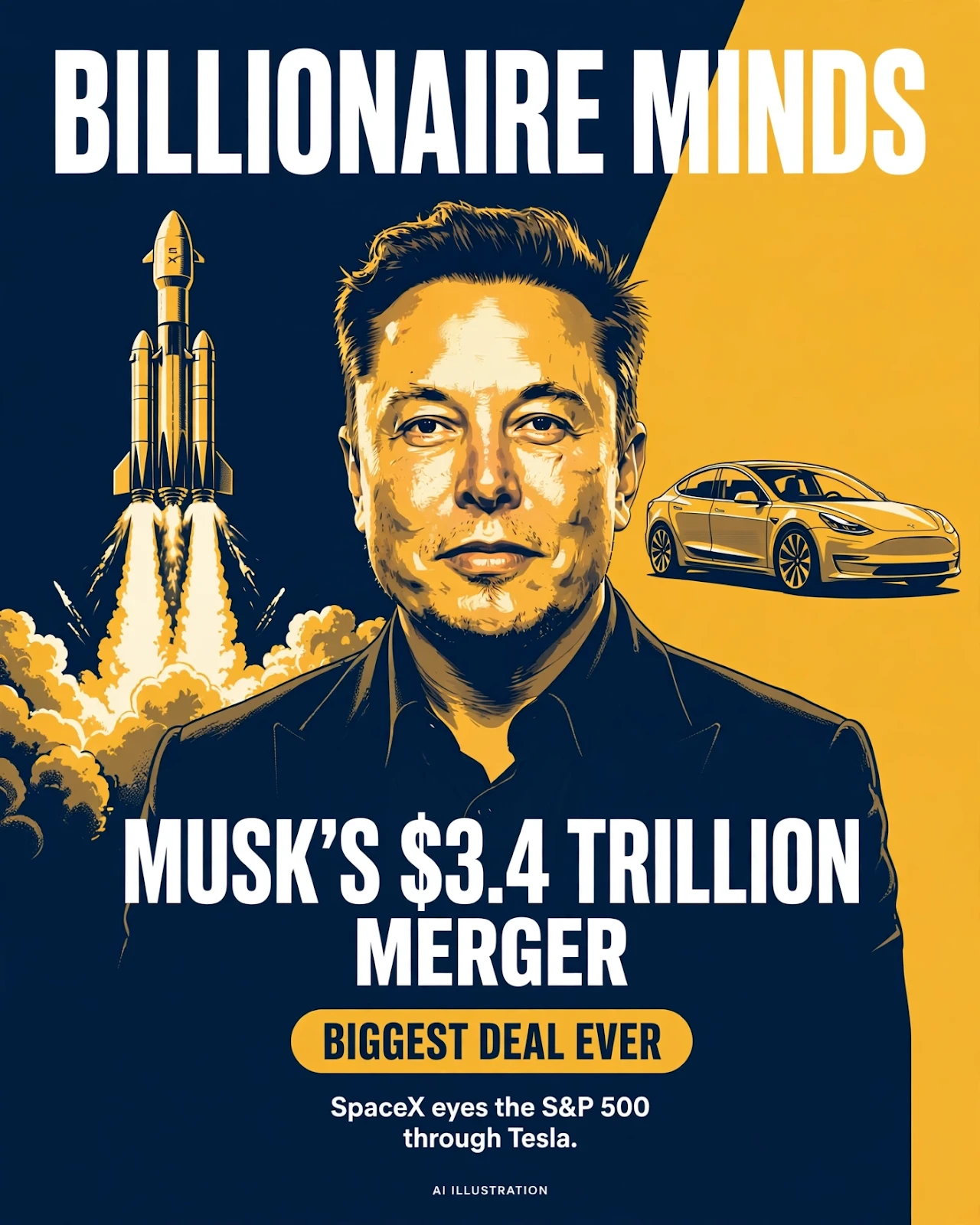
Elon Musk's SpaceX–Tesla Merger: A $3.4 Trillion Deal to Sneak SpaceX Into the S&P 500

Elon Musk's SpaceX and Tesla merger — a $3.4 trillion deal that could sneak SpaceX into the S&P 500

Elon Musk is chasing the biggest deal in corporate history — and the prize is a backdoor into the S&P 500. The world's richest person is pushing to merge SpaceX with Tesla, a combination worth about $3.4 trillion that would dwarf every merger ever attempted.

The logic, reported by Bloomberg on November 14, is simple. Tesla has been an S&P 500 member since December 2020, while SpaceX — which listed on Nasdaq in June — was refused a fast track into the index. Folding the rocket company into Tesla would hand it the membership it could not win alone, and index membership matters: trillions of dollars in index funds automatically buy member stocks.

A December Announcement?

Talks have moved faster in recent weeks, and an announcement could come as early as December, according to a November 12 report. Musk wants a deal that can close while President Donald Trump is still in office, Bloomberg reported in October. Both boards have set up special committees, and analysts at JPMorgan Chase expect an all-stock deal led by SpaceX. The pair were worth about $3.7 trillion combined in October; a slide in SpaceX shares since the US midterm elections has trimmed that to about $3.4 trillion.

Who Holds the Cards

Musk owns about 42% of SpaceX and controls more than 80% of its votes, so approval there is not in doubt. The harder sell is Tesla, where he holds about 20% and shareholders will have the final say — Musk himself has warned that winning them over could be difficult, and no terms have been agreed. The companies already work closely together, including a $16.8 billion joint chip plant in Texas, and SpaceX absorbed Musk's AI company xAI before its listing. Musk, 55, calls the merger a "good idea" — while comparing the negotiations to "tap dancing through a minefield."

Source: Bloomberg / The New York Times, November 16, 2026. This is a fan/commentary summary of reported news; all figures are the sources' estimates. Image is an AI illustration.

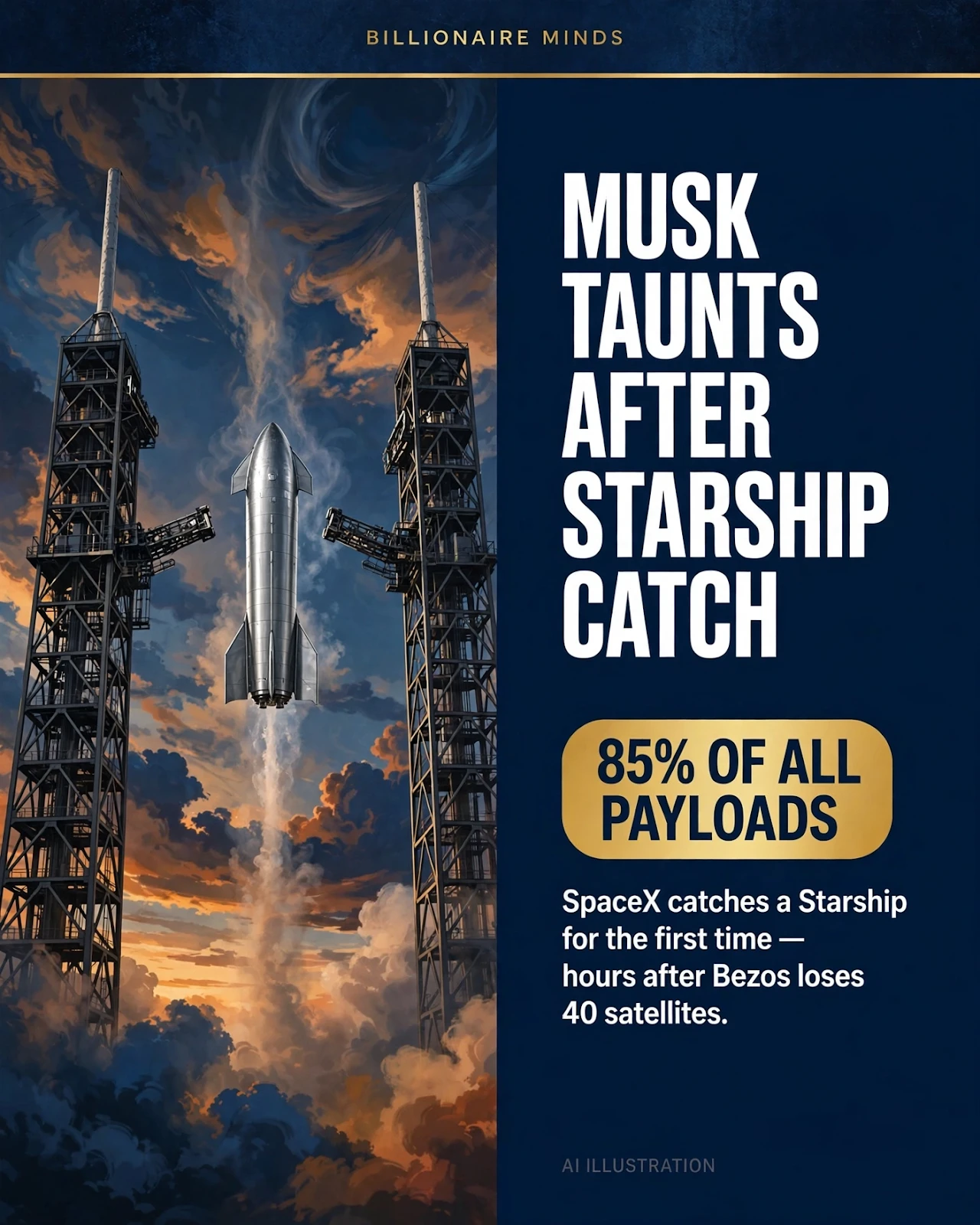
Musk Taunts Bezos After SpaceX's First Starship Catch — "Anyone Can Throw Money at Rockets"

AI illustration of SpaceX's Starship rocket being caught by launch tower arms — Elon Musk taunts Jeff Bezos after the first Starship catch

Elon Musk did not wait long to enjoy the moment. Hours after SpaceX caught a Starship returning from orbit for the first time, the world's richest man took to X to ask why his billionaire rivals — Jeff Bezos, Boeing and Lockheed Martin — still cannot match him, even with fortunes behind them.

It was the second act of a brutal weekend for Bezos. Hours before the catch, a Vulcan rocket failed 10 minutes after liftoff and destroyed 40 of Amazon's Leo internet satellites — the story this blog covered earlier today.

The Catch That Started It

On Saturday, two steel arms on SpaceX's launch tower in Texas caught Ship 42 as it returned from orbit — the first time a Starship has ever been caught. SpaceX had hoped to catch both halves of the rocket on Flight 15; the Super Heavy booster diverted to the Gulf after Friday's launch, but Ship 42 reached orbit, deployed 26 Starlink satellites, and about 22 and a half hours after liftoff descended through the clouds and settled between the tower's two arms.

Musk inspected the ship himself. "I hugged ship 42 upon its return," he posted, adding that it "could probably be reflown with a few weeks of refurbishment." He also teased the next version: "Starship V4 will be ~70m long, which is roughly a 40% length increase and allows >60% more propellant load."

"Anyone Can Throw Money at Rockets"

Soon after the catch, Musk challenged the idea that money alone buys a space program. "Let's take this gentleman's argument at face value that anyone can throw money at rockets and get something like Starship, Falcon or Dragon," he wrote on X.

He pointed at Bezos's Blue Origin, which started before SpaceX and had Bezos's fortune behind it, and asked why it still struggles to launch reliably when, by his estimate, SpaceX's Falcon rockets carry 85% of the world's payload to orbit by mass. United Launch Alliance, the Boeing and Lockheed Martin joint venture, carries less than 5% as much payload to orbit as SpaceX, he said.

When ULA confirmed the loss of the 40 Amazon satellites, Musk struck a different tone: "Sorry to hear this. Hope you are back to flight soon." He also questioned what Boeing had achieved with federal funding for its Starliner capsule: in 2014, NASA awarded Boeing up to $4.2 billion and SpaceX up to $2.6 billion to fly astronauts to the International Space Station. SpaceX now makes those trips regularly; Boeing's next Starliner flight, targeted for December or January, is set to carry cargo without a crew.

The Market Heard Him

Shares of SpaceX (SPCX) rose nearly 1% overnight after the catch, after climbing 3% last week — its strongest weekly gain in more than a month. Google CEO Sundar Pichai watched the catch live and posted: "Congrats @SpaceX for that starship catch, still feels like science fiction!" ARK's chief futurist Brett Winton noted the catch drops the cost per kilogram to orbit to roughly $100, from $1,000.

Walter Isaacson, Musk's biographer, recalled December 2020, when Musk first suggested the launchpad arms could catch a returning Starship: "I will always remember the looks on the engineers' faces in the Starbase conference room." Six years later, the arms caught one — and Musk made sure his rivals knew it.

Source: Stocktwits (November 16, 2026). This is a fan/commentary summary of reported news; all figures are the sources' estimates. Image: AI illustration.

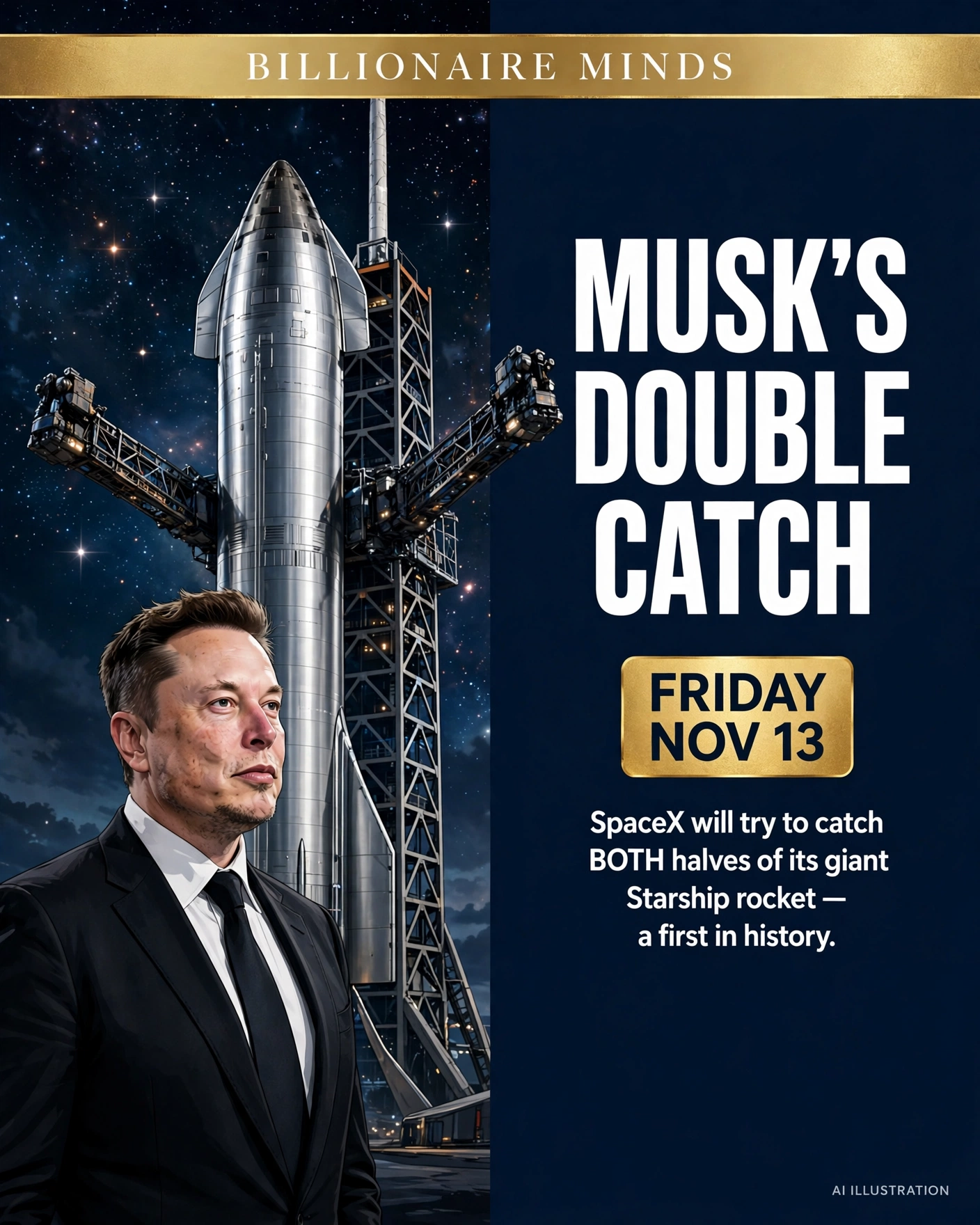
Elon Musk's SpaceX Targets Friday the 13th for the First-Ever Double Rocket Catch

Stylized illustration of Elon Musk with SpaceX's giant Starship rocket and launch tower against a starry sky — SpaceX will try to catch both halves of the rocket on Friday, November 13

Elon Musk's SpaceX is one week away from the most audacious test flight in its history. On Friday, November 13, the company will attempt something no one has ever done: catch both halves of an orbital rocket and bring them home in one piece. "SpaceX will attempt to catch both the Super Heavy booster and Starship on the upcoming flight," Musk wrote on X on November 6. "If both are successful, it will mark the first time that all parts of an orbital rocket return to Earth intact. This is the critical breakthrough needed to make life multiplanetary."

Two catches, one flight

Flight 15 will fly Booster 22 and Ship 42 — both Block 3 vehicles — from Orbital Launch Pad 2 at Starbase, Texas, in a 75-minute window opening at 4:45 p.m. Central Time, pending final regulatory approval. After hot staging and separation, the Super Heavy booster is planned to return for a tower catch roughly six minutes and 35 seconds after liftoff. The Ship has the harder job: it will climb to a roughly 275-kilometre orbit, deploy 26 advanced Starlink V3 satellites, circle Earth about 14 times over more than 22 hours, then attempt a deorbit burn, a belly-flop reentry, a flip and a landing burn into the launch tower's chopstick arms at about T-plus 22 hours and 32 minutes. SpaceX has caught boosters three times before, on Flights 5, 7 and 8. The Ship has never been caught.

Why it matters — and what it is worth

Full recovery is the economics of Musk's space empire. A rocket that can be caught, inspected, refurbished and reflown quickly slashes the cost of every launch — and the high launch cadence it enables is what Starlink, lunar missions and eventually Mars settlement all depend on. Musk told investors at last week's Baron conference that SpaceX aims to pass a $100 billion annualized revenue run rate in December, and the Starlink satellites riding on Flight 15 are the revenue engine behind that number. Musk put the odds of pulling off the first double catch at "more likely than not" — and if the Ship's health checks fail, it will splash down in the Pacific instead, with the booster falling back to the Gulf of Mexico. Either way, a steady stream of further flights is already scheduled. Friday the 13th, it turns out, could be the luckiest day in rocket history.

Source: Teslarati, November 8, 2026 (Musk X post November 6; SpaceX VP of Launch Kiko Dontchev at the UP.Summit, November 5); Business Today, November 7, 2026. This is a fan/commentary summary of reported news; all figures are the sources' estimates. Portrait: AI illustration.