Posts

Showing posts with the label SpaceX

Billionaire Stanley Druckenmiller Dumps Google for SpaceX — Sells Every Alphabet Share in a $120 Million Exit

Stanley Druckenmiller — billionaire sells every Alphabet share and buys into SpaceX

One of Wall Street's most closely watched billionaires just swapped one AI giant for another. Stanley Druckenmiller's Duquesne Family Office sold every single Alphabet share it owned in the third quarter — all 336,300 of them, worth more than $120 million — and used the moment to buy into Elon Musk's SpaceX instead.

The moves surfaced in Duquesne's Form 13F, filed with the SEC on Monday, November 16. The Alphabet exit is striking because Druckenmiller had only bought the Google parent's stock one quarter earlier. Three months in, the whole position was gone.

The SpaceX Bet

On the other side of the trade, Duquesne opened a new position of 202,125 SpaceX shares, worth about $30.5 million at the end of September. SpaceX went public in June at $135 a share with a valuation of roughly $1.77 trillion, and Druckenmiller's move puts the legendary investor on the same side of the AI trade as Musk — just in a different company.

Druckenmiller has said artificial intelligence "might be a little overhyped now, but underhyped long term" — a view that fits a portfolio rotating toward the companies he believes will win the long game.

Gold, Chips and a 94% Cut

The Alphabet exit was not the filing's only surprise. Duquesne slashed its Taiwan Semiconductor stake by 94%, from 589,680 shares to just 32,700, and opened three new gold-miner positions totalling about $129 million in Newmont, Barrick and Agnico Eagle. It also nearly tripled its Seagate holding and added first-time stakes in Palantir and AppLovin.

The filing is a snapshot, not a diary: it shows what Duquesne held on September 30, not when it traded or why. But the direction is unmistakable — out of Google, into SpaceX, gold and data storage, with the biggest bet still on molecular diagnostics firm Natera at about $1.3 billion.

Source: Motley Fool / TradingView / Benzinga / MLQ.ai

Image: AI illustration. This is a commentary post based on public reporting.

Musk Taunts Bezos After SpaceX's Historic Starship Flight — and a Rocket Failure Just Wrecked 40 of Amazon's Satellites

Elon Musk and Jeff Bezos in a stylized space-race face-off — Musk taunts Bezos after SpaceX's Starship flight while a rocket failure destroys 40 Amazon satellites

Elon Musk is not letting a historic weekend in space slide — and he used it to take a very public swipe at Jeff Bezos. Hours after SpaceX pulled off its most ambitious orbital feat yet, Musk went on X and asked the question no one at Blue Origin wanted to hear: if throwing money at rockets was all it took, why can't Bezos' billions buy a reliable launch?

The jab landed on Sunday, November 15, and it came with receipts. The same morning, a rival rocket carrying Amazon's own satellites failed minutes after liftoff — destroying 40 of them.

Starship's Historic Flight Set the Stage

On November 13, SpaceX's Starship flew its 15th test flight. Ship 42 entered orbit, deployed 26 next-generation Starlink V3 satellites, completed multiple orbits around Earth, and returned to its Texas launch site roughly 22.5 hours after liftoff on November 14 — an unprecedented orbital engineering feat, and arguably SpaceX's biggest accomplishment to date.

Musk wasted no time. When a critic on X argued that anyone could build reusable rockets simply by throwing enough money at the problem, Musk dismantled the argument by pointing straight at Bezos and Blue Origin.

"Let's take this gentleman's argument at face value that anyone can throw money at rockets and get something like Starship, Falcon, or Dragon," Musk wrote on Sunday. "Perhaps he can explain to everyone how SpaceX is able to catch giant starships from orbit with chopsticks and deliver 85% of all Earth payload to orbit with Falcon, while Blue Origin, which started before SpaceX and was funded by the immensely wealthy Jeff Bezos, is not yet able to launch reliably? I am genuinely curious."

Bezos Had a Head Start — and Billions More

The numbers back up Musk's taunt. Bezos founded Blue Origin in September 2000 — nearly two years before Musk established SpaceX in May 2002 — and has personally funnelled billions of dollars from Amazon stock sales into the venture. Despite the head start, SpaceX's Falcon fleet now hauls around 75% of global orbital tonnage, according to industry data cited by FourWeekMBA.

Musk didn't stop with Bezos. In the second half of his Sunday post, he aimed at Washington's legacy aerospace contractors: "And why is it that Boeing and Lockheed Martin, despite receiving several times more government funding than SpaceX, are so far behind?"

NASA's own numbers tell the story. In 2014, the agency awarded Boeing $4.2 billion to develop the Starliner crew capsule and SpaceX $2.6 billion to develop Crew Dragon. A decade later, SpaceX routinely ferries astronauts to the International Space Station, while Boeing has grappled with propulsion failures and more than $1.85 billion in Starliner charges, according to CNBC.

The Rocket Failure That Proved Musk's Point

Hours before Musk posted, a United Launch Alliance Vulcan Centaur rocket — the Boeing-Lockheed joint venture — malfunctioned within 10 minutes of liftoff on Sunday morning and failed to reach orbit, destroying all 40 commercial satellites aboard, according to Space.com.

Those 40 lost satellites belonged to Amazon's Leo network, previously known as Project Kuiper — Amazon's $10 billion-plus low-Earth-orbit broadband network designed to go head-to-head with SpaceX's Starlink, according to GeekWire.

Bezos is determined to diversify Amazon's launch options rather than rely solely on Musk's Falcon 9 rockets to deploy a planned 3,236-satellite constellation. That is why Amazon secured the largest commercial launch procurement in aerospace history, with contracts from ULA and Blue Origin — including 38 missions on ULA's Vulcan rocket. Sunday's mishap happened on the very first of those 38 contracted Vulcan flights.

What This Means for the Billionaire Space Race

The failure leaves Amazon's satellite broadband rollout bottlenecked by the exact launch struggles Musk just called out. SpaceX, meanwhile, keeps expanding its commercial grip on low Earth orbit — a dominance that underpins the company's roughly $1.9 trillion valuation and Musk's position as the world's richest person, worth around $890 billion by Forbes' real-time estimates, with Bezos second at about $377 billion.

For Bezos, the weekend was a brutal reminder that in the space race, billions in capital no longer buy a technological moat. For Musk, it was the perfect stage to say so out loud.

Image: AI illustration. This article is commentary on publicly reported events.

Source: TheStreet — "Elon Musk calls out Jeff Bezos over SpaceX rivals"

Australia's Richest Woman Keeps Buying Musk's SpaceX — Even as Her Fortune Drops $19 Billion

Gina Rinehart, Australia's richest woman, keeps buying Elon Musk's SpaceX even as her fortune falls $19 billion to $28 billion

Gina Rinehart is not flinching. Australia's richest person just added to her company's holdings in Elon Musk's SpaceX and in US defense stocks — even as her own fortune has fallen about $19 billion from its February peak to roughly $28 billion.

Hancock Prospecting, the closely held iron ore company Rinehart chairs, increased both positions in the three months to September 30, Bloomberg reported on November 16. The purchases extend a steady shift by Hancock this year toward space, defense, mining and energy companies in the United States.

The Musk Bet Keeps Growing

SpaceX is already Hancock's biggest US holding. Rinehart backed the rocket and satellite company at its June 12 initial public offering, calling it "a significant investment" without giving a figure. Hancock's filing for the second quarter later showed 8 million SpaceX shares worth $1.37 billion at the end of June.

That filing showed Hancock's US-listed portfolio at $5.71 billion on June 30, up 72% from three months earlier and spread across 42 securities. The company also doubled its holding in Trump Media & Technology Group during that quarter.

A Bigger Push Into US Defense

Hancock moved into US defense shares in the first quarter, buying stakes in Lockheed Martin, Northrop Grumman, RTX and L3Harris Technologies, along with cybersecurity company CrowdStrike and gold producer Newmont. Those purchases were worth about $133 million together. It sold its entire holding in Chilean lithium producer SQM in the same period.

Rinehart, 72, inherited Hancock Prospecting from her father, Lang Hancock, in 1992, when it was heavily indebted. She rebuilt it into one of Australia's most profitable private companies, largely through the Roy Hill iron ore mine in Western Australia's Pilbara region. Her US portfolio is a small part of a fortune that rests mainly on iron ore — but it is the part she is growing fastest.

Source: Billionaires.Africa, reporting Bloomberg

After Huang's Shock Exit, Investors Ask the $1 Trillion Question: Who Replaces Musk and Zuckerberg?

Stylized illustration of two tech founders back to back under a neon question mark — who replaces Elon Musk and Mark Zuckerberg after Jensen Huang's Nvidia exit

Jensen Huang's shock departure from Nvidia has done more than wipe billions off the chipmaker's value. It has forced investors to ask a question Silicon Valley's most powerful companies have spent years avoiding: what happens if Elon Musk or Mark Zuckerberg suddenly aren't there?

Huang built Nvidia into the world's most valuable company and then walked away after an investigation into his relationships with employees and a suspected Chinese intelligence asset. His exit has put a spotlight on a problem facing every founder-led giant — succession planning.

The question nobody at Tesla or Meta wants to answer

Tesla, SpaceX and Meta remain heavily dependent on their founders, and their own financial disclosures admit it. SpaceX warned investors in its filing ahead of its public listing that losing Musk — through death, disability or another circumstance — could disrupt its management structure and affect its ability to execute its business strategy. The company cautioned that finding a replacement with Musk's combination of skills and experience could be a lengthy and uncertain process, with no assurance it could find a suitable successor in time, or at all.

Ross Gerber, an investor in SpaceX who has previously raised concerns about Tesla's succession planning, believes the Nvidia episode could be particularly unsettling for Musk. "This Jensen thing is probably the biggest fear that Elon has," Gerber told The Washington Post.

Musk's $1 trillion pay deal has a succession clause

There is another twist. Tesla's massive compensation package for Musk — potentially worth $1 trillion and designed to keep him involved through the middle of the next decade — requires him to develop a succession planning framework to qualify for its final two award tranches. But a requirement to plan is not the same as having a ready replacement, and Tesla has not publicly demonstrated a clear succession framework.

Zuckerberg holds the votes — and no public plan

Meta faces the same problem. Its filings warn that Zuckerberg becoming unavailable could have a materially adverse impact on operations, and he holds a majority of the company's voting power — giving him decisive influence over shareholder decisions, including the appointment of directors. Yet Meta's filings do not disclose a succession plan for the chief executive position.

The other side: Apple proved founders can be replaced

A founder's departure does not automatically mean collapse. Apple continued to expand after Steve Jobs died in 2011, with Tim Cook leading it through a period of substantial growth, and Microsoft, Amazon and Alphabet have all moved beyond their founders as chief executives. As Dipal Dutta, CEO at RedoQ, told NDTV: "Technology companies are often driven by the vision of their founders. For long-term success, this inspiration must be sustainable."

The stakes are enormous. Tesla, Meta and Nvidia collectively employ at least 200,000 people and account for almost 10 per cent of the S&P 500's market value, while SpaceX is valued at nearly $1.9 trillion. For investors, the question is no longer hypothetical — it is the $1 trillion question.

Source: NDTV, reporting The Washington Post. Image: AI illustration.

Ramaphosa Tells Musk to 'Give Back' to South Africa — the R12 vs R1 Schooling Gap Behind the Starlink Standoff

South African President Cyril Ramaphosa challenges billionaire Elon Musk to give back to South Africa — apartheid spent R12 on Musk's schooling for every R1 on his own, while Starlink stays locked out

South Africa's president has a message for the world's richest man: remember where you came from — and give something back. Speaking in California on Monday, Cyril Ramaphosa told ABC News that Elon Musk owes much of his success to the education he received growing up in South Africa, and that the billionaire should help develop the country he left at 17.

The R12 vs R1 line

Ramaphosa put it in stark numbers. "When the apartheid government spent R12 on his education, it spent R1 on my education," he said, arguing Musk has never fully grasped what apartheid did to Black South Africans. "I have met Elon Musk in the past, and I've been awed by his brilliance, but also I would like to chat to him about him remembering his country, because even as one is a citizen of a new country, you should still be loyal to your old country." His message to Musk in the room: "What you've become today is from your own origins, where you were initially educated... he should be one of those who would say, I would like to contribute to the development of South Africa and give back to this country."

Why Starlink still can't launch in South Africa

The clash sits on top of a long-running business standoff. Starlink still has no licence to operate in South Africa: the law requires individual licence-holders to have at least 30% ownership by historically disadvantaged groups, and SpaceX has refused to give up a 30% stake in its local operation. Musk has called the ownership rules "openly racist ownership laws." Communications minister Solly Malatsi has pushed an alternative — equity-equivalent investment instead of a share transfer — and Starlink has offered to connect 5,000 rural schools, but the regulator says changing the rules needs an act of parliament, and a business lobby group took the dispute to court on November 9. A meeting between Ramaphosa and Musk was discussed during the president's Silicon Valley visit — but their diaries did not line up.

Source: ITWeb. The portrait image above is a stylized AI illustration, not a photograph of Cyril Ramaphosa or Elon Musk.

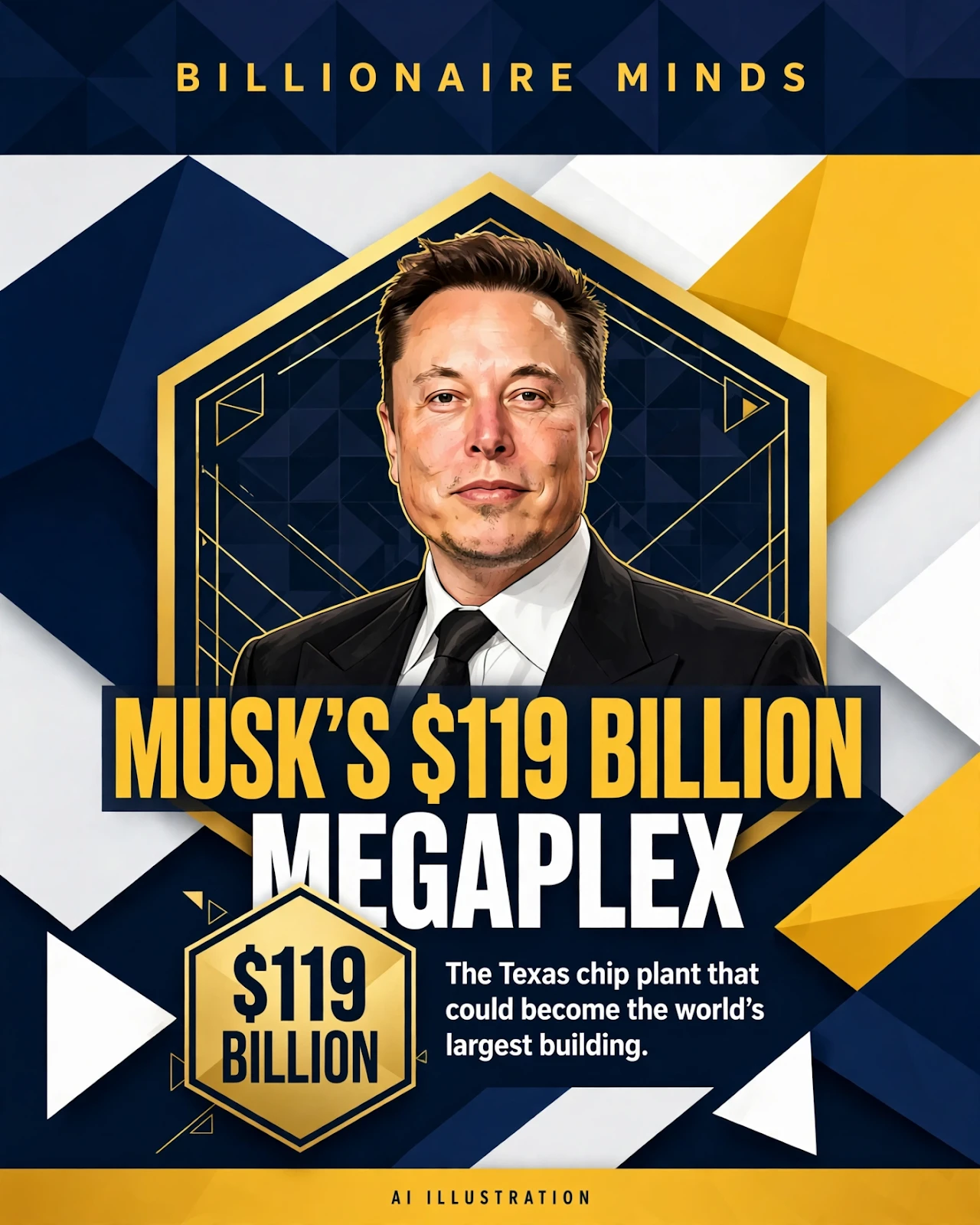
Elon Musk's $119 Billion Texas Megafactory Could Become the World's Largest Building

Elon Musk — his $119 billion Terafab chip plant in Texas could become the world's largest building

Elon Musk is building something so big it could dwarf the largest building on Earth. The project is called Terafab — a joint venture between SpaceX and Tesla — and it is rising in a quiet corner of rural Texas, about 70 miles northwest of Houston.

If it is finished as planned, the industrial complex would cover 100 million square feet. Architectural Digest has reported that would make it more than five times larger than China's New Century Global Centre, one of the largest buildings in the world.

A $119 Billion Bet on Chips

The goal is to make the advanced chips that artificial intelligence, self-driving cars, humanoid robots and space technology will need in the years ahead — all under one roof, including logic chips, memory and advanced packaging. The chips would supply Tesla's autonomous vehicles, its Optimus robots and SpaceX's space programmes.

Texas Governor Greg Abbott's office announced on August 6 that the first phase alone would involve more than $16.8 billion of investment and create about 3,000 jobs. The full ambition is far larger: tax incentive filings reported by local broadcaster KBTX put total investment at about $119 billion across four phases, with construction running until 2036 and more than 4,000 direct jobs. Those figures are projections — not money already spent.

Why Texas, Why Now

Reuters reported in October that Musk is aiming for volume production by the third quarter of 2028. Musk himself called that timeline highly ambitious and said it was uncertain whether it could be met.

Land acquisition has moved fast. KBTX reported on November 10 that WIT TECH LLC, a company linked to the project, now holds more than 10,000 acres in the county, up from about 7,700 acres in August. A Musk-linked company has also bought a water pumping station on the Navasota River.

The public incentives behind the project have drawn close scrutiny. The Houston Chronicle reported that two local school districts gave preliminary approval in July to property tax deals worth an estimated $1.66 billion in future tax relief, phased in through 2046. A separate agreement with Grimes County requires SpaceX to invest at least $5 billion by 2030 and create 1,800 permanent jobs by 2035 — though the company can walk away at any time with 30 days' written notice, with a maximum penalty of $60 million.

The Pushback

Hopes for jobs have come with local concerns about water, power, roads, the environment and the rural way of life. County Judge Joe Fauth has said the plant will not draw on groundwater, instead using recycled surface water from the Gibbons Creek Reservoir and generating its own power, separate from the state grid. Some community groups are still pressing for stronger safeguards and greater transparency.

The fight over transparency has reached the courts. In September, SpaceX sued the Texas attorney general and Grimes County to block the release of certain records, and on November 9 it amended its petition to also challenge the release of documents requested by KBTX.

Texas politics adds a new layer of uncertainty. In the November 3 election, Democrat Gina Hinojosa defeated Abbott and will take office in January as the state's first Democratic governor since 1995. She campaigned against corporate incentives, but has since struck a more conciliatory tone, saying she could have a strong working relationship with Musk "on our terms" — while calling for strict rules on water, power and community rights for data centres.

Whether Terafab ends up the world's largest building or not, one thing is clear: the world's richest man is betting $119 billion that the future of AI will be built in rural Texas.

Source: Geo TV. Image: AI illustration.

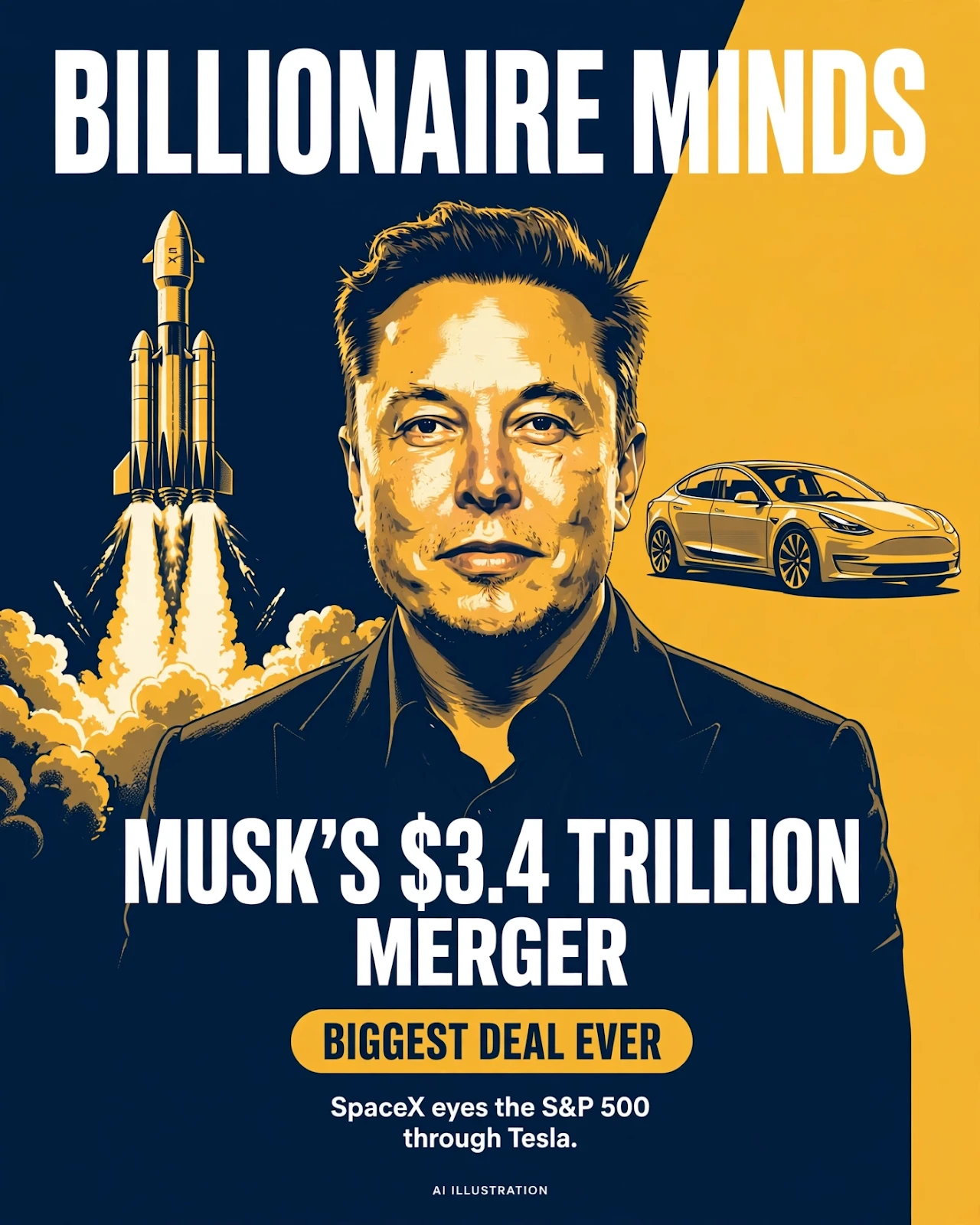
Elon Musk's SpaceX–Tesla Merger: A $3.4 Trillion Deal to Sneak SpaceX Into the S&P 500

Elon Musk's SpaceX and Tesla merger — a $3.4 trillion deal that could sneak SpaceX into the S&P 500

Elon Musk is chasing the biggest deal in corporate history — and the prize is a backdoor into the S&P 500. The world's richest person is pushing to merge SpaceX with Tesla, a combination worth about $3.4 trillion that would dwarf every merger ever attempted.

The logic, reported by Bloomberg on November 14, is simple. Tesla has been an S&P 500 member since December 2020, while SpaceX — which listed on Nasdaq in June — was refused a fast track into the index. Folding the rocket company into Tesla would hand it the membership it could not win alone, and index membership matters: trillions of dollars in index funds automatically buy member stocks.

A December Announcement?

Talks have moved faster in recent weeks, and an announcement could come as early as December, according to a November 12 report. Musk wants a deal that can close while President Donald Trump is still in office, Bloomberg reported in October. Both boards have set up special committees, and analysts at JPMorgan Chase expect an all-stock deal led by SpaceX. The pair were worth about $3.7 trillion combined in October; a slide in SpaceX shares since the US midterm elections has trimmed that to about $3.4 trillion.

Who Holds the Cards

Musk owns about 42% of SpaceX and controls more than 80% of its votes, so approval there is not in doubt. The harder sell is Tesla, where he holds about 20% and shareholders will have the final say — Musk himself has warned that winning them over could be difficult, and no terms have been agreed. The companies already work closely together, including a $16.8 billion joint chip plant in Texas, and SpaceX absorbed Musk's AI company xAI before its listing. Musk, 55, calls the merger a "good idea" — while comparing the negotiations to "tap dancing through a minefield."

Source: Bloomberg / The New York Times, November 16, 2026. This is a fan/commentary summary of reported news; all figures are the sources' estimates. Image is an AI illustration.

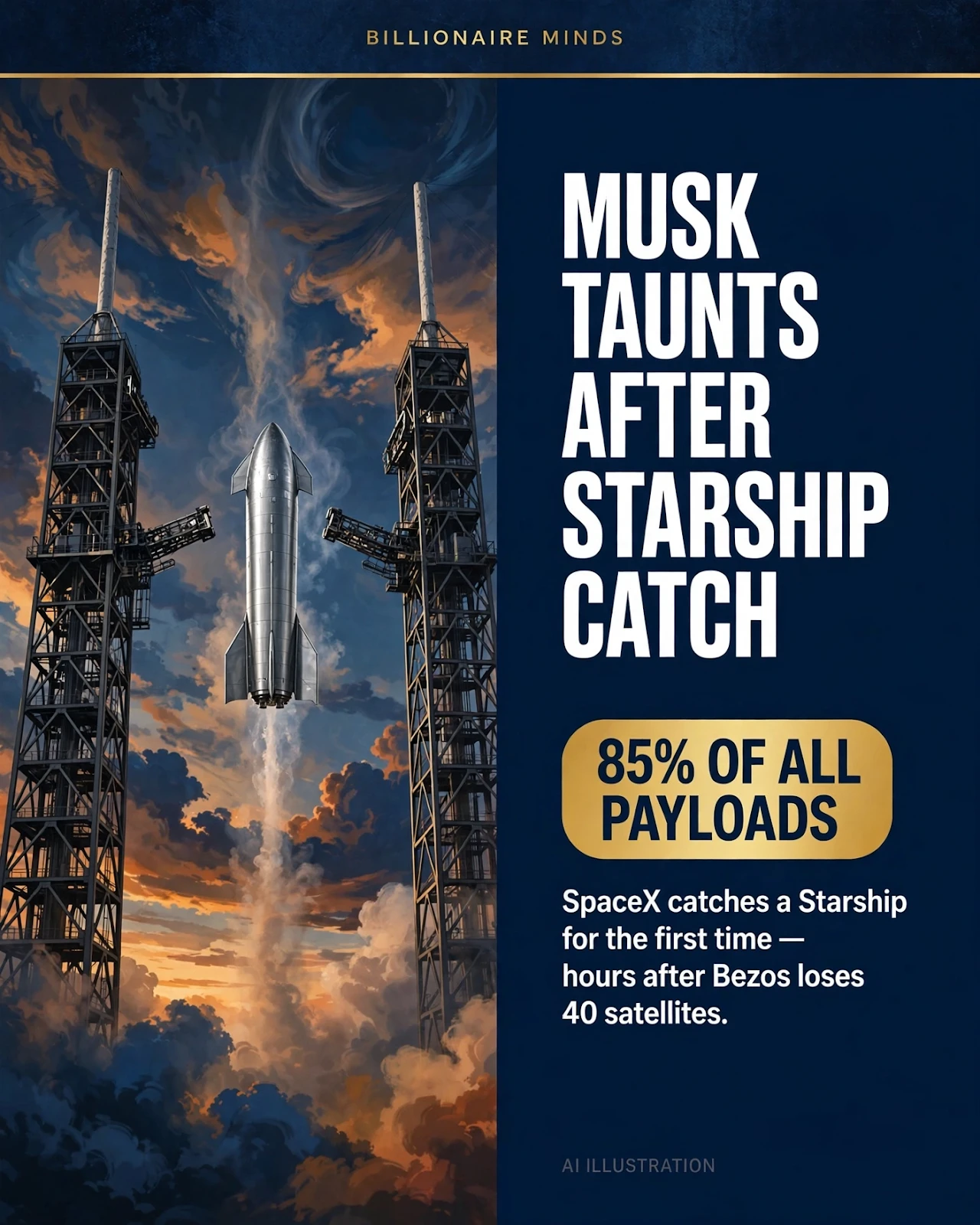
Musk Taunts Bezos After SpaceX's First Starship Catch — "Anyone Can Throw Money at Rockets"

AI illustration of SpaceX's Starship rocket being caught by launch tower arms — Elon Musk taunts Jeff Bezos after the first Starship catch

Elon Musk did not wait long to enjoy the moment. Hours after SpaceX caught a Starship returning from orbit for the first time, the world's richest man took to X to ask why his billionaire rivals — Jeff Bezos, Boeing and Lockheed Martin — still cannot match him, even with fortunes behind them.

It was the second act of a brutal weekend for Bezos. Hours before the catch, a Vulcan rocket failed 10 minutes after liftoff and destroyed 40 of Amazon's Leo internet satellites — the story this blog covered earlier today.

The Catch That Started It

On Saturday, two steel arms on SpaceX's launch tower in Texas caught Ship 42 as it returned from orbit — the first time a Starship has ever been caught. SpaceX had hoped to catch both halves of the rocket on Flight 15; the Super Heavy booster diverted to the Gulf after Friday's launch, but Ship 42 reached orbit, deployed 26 Starlink satellites, and about 22 and a half hours after liftoff descended through the clouds and settled between the tower's two arms.

Musk inspected the ship himself. "I hugged ship 42 upon its return," he posted, adding that it "could probably be reflown with a few weeks of refurbishment." He also teased the next version: "Starship V4 will be ~70m long, which is roughly a 40% length increase and allows >60% more propellant load."

"Anyone Can Throw Money at Rockets"

Soon after the catch, Musk challenged the idea that money alone buys a space program. "Let's take this gentleman's argument at face value that anyone can throw money at rockets and get something like Starship, Falcon or Dragon," he wrote on X.

He pointed at Bezos's Blue Origin, which started before SpaceX and had Bezos's fortune behind it, and asked why it still struggles to launch reliably when, by his estimate, SpaceX's Falcon rockets carry 85% of the world's payload to orbit by mass. United Launch Alliance, the Boeing and Lockheed Martin joint venture, carries less than 5% as much payload to orbit as SpaceX, he said.

When ULA confirmed the loss of the 40 Amazon satellites, Musk struck a different tone: "Sorry to hear this. Hope you are back to flight soon." He also questioned what Boeing had achieved with federal funding for its Starliner capsule: in 2014, NASA awarded Boeing up to $4.2 billion and SpaceX up to $2.6 billion to fly astronauts to the International Space Station. SpaceX now makes those trips regularly; Boeing's next Starliner flight, targeted for December or January, is set to carry cargo without a crew.

The Market Heard Him

Shares of SpaceX (SPCX) rose nearly 1% overnight after the catch, after climbing 3% last week — its strongest weekly gain in more than a month. Google CEO Sundar Pichai watched the catch live and posted: "Congrats @SpaceX for that starship catch, still feels like science fiction!" ARK's chief futurist Brett Winton noted the catch drops the cost per kilogram to orbit to roughly $100, from $1,000.

Walter Isaacson, Musk's biographer, recalled December 2020, when Musk first suggested the launchpad arms could catch a returning Starship: "I will always remember the looks on the engineers' faces in the Starbase conference room." Six years later, the arms caught one — and Musk made sure his rivals knew it.

Source: Stocktwits (November 16, 2026). This is a fan/commentary summary of reported news; all figures are the sources' estimates. Image: AI illustration.

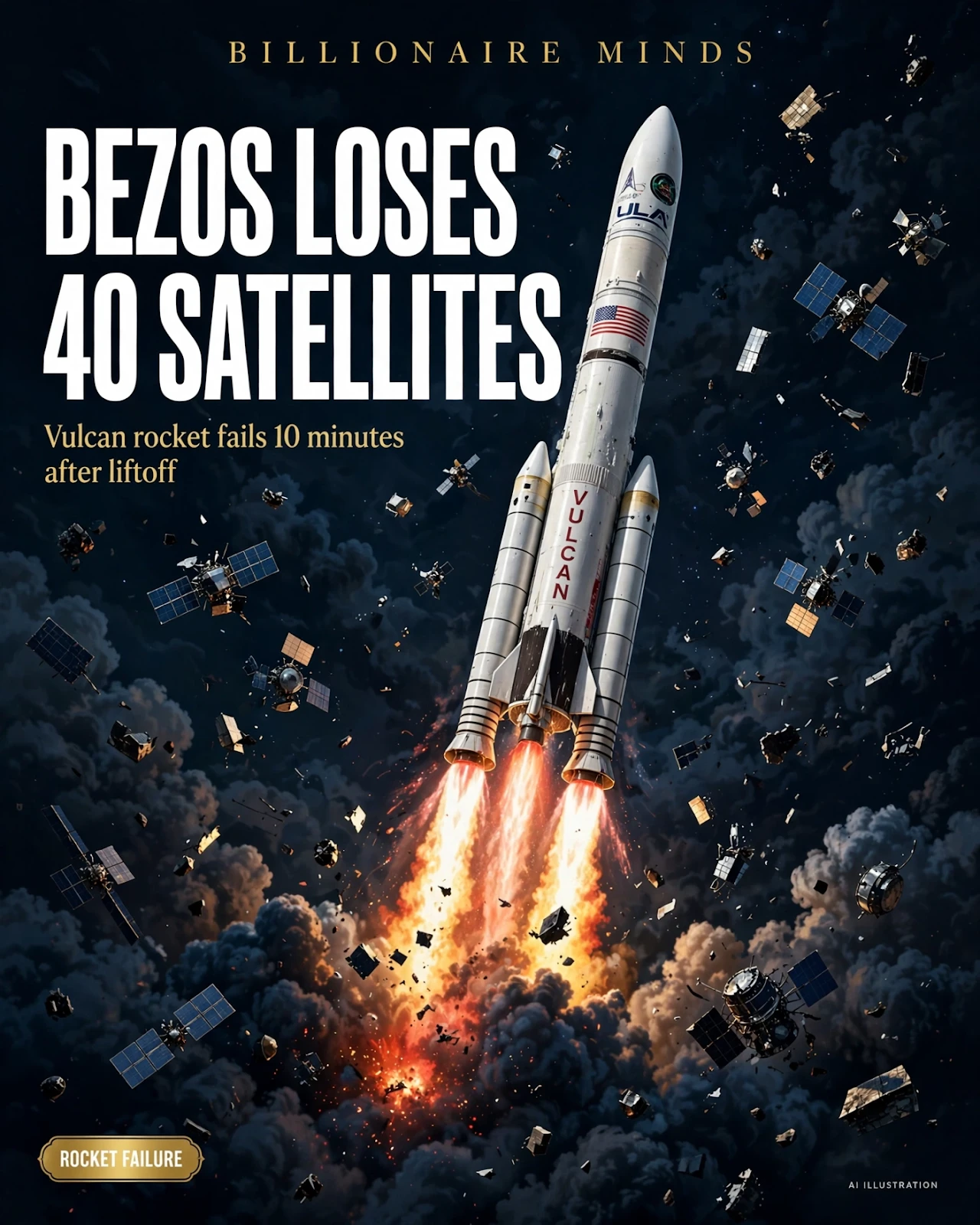
Jeff Bezos Loses 40 Satellites as Amazon's Vulcan Rocket Fails 10 Minutes After Liftoff

AI illustration of Amazon's Vulcan rocket failing after liftoff, with 40 Leo satellites scattered — Jeff Bezos loses 40 satellites in rocket failure

Jeff Bezos just watched 40 of his satellites burn up in the sky. A Vulcan rocket carrying Amazon's Leo internet satellites failed roughly 10 minutes after liftoff from Florida on Sunday, destroying its entire payload in the launch company's first-ever mission failure.

It is a brutal setback for the Amazon founder's long-running bid to build a satellite internet network to rival Elon Musk's Starlink — and the rocket that failed runs on engines built by Bezos's own space company.

Ten Minutes In, the Mission Was Over

The Vulcan rocket, owned by United Launch Alliance — the Boeing and Lockheed Martin joint venture — lifted off from Space Launch Complex 41 at Cape Canaveral Space Force Station carrying 40 satellites for Amazon's Leo network. About 10 minutes into the flight, it suffered an anomaly and failed to deliver the mission to orbit.

"Based on data received by our Launch Director, we confirm that the Vulcan vehicle launched from Space Launch Complex 41 suffered an anomaly 10 minutes into the flight and failed to deliver the Amazon mission to orbit," ULA said in a statement. "Every flight generates data, and every flight teaches us something. Since the anomaly just occurred, we don't have any specific data yet to understand what occurred today."

The failure is expected to trigger a lengthy technical investigation that would keep the rocket grounded for months. It was Vulcan's fifth flight since its 2024 debut and its first in nine months, after a launch hiatus drawn out by separate technical investigations into its solid rocket boosters and its core BE-4 engines.

Bezos's Own Engines Are Under the Microscope

The BE-4 engines that power Vulcan's first stage are supplied by Blue Origin, the space company founded by Bezos. It is not yet clear whether the engines played a role in Sunday's failure — the anomaly appeared to occur after the second stage, carrying the Amazon satellites, separated from the first-stage booster powered by the BE-4 engines. Blue Origin is working with ULA on the investigation, according to a person familiar with the matter.

The engines already carry baggage: Blue Origin's New Glenn rocket suffered a launchpad explosion in May, and its investigation determined the engine was the cause. That led the company to modify the engines delivered to ULA for Vulcan, ULA spokesperson Jessica Rye told Reuters in August.

Amazon struck a measured tone. "There is risk with any launch, and that's especially true for inaugural missions like LV-01," the company said in a statement. "ULA has been a trusted partner for Amazon, and we believe they'll learn from this mission and deliver on their long-term plans for Vulcan."

The Race Against Starlink Just Got Harder

The failure is another blow to Amazon's slow climb into orbit. Since 2025, only 398 Leo satellites have been deployed across 14 launches — about 12% of the 3,236 satellites Amazon needs for global service coverage. The company had hoped to start initial internet service this year.

Meanwhile, Musk's Starlink already has more than 11,000 satellites in orbit and millions of customers worldwide. SpaceX's wide lead comes in part from having its own rocket to launch its satellites, while rivals like Amazon spend billions on external launches — and now, on launches that fail.

ULA, formed in 2006 from the merger of Boeing's Delta and Lockheed Martin's Atlas rocket programs, had held a 100% mission success record ever since. Sunday ended that run — and with Falcon 9, the world's most active rocket, nearing retirement and no longer accepting bookings, the failure could deepen a US launch bottleneck just as Amazon needs launches most.

Source: Indian Express (November 16, 2026), reporting Reuters. This is a fan/commentary summary of reported news; all figures are the sources' estimates. Image: AI illustration.

Billionaire Leo KoGuan Freezes Nvidia Cash — "No Further Investment Without Jensen"

Leo KoGuan, the $13.2 billion investor, freezes new investment in Nvidia after Jensen Huang's ouster — his $1.3 billion stake stays, but no more cash without Jensen.

One of Nvidia's biggest individual shareholders just drew a line in the sand. Singapore-based billionaire Leo KoGuan — worth $13.2 billion, according to the Bloomberg Billionaires Index — says he will not put another dollar into the chipmaker while Jensen Huang is out of the CEO's chair.

"No further investment without Jensen"

KoGuan, who has around $1.3 billion invested in Nvidia, took to X on November 12 to defend the ousted founder and attack the board's decision. "Jensen is a good guy, he is the main driver of si chips and si industries," he wrote. "As one of the largest individual SH of NVDA, I demand the NVDA board and the world to retain him as CEO of Nvidia."

He claims Elon Musk, investor Gavin Baker and President Donald Trump all advised Huang to stay on as CEO of the company he founded. Huang resigned on November 12 after 33 years at the helm, following reports of three affairs — including one with a woman suspected of spying for China. Nvidia has lost more than $500 billion in market value since the scandal broke, and CFO Colette Kress has taken over as interim CEO.

Loyalty to the founder, not the company

On November 13, KoGuan escalated. While insisting Nvidia's business trajectory is unchanged over the next three years, he confirmed he will scale back his planned investment in the chipmaker and redirect the money toward rival super-intelligence companies instead.

"I will reduce my plan investment in NVDA. Instead, I will invest more in other si companies. I hope and plan to invest in Jensen Huang if he creates or buys si company," he posted. "I hope he will offer me the opportunity to invest in his future company."

KoGuan began buying Nvidia shares in March, a major diversification for an investor whose fortune was long tied largely to Tesla. He has also disclosed stakes in SpaceX and Google parent Alphabet. His message to the board is blunt: the money follows the creator — not the company that pushed him out.

Source: BusinessToday (November 13, 2026), reporting Leo KoGuan's posts on X. The spying allegation against Alice Huang is reported as suspicion by US intelligence and has not been proven in court.

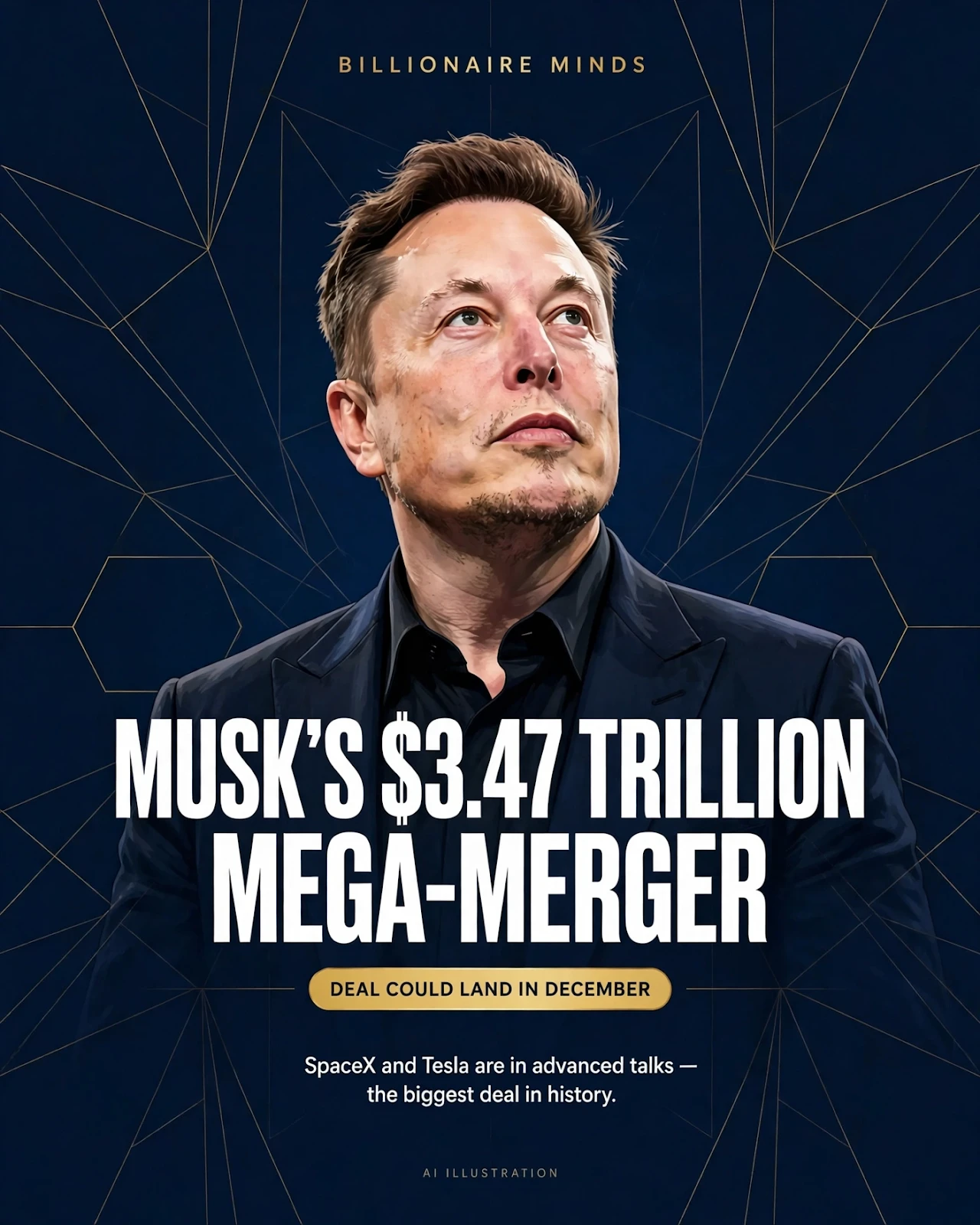
Musk's $3.47 Trillion Mega-Merger Is Moving Fast — SpaceX and Tesla Could Announce in December

Elon Musk — SpaceX and Tesla are in advanced merger talks on a $3.47 trillion deal that could be announced as early as December

Elon Musk is moving fast on the biggest deal in corporate history. SpaceX and Tesla are progressing in their merger negotiations, Bloomberg reported on Thursday, and the two companies could announce the combination as soon as December.

The deal would unite Musk's two largest companies — SpaceX, worth more than $1.9 trillion after its June IPO, and Tesla, worth about $1.5 trillion — into a single $3.47 trillion giant spanning rockets, satellites, electric cars, batteries, AI and humanoid robots.

The biggest deal in history

The boards and advisers of both companies are now hammering out the terms of the tie-up and the governance structure of the combined entity, according to people familiar with the matter. Musk said in October that both boards had formed special committees of independent directors to consider combining. Tesla shares jumped to a session high, rising as much as 1.9%, on Thursday, while SpaceX stock gained 0.5%.

An announcement could also slip into early 2027, the sources said. Bloomberg had earlier reported that the companies were pushing to announce a deal by the first half of next year, with the aim of closing it before the end of President Donald Trump's term. One factor under discussion is how many SpaceX shares Tesla investors would receive. Tesla is slated to hold its annual shareholder meeting on December 3.

Why Musk wants one company

The rationale, Bloomberg reports, is a shared ambition to leverage artificial intelligence across space, driverless cars and humanoid robots. The companies already cooperate closely, including a joint effort to build a semiconductor plant in Texas called Terafab. SpaceX has transformed from a rocket maker into a crucial supplier of AI infrastructure — including to Anthropic — and a top provider of satellite internet.

The obstacles standing in the way

The deal still faces steep hurdles. The companies must work out how to ring-fence Tesla's operations in China, while national security sensitivities around SpaceX's US government and defence contracts loom large. JPMorgan analyst Rajat Gupta called those "key dynamics that are at odds with each other" when it comes to winning regulatory and shareholder approval.

It will also be a major test of the political mood after the US midterm elections, in which Democrats took control of Congress and pledged to probe Musk's business and political dealings. But if the talks hold, December could deliver the largest merger the world has ever seen.

Source: Bloomberg via The Hindu BusinessLine (Nov 13, 2026); Reuters via bdnews24 (Nov 13, 2026). This is a fan/commentary summary of reported news. All figures are the sources' estimates. The portrait on this post is a stylised AI illustration, not a photograph of Elon Musk.

Anthropic's $90 Billion IPO Is Already Oversubscribed — and It Could Smash SpaceX's Record


Anthropic's $90 billion IPO is already oversubscribed several times over, putting SpaceX's record $86 billion listing in sight

Two days into its investor roadshow, Anthropic's blockbuster listing is already oversubscribed several times over — and bankers now believe the maker of the Claude chatbot could pull off the largest IPO in history.

Investors have put in orders for several times as many Anthropic shares as the company is selling, Bloomberg reported on Wednesday, citing people familiar with the matter. Most of the demand came from anchor-size orders — big blocks from large long-term investors — and the order book was covered in full as soon as the offering launched.

A $90 billion deal — and bankers want more

Anthropic kicked off its roadshow on Tuesday, November 10, offering 825 million Class A shares priced between $70 and $78 each. At the top of the range, the base offering would raise about $64.35 billion and value the company at roughly $1.4 trillion. A simultaneous $26 billion private placement of Class N stock at the IPO price takes the combined fundraising to as much as $90.4 billion. The Financial Times reports bankers now expect to price above the range, pushing the valuation beyond $1.5 trillion.

Morningstar says the range is too cheap

Morningstar added fuel on Thursday, putting a fair value of $92 a share on Anthropic — about 24% above the $74 midpoint — and calling the IPO range undervalued. At $92, the IPO and the private placement together could raise about $113 billion. Its bull case is $188 a share; its bear case is $25.

SpaceX's record is the one to beat

The record belongs to Elon Musk's SpaceX, which raised $75 billion in its June 2026 IPO and $85.7 billion after the banks exercised their option for extra shares. Anthropic's $90.4 billion would eclipse it. The numbers behind the hype are real: Anthropic brought in $33.2 billion of revenue in the first nine months of 2026, up from $2.5 billion a year earlier, pushing its annualised revenue run rate to $81 billion by the end of October. Final pricing is set for November 18, with shares due to start trading on the Nasdaq on November 19 under the ticker ANT. Goldman Sachs and Morgan Stanley are leading the deal, with a 22-bank syndicate behind them, and Anthropic's seven co-founders are each due to sell about $250 million of stock in the offering.

One caution: oversubscription is no guarantee of a strong debut. Klarna and StubHub both had heavily oversubscribed IPOs and still traded below their offering prices — while SpaceX itself was about four times subscribed.

Source: Bloomberg via Business Today (Nov 12, 2026); Morningstar (Nov 12, 2026); Reuters (Nov 12, 2026); Financial Times via ZeroHedge (Nov 11, 2026). This is a fan/commentary summary of reported news. All figures are the sources' estimates. The portrait on this post is a stylised AI illustration, not a photograph.

SpaceX's 12% Slide Just Made Musk's Tesla Buyout a Lot More Expensive — Tesla Investors Would Own the Combined Company

Elon Musk's dream of folding Tesla into SpaceX just hit a very expensive snag — and the stock market did it. SpaceX shares have fallen roughly 12% since the company reported strong third-quarter results on October 21, while Tesla stock has stayed flat over the same stretch. That gap has quietly rewritten the price of the biggest merger in stock market history.

The math just flipped

Most Wall Street analysts expect SpaceX to act as the buyer in an all-stock deal, paying a premium for Tesla. But a lower SpaceX share price means the rocket company must hand over far more stock to buy the carmaker. At a 15% premium at current prices, SpaceX would have to give Tesla investors about 3.2 SpaceX shares for each Tesla share — and based on fully diluted share counts from FactSet, that exchange rate would leave Tesla shareholders owning more than 50% of the combined company.

Compare that with earlier this year, when SpaceX traded at $200 a share. Back then, a 15% premium would have cost just 2.3 SpaceX shares per Tesla share, leaving SpaceX investors with roughly 57% of the merged business. The 12% slide has flipped majority control to the other side of the table.

A $3.5 trillion question with no deal yet

Talk of a tie-up jumped after Musk told investors on October 20 that the boards of both companies had formed special committees to review a deal. Bringing the two together would create an AI giant controlling power generation, chip making, AI models, software agents and humanoid robots. Barclays has even put a $450-a-share value on Tesla in a deal — roughly a 20% premium — and called the merger a key part of the Tesla bull case.

But there is still no agreement, no merger proposal and no shareholder vote scheduled. Any deal would need approval from a majority of all outstanding Tesla shares, and Musk himself cannot take part in the committees' discussions because he leads both companies.

The warning sign is already flashing elsewhere. Traders recently punished chipmaker Marvell and optical firm Lumentum after the pair announced an all-stock merger in early November — Marvell's share price sat well below its 52-week high, so it had to issue far more shares to pay the same price. SpaceX faces the same hurdle. Unless its shares bounce back soon, the sheer cost of issuing so much new stock could stall the buyout talks altogether — and leave Musk's mega-merger on the launch pad.

Source: TipRanks (Nov 12, 2026); The Motley Fool / Barclays (Nov 1, 2026). SpaceX is valued at roughly $2 trillion and Tesla at about $1.5 trillion. No merger agreement has been announced.


Musk's $24 Billion Texas Power Play — SpaceX Wants Its Own Gas Plant and Supercomputer at Starbase


Elon Musk's SpaceX wants to build its own power station — and its own supercomputer — in Texas. The company has asked the City of Starbase to approve a $24 billion project pairing a natural gas-fired power plant with a "super-compute facility" on a 444-acre site near the Port of Brownsville, according to a city notice published November 6.

The plan in numbers

The proposed plant would run on 35 gas turbines producing about 748 megawatts — enough electricity to run the giant AI data center without touching the Texas power grid at all. SpaceX has also applied for an air emissions permit and is seeking a property tax abatement and access to the Cameron County Enterprise Zone. The city commission is scheduled to hold a public hearing on the request on December 9.

Why SpaceX wants its own power

Texas has frozen new data centers from joining the state grid queue since August, while regulators audit the system — so building its own generation is the fastest way to keep the AI race moving. SpaceX merged with Musk's AI company xAI in February 2026 and is now aiming for roughly 13 gigawatts of AI compute capacity by the end of 2027. It already leases computing power to Google and Anthropic, and job postings openly reference the "Starbase supercomputer." The company is also building its own gas pipelines in Texas and Florida, and a separate gas-fired plant for a semiconductor factory it is building with Tesla near Houston.

The political risk

The timing is awkward. Democrat Gina Hinojosa, who won the Texas governor's race on November 3, opposes energy-intensive AI data centers — and she has already moved to freeze a possible sale of state park land next to Starbase to SpaceX. Musk hit back on X, saying "SpaceX and Tesla have prospered in Texas, because we were not constantly operating under an oppressive and extractive state government." Investors are watching closely: Tesla fell nearly 11% and SpaceX 9% in Thursday's broad market selloff, though analysts at Stifel reaffirmed a buy rating on SpaceX with a $190 price target.

Sources: CoinDesk (Nov 9, 2026), Crypto Briefing, TradersUnion, Chosun Biz reporting Bloomberg and Reuters. This is a fan/commentary summary of reported news; all figures are the sources' estimates. Image: AI illustration.

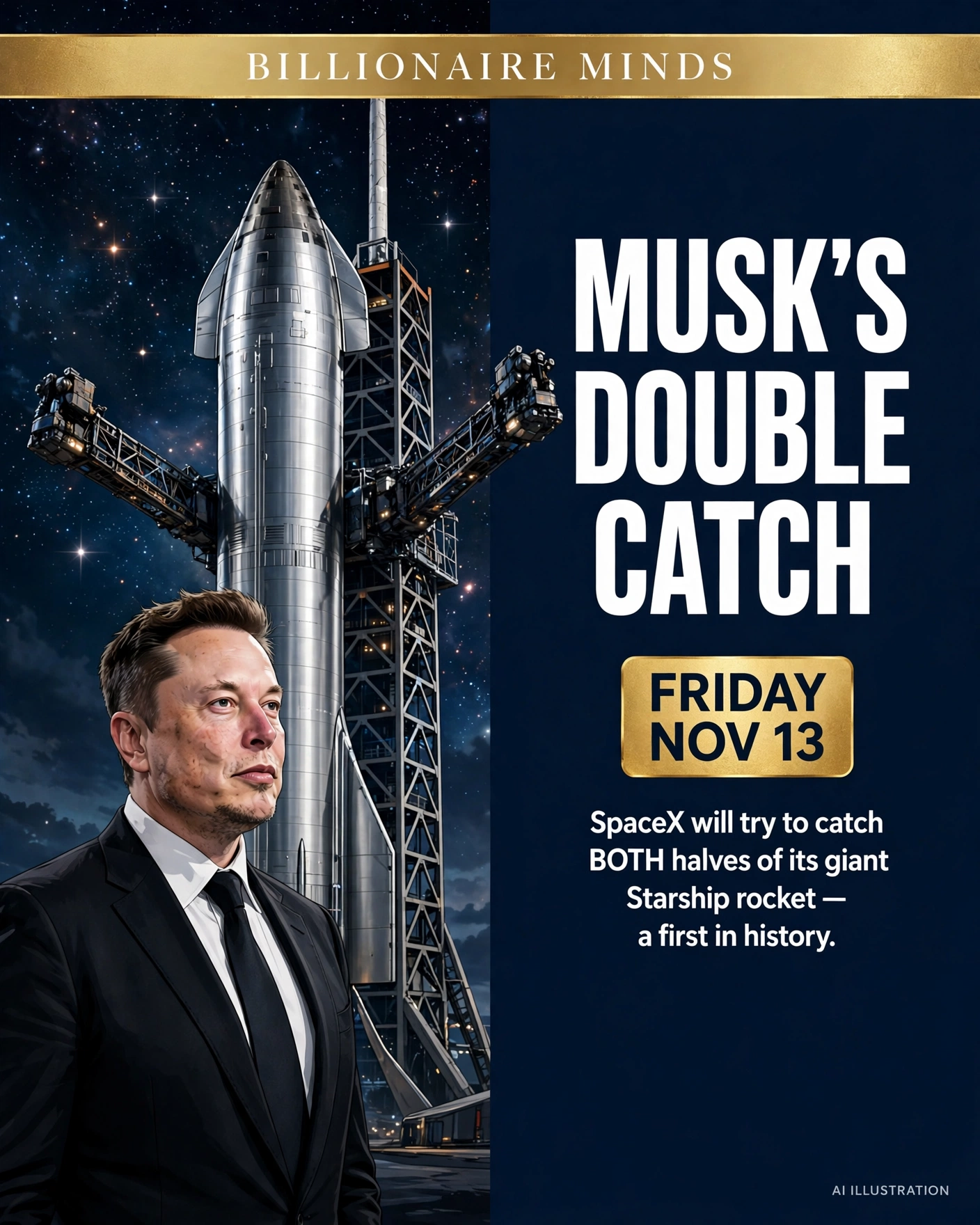
Elon Musk's SpaceX Targets Friday the 13th for the First-Ever Double Rocket Catch

Stylized illustration of Elon Musk with SpaceX's giant Starship rocket and launch tower against a starry sky — SpaceX will try to catch both halves of the rocket on Friday, November 13

Elon Musk's SpaceX is one week away from the most audacious test flight in its history. On Friday, November 13, the company will attempt something no one has ever done: catch both halves of an orbital rocket and bring them home in one piece. "SpaceX will attempt to catch both the Super Heavy booster and Starship on the upcoming flight," Musk wrote on X on November 6. "If both are successful, it will mark the first time that all parts of an orbital rocket return to Earth intact. This is the critical breakthrough needed to make life multiplanetary."

Two catches, one flight

Flight 15 will fly Booster 22 and Ship 42 — both Block 3 vehicles — from Orbital Launch Pad 2 at Starbase, Texas, in a 75-minute window opening at 4:45 p.m. Central Time, pending final regulatory approval. After hot staging and separation, the Super Heavy booster is planned to return for a tower catch roughly six minutes and 35 seconds after liftoff. The Ship has the harder job: it will climb to a roughly 275-kilometre orbit, deploy 26 advanced Starlink V3 satellites, circle Earth about 14 times over more than 22 hours, then attempt a deorbit burn, a belly-flop reentry, a flip and a landing burn into the launch tower's chopstick arms at about T-plus 22 hours and 32 minutes. SpaceX has caught boosters three times before, on Flights 5, 7 and 8. The Ship has never been caught.

Why it matters — and what it is worth

Full recovery is the economics of Musk's space empire. A rocket that can be caught, inspected, refurbished and reflown quickly slashes the cost of every launch — and the high launch cadence it enables is what Starlink, lunar missions and eventually Mars settlement all depend on. Musk told investors at last week's Baron conference that SpaceX aims to pass a $100 billion annualized revenue run rate in December, and the Starlink satellites riding on Flight 15 are the revenue engine behind that number. Musk put the odds of pulling off the first double catch at "more likely than not" — and if the Ship's health checks fail, it will splash down in the Pacific instead, with the booster falling back to the Gulf of Mexico. Either way, a steady stream of further flights is already scheduled. Friday the 13th, it turns out, could be the luckiest day in rocket history.

Source: Teslarati, November 8, 2026 (Musk X post November 6; SpaceX VP of Launch Kiko Dontchev at the UP.Summit, November 5); Business Today, November 7, 2026. This is a fan/commentary summary of reported news; all figures are the sources' estimates. Portrait: AI illustration.

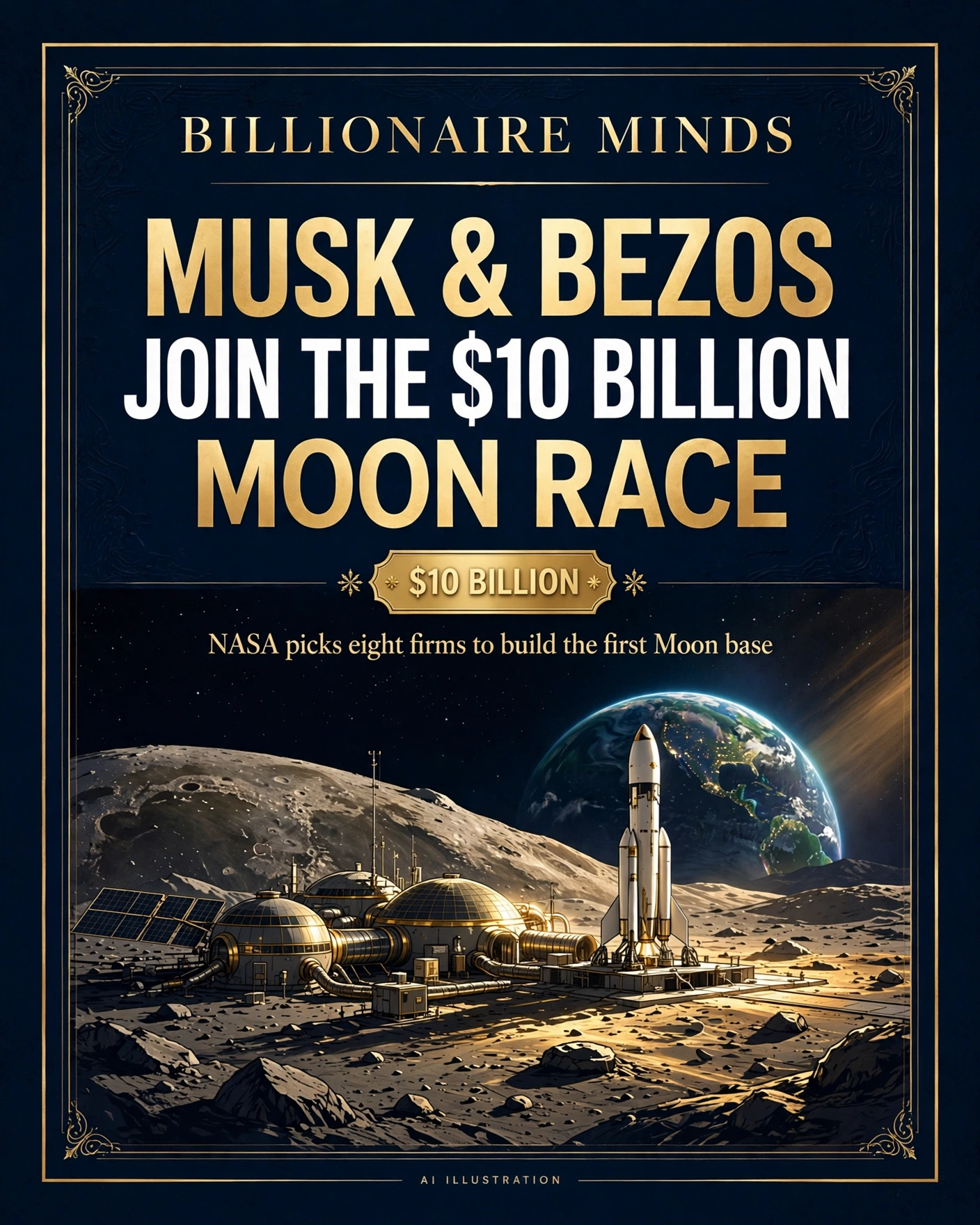
Musk and Bezos Just Won a Shot at NASA's $10 Billion Moon Base — the Lunar Gold Rush Is On

Stylized illustration of a lunar base on the Moon's surface with a rocket and Earth in the sky — NASA's $10 billion Moon base program

NASA has just turned the Moon into the biggest prize in the billionaire space race. On Saturday, November 7, the agency announced it has selected eight companies — including Elon Musk's SpaceX and Jeff Bezos's Blue Origin — to compete for lunar delivery contracts worth up to $10 billion over the next decade, laying the groundwork for a permanent base near the Moon's South Pole.

The $10 Billion Contract — and What It Really Means

The headline figure is a ceiling, not a cheque. Under the new Commercial Lunar Payload Services 2 (CLPS 2) framework, the eight firms are eligible to compete for future delivery task orders over a 10-year term, with a combined maximum value of $10 billion. Each company is guaranteed just $25,000 under its base contract — the real money flows only when NASA awards a specific delivery mission. The pool can grow to $15 billion if NASA exercises a five-year extension. Alongside SpaceX and Blue Origin, the winners are Firefly Aerospace, Intuitive Machines, ispace US, Lockheed Martin Space, Northrop Grumman Space Systems and Voyager Technologies. NASA also raised the ceiling on its existing CLPS contract from $2.6 billion to $4.2 billion.

Blue Origin's $94 Million Rover — and SpaceX's Starship Job

Blue Origin walked away with the day's only concrete payday: a $94 million base contract, with a further $140 million available on performance, to deliver NASA's nuclear-powered PROMISE rover to the lunar South Pole aboard its Mark 1 lander, targeting a late-2028 launch for an 18-month mission hunting for water ice. SpaceX, meanwhile, was selected to fly communications satellites aboard its Starship rocket into the region between Earth and the Moon in 2028. NASA also issued six transport task orders worth about $1.3 billion combined to Arrow Science and Technology, Blue Origin and Impulse Space.

Musk vs. Bezos — Now on the Moon

The announcement, made at the MAX POWER aerospace expo at Kennedy Space Center in Florida, puts the two richest space rivals on the same starting line — and the timing could not be sharper. Musk has spent recent weeks talking up a self-growing city on the Moon, while Bezos answered with a tortoise: a quiet nod to Blue Origin's "step by step, ferociously" motto. NASA Administrator Jared Isaacman captured the stakes in a statement: "When our astronauts return to the Moon, they will arrive with the first elements of the Moon Base already waiting for them on the surface." For Musk and Bezos, the race to build that base is now officially a $10 billion contest — and only one of them can win the biggest orders.

Source: The New York Ledger (Nov 8, 2026), reporting NASA Release 26-095; Public Rot contract analysis. AI illustration: stylized artwork, not a photograph.

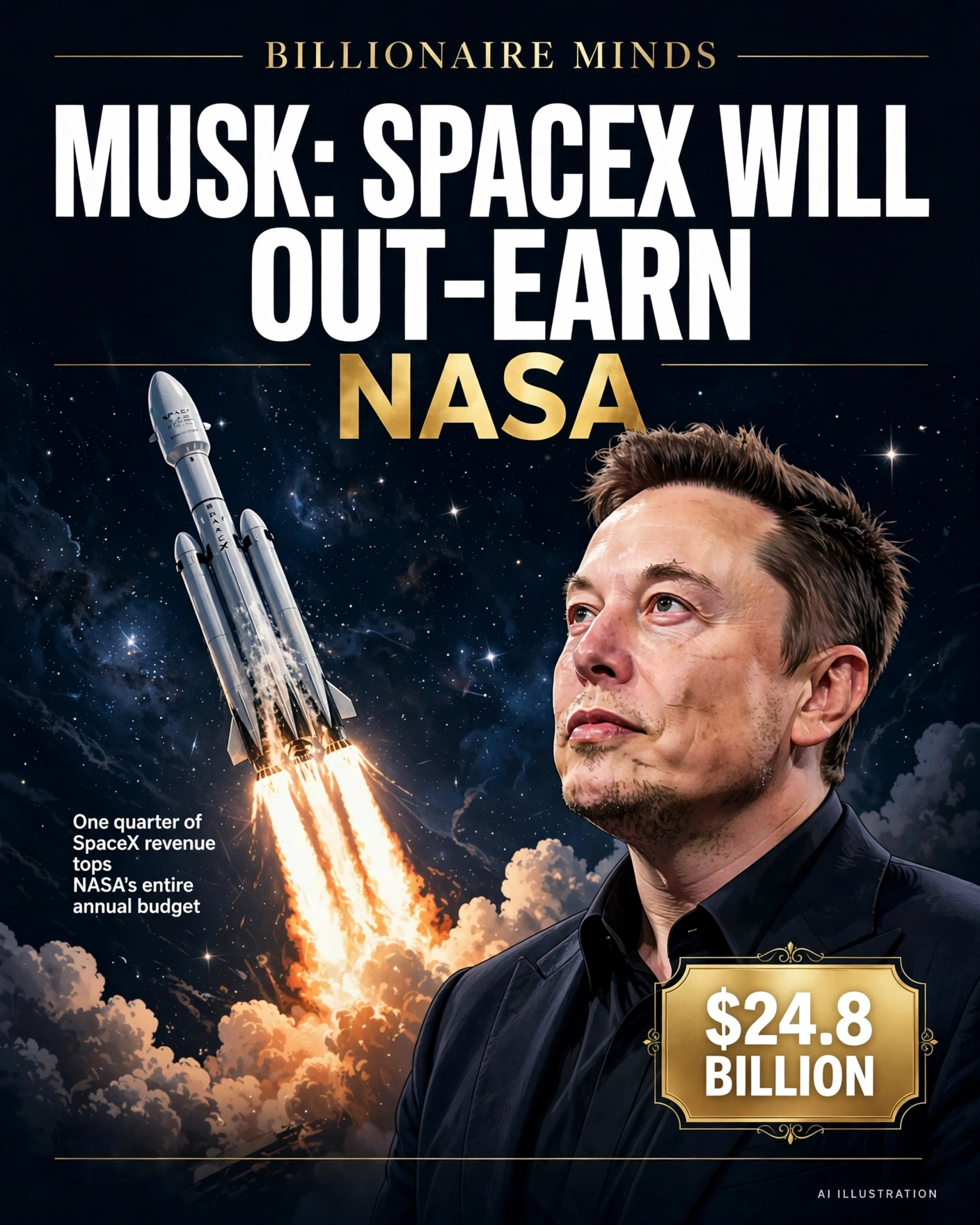
Musk Says SpaceX Will Out-Earn NASA's Entire Budget This Quarter — $24.8 Billion in 3 Months

Elon Musk looking up at a SpaceX rocket launching into a starry sky — he says SpaceX will earn $24.8 billion this quarter, more than NASA's entire annual budget

Image: AI illustration.

Elon Musk just put a number on SpaceX's transformation — and it is bigger than NASA's entire year. Speaking virtually at the 33rd Annual Baron Investment Conference in New York on Friday, Musk said SpaceX's fourth-quarter revenue should rise roughly 70 percent from the third quarter, putting sales near $24.8 billion. Then he drove the point home on X: "SpaceX revenue this quarter alone will be substantially higher than NASA's entire annual budget!" NASA received $24.4 billion in regular fiscal 2026 appropriations, according to a Congressional Budget Office assessment — so on that measure, one quarter of SpaceX now tops a full year of NASA.

The AI business is now bigger than the rockets

The forecast builds on a third quarter in which SpaceX reported $14.58 billion in revenue, up 161 percent from a year earlier. The surprise is what is driving it: the company's Super Intelligence unit, which leases AI computing capacity to other developers, generated $7.56 billion — more than half of total revenue and the company's largest segment for the first time. Connectivity, home to Starlink, brought in $5.25 billion, and space operations $1.77 billion. Anthropic has replaced NASA as SpaceX's single largest customer, accounting for about 34.5 percent of third-quarter revenue. Musk also gave a first launch date for StarMind, SpaceX's planned space-based AI computing network: 2027.

Washington is becoming a footnote

Musk used the moment to answer the midterm-election question hanging over his companies. Government contracts made up 16.6 percent of SpaceX revenue last quarter, he said, and will fall below 10 percent this quarter — and under 5 percent within a year. "Happy to cancel any that the government doesn't want. Just say the word!" he posted on X. The pitch landed with investors: SpaceX shares finished Friday up 8.6 percent at $134.27, rebounding from a two-day slide that had wiped more than $420 billion off the combined market value of Tesla and SpaceX after Democrats swept Congress. Musk repeated his goal of reaching a $100 billion annualized revenue rate by December — and said it could exceed $500 billion by December 2027 — while cautioning investors: "This is not a promise. This is what I think will happen. This is my best guess." The rocket company that once survived on NASA contracts is now telling the world it can out-earn the agency in a single quarter.

Source: Benzinga via MarketSpeaker; TipRanks; Gizmodo; The Currency Analytics, November 6–7, 2026. This is a fan/commentary summary of reported news; all figures are the sources' estimates.