Elon Musk is not letting a historic weekend in space slide — and he used it to take a very public swipe at Jeff Bezos. Hours after SpaceX pulled off its most ambitious orbital feat yet, Musk went on X and asked the question no one at Blue Origin wanted to hear: if throwing money at rockets was all it took, why can't Bezos' billions buy a reliable launch?
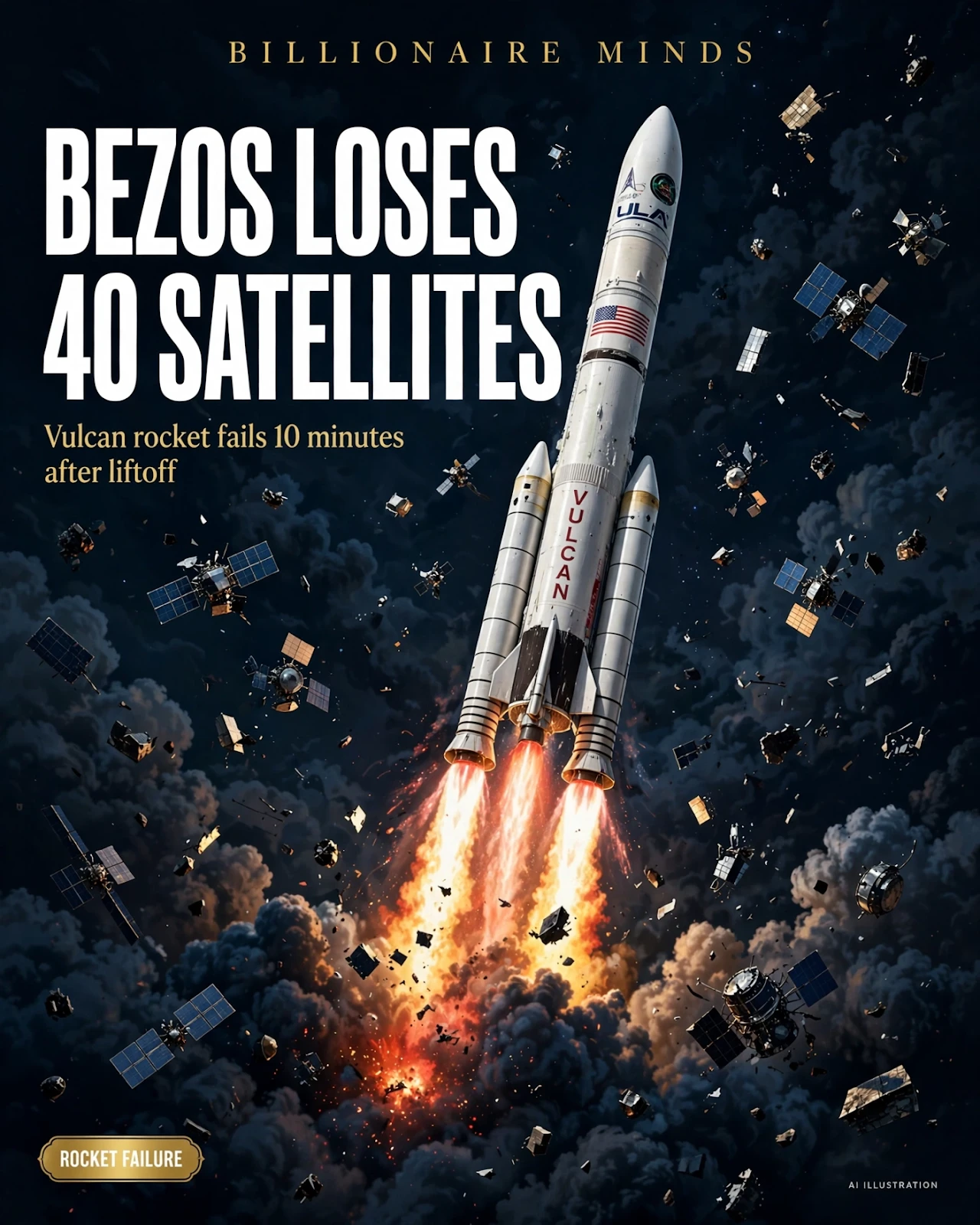
The jab landed on Sunday, November 15, and it came with receipts. The same morning, a rival rocket carrying Amazon's own satellites failed minutes after liftoff — destroying 40 of them.
Starship's Historic Flight Set the Stage
On November 13, SpaceX's Starship flew its 15th test flight. Ship 42 entered orbit, deployed 26 next-generation Starlink V3 satellites, completed multiple orbits around Earth, and returned to its Texas launch site roughly 22.5 hours after liftoff on November 14 — an unprecedented orbital engineering feat, and arguably SpaceX's biggest accomplishment to date.
Musk wasted no time. When a critic on X argued that anyone could build reusable rockets simply by throwing enough money at the problem, Musk dismantled the argument by pointing straight at Bezos and Blue Origin.
"Let's take this gentleman's argument at face value that anyone can throw money at rockets and get something like Starship, Falcon, or Dragon," Musk wrote on Sunday. "Perhaps he can explain to everyone how SpaceX is able to catch giant starships from orbit with chopsticks and deliver 85% of all Earth payload to orbit with Falcon, while Blue Origin, which started before SpaceX and was funded by the immensely wealthy Jeff Bezos, is not yet able to launch reliably? I am genuinely curious."
Bezos Had a Head Start — and Billions More
The numbers back up Musk's taunt. Bezos founded Blue Origin in September 2000 — nearly two years before Musk established SpaceX in May 2002 — and has personally funnelled billions of dollars from Amazon stock sales into the venture. Despite the head start, SpaceX's Falcon fleet now hauls around 75% of global orbital tonnage, according to industry data cited by FourWeekMBA.
Musk didn't stop with Bezos. In the second half of his Sunday post, he aimed at Washington's legacy aerospace contractors: "And why is it that Boeing and Lockheed Martin, despite receiving several times more government funding than SpaceX, are so far behind?"
NASA's own numbers tell the story. In 2014, the agency awarded Boeing $4.2 billion to develop the Starliner crew capsule and SpaceX $2.6 billion to develop Crew Dragon. A decade later, SpaceX routinely ferries astronauts to the International Space Station, while Boeing has grappled with propulsion failures and more than $1.85 billion in Starliner charges, according to CNBC.
The Rocket Failure That Proved Musk's Point
Hours before Musk posted, a United Launch Alliance Vulcan Centaur rocket — the Boeing-Lockheed joint venture — malfunctioned within 10 minutes of liftoff on Sunday morning and failed to reach orbit, destroying all 40 commercial satellites aboard, according to Space.com.
Those 40 lost satellites belonged to Amazon's Leo network, previously known as Project Kuiper — Amazon's $10 billion-plus low-Earth-orbit broadband network designed to go head-to-head with SpaceX's Starlink, according to GeekWire.
Bezos is determined to diversify Amazon's launch options rather than rely solely on Musk's Falcon 9 rockets to deploy a planned 3,236-satellite constellation. That is why Amazon secured the largest commercial launch procurement in aerospace history, with contracts from ULA and Blue Origin — including 38 missions on ULA's Vulcan rocket. Sunday's mishap happened on the very first of those 38 contracted Vulcan flights.
What This Means for the Billionaire Space Race
The failure leaves Amazon's satellite broadband rollout bottlenecked by the exact launch struggles Musk just called out. SpaceX, meanwhile, keeps expanding its commercial grip on low Earth orbit — a dominance that underpins the company's roughly $1.9 trillion valuation and Musk's position as the world's richest person, worth around $890 billion by Forbes' real-time estimates, with Bezos second at about $377 billion.
For Bezos, the weekend was a brutal reminder that in the space race, billions in capital no longer buy a technological moat. For Musk, it was the perfect stage to say so out loud.
Image: AI illustration. This article is commentary on publicly reported events.
Source: TheStreet — "Elon Musk calls out Jeff Bezos over SpaceX rivals"