Posts

Showing posts with the label Space

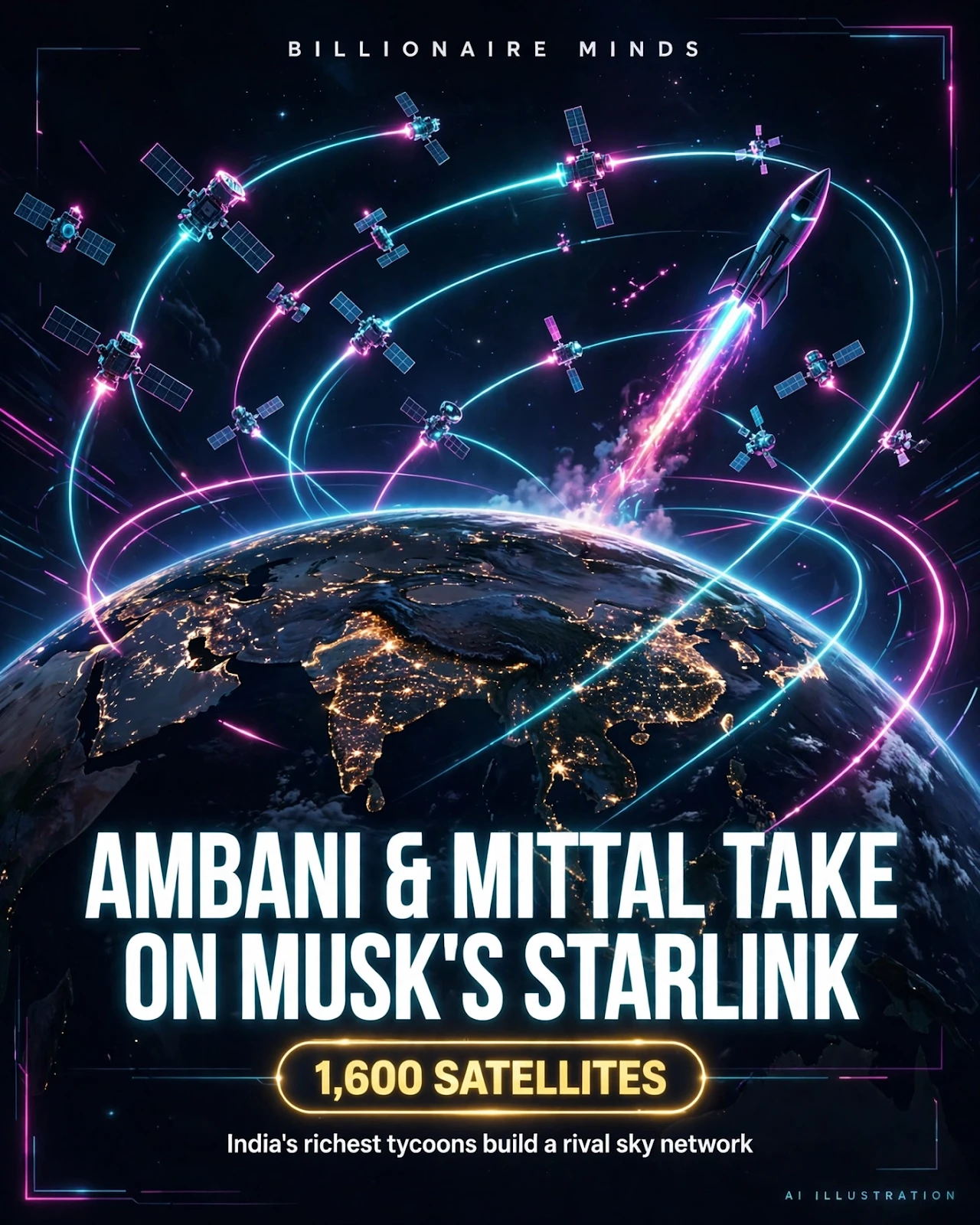
Ambani and Mittal Just Declared War on Musk's Starlink — a 1,600-Satellite Rival

Stylized illustration of satellites orbiting Earth — Ambani and Mittal take on Musk's Starlink with a 1,600-satellite rival network

Two of India's richest men are taking the fight to Elon Musk — in orbit. Mukesh Ambani's Reliance Industries is planning a 1,600-satellite low Earth orbit constellation to rival Starlink, while telecom tycoon Sunil Mittal is backing Eutelsat's OneWeb as the independent alternative. The billionaire space race just got a lot more crowded.

Ambani's 1,600-Satellite Plan

Reliance is in talks with Indian satellite manufacturers, technology startups and larger industrial groups, offering to fund the infrastructure needed to scale up production. India currently produces fewer than 15 satellites a year — the constellation would need output of around 200 a year. The plan combines domestic manufacturing with imports, including at least 400 satellites from the US. Reliance is discussing procurement with two US companies and evaluating suppliers in Europe, while ruling out China as a source. A test mission is targeted for September 2027, with wider deployment from early 2028; completion has slipped from 2030 to 2035.

Mittal's OneWeb Bet

Meanwhile, Sunil Mittal is backing Eutelsat Communications' OneWeb, which is building a global satellite-internet network independent of both the US and China. "Countries can't rely on another country," Mittal told Bloomberg TV. OneWeb has around 650 satellites — far fewer than Starlink — and Bharti Airtel, India's second-largest telecom operator, was an early investor in 2015, joining the UK government in a $1 billion rescue in 2020 and investing another $500 million since.

The Gap They Have to Close

The commercial gap remains substantial. Starlink serves at least 13.6 million customers worldwide and generated more than $5 billion in connectivity revenue in the three months ended September. Eutelsat's LEO business, including OneWeb, generated just €70.9 million ($81.5 million) in the same period. Amazon is also developing a network of thousands of satellites. For Ambani and Mittal, the stakes go beyond broadband — satellite networks are increasingly vital for remote connectivity, communications and military operations, making control a matter of strategic autonomy. Starlink's planned India entry remains subject to regulatory and security scrutiny, strengthening the case for homegrown alternatives.

Source: BusinessToday, November 18, 2026. Image: AI illustration.
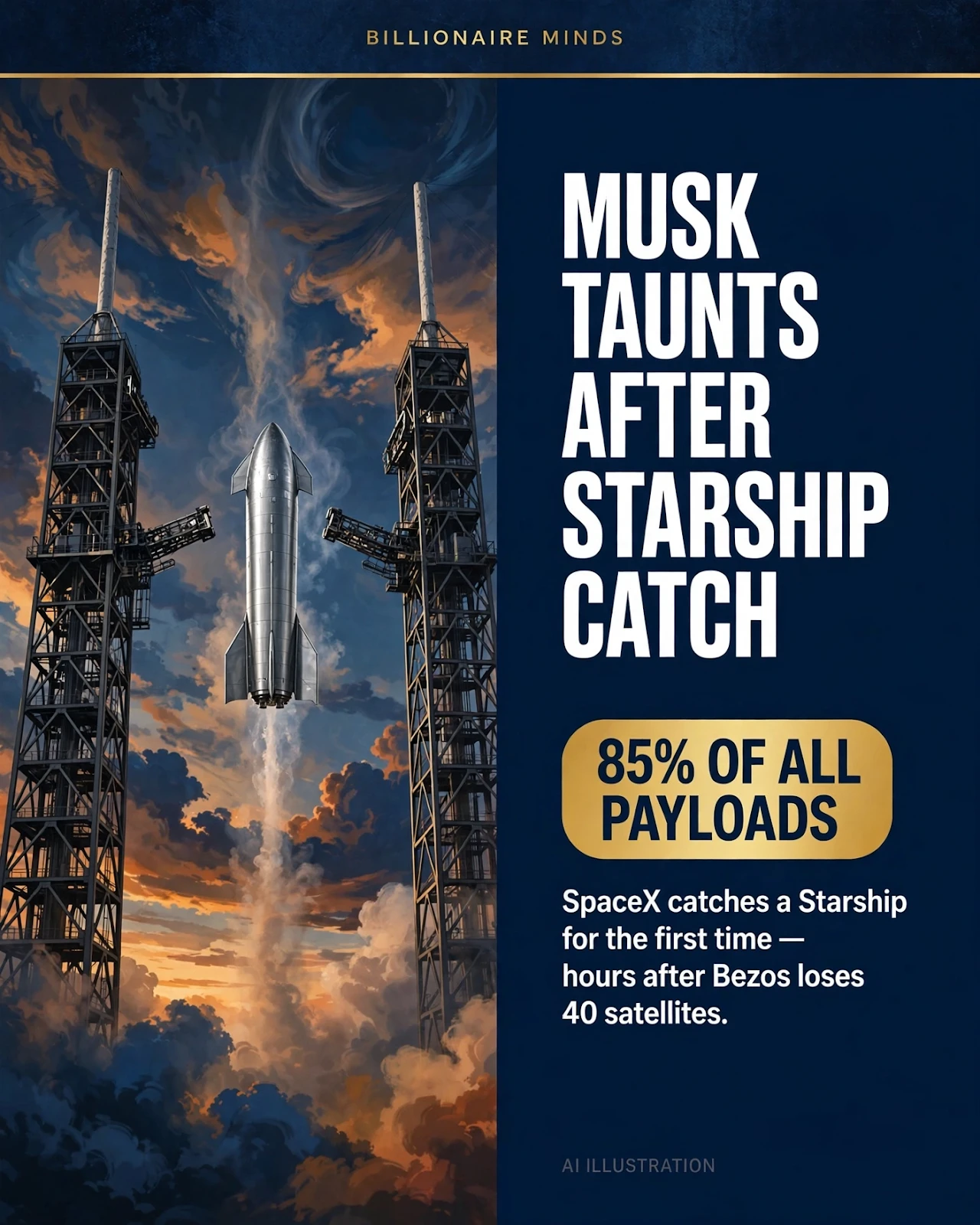
Musk Taunts Bezos After SpaceX's First Starship Catch — "Anyone Can Throw Money at Rockets"

AI illustration of SpaceX's Starship rocket being caught by launch tower arms — Elon Musk taunts Jeff Bezos after the first Starship catch

Elon Musk did not wait long to enjoy the moment. Hours after SpaceX caught a Starship returning from orbit for the first time, the world's richest man took to X to ask why his billionaire rivals — Jeff Bezos, Boeing and Lockheed Martin — still cannot match him, even with fortunes behind them.

It was the second act of a brutal weekend for Bezos. Hours before the catch, a Vulcan rocket failed 10 minutes after liftoff and destroyed 40 of Amazon's Leo internet satellites — the story this blog covered earlier today.

The Catch That Started It

On Saturday, two steel arms on SpaceX's launch tower in Texas caught Ship 42 as it returned from orbit — the first time a Starship has ever been caught. SpaceX had hoped to catch both halves of the rocket on Flight 15; the Super Heavy booster diverted to the Gulf after Friday's launch, but Ship 42 reached orbit, deployed 26 Starlink satellites, and about 22 and a half hours after liftoff descended through the clouds and settled between the tower's two arms.

Musk inspected the ship himself. "I hugged ship 42 upon its return," he posted, adding that it "could probably be reflown with a few weeks of refurbishment." He also teased the next version: "Starship V4 will be ~70m long, which is roughly a 40% length increase and allows >60% more propellant load."

"Anyone Can Throw Money at Rockets"

Soon after the catch, Musk challenged the idea that money alone buys a space program. "Let's take this gentleman's argument at face value that anyone can throw money at rockets and get something like Starship, Falcon or Dragon," he wrote on X.

He pointed at Bezos's Blue Origin, which started before SpaceX and had Bezos's fortune behind it, and asked why it still struggles to launch reliably when, by his estimate, SpaceX's Falcon rockets carry 85% of the world's payload to orbit by mass. United Launch Alliance, the Boeing and Lockheed Martin joint venture, carries less than 5% as much payload to orbit as SpaceX, he said.

When ULA confirmed the loss of the 40 Amazon satellites, Musk struck a different tone: "Sorry to hear this. Hope you are back to flight soon." He also questioned what Boeing had achieved with federal funding for its Starliner capsule: in 2014, NASA awarded Boeing up to $4.2 billion and SpaceX up to $2.6 billion to fly astronauts to the International Space Station. SpaceX now makes those trips regularly; Boeing's next Starliner flight, targeted for December or January, is set to carry cargo without a crew.

The Market Heard Him

Shares of SpaceX (SPCX) rose nearly 1% overnight after the catch, after climbing 3% last week — its strongest weekly gain in more than a month. Google CEO Sundar Pichai watched the catch live and posted: "Congrats @SpaceX for that starship catch, still feels like science fiction!" ARK's chief futurist Brett Winton noted the catch drops the cost per kilogram to orbit to roughly $100, from $1,000.

Walter Isaacson, Musk's biographer, recalled December 2020, when Musk first suggested the launchpad arms could catch a returning Starship: "I will always remember the looks on the engineers' faces in the Starbase conference room." Six years later, the arms caught one — and Musk made sure his rivals knew it.

Source: Stocktwits (November 16, 2026). This is a fan/commentary summary of reported news; all figures are the sources' estimates. Image: AI illustration.

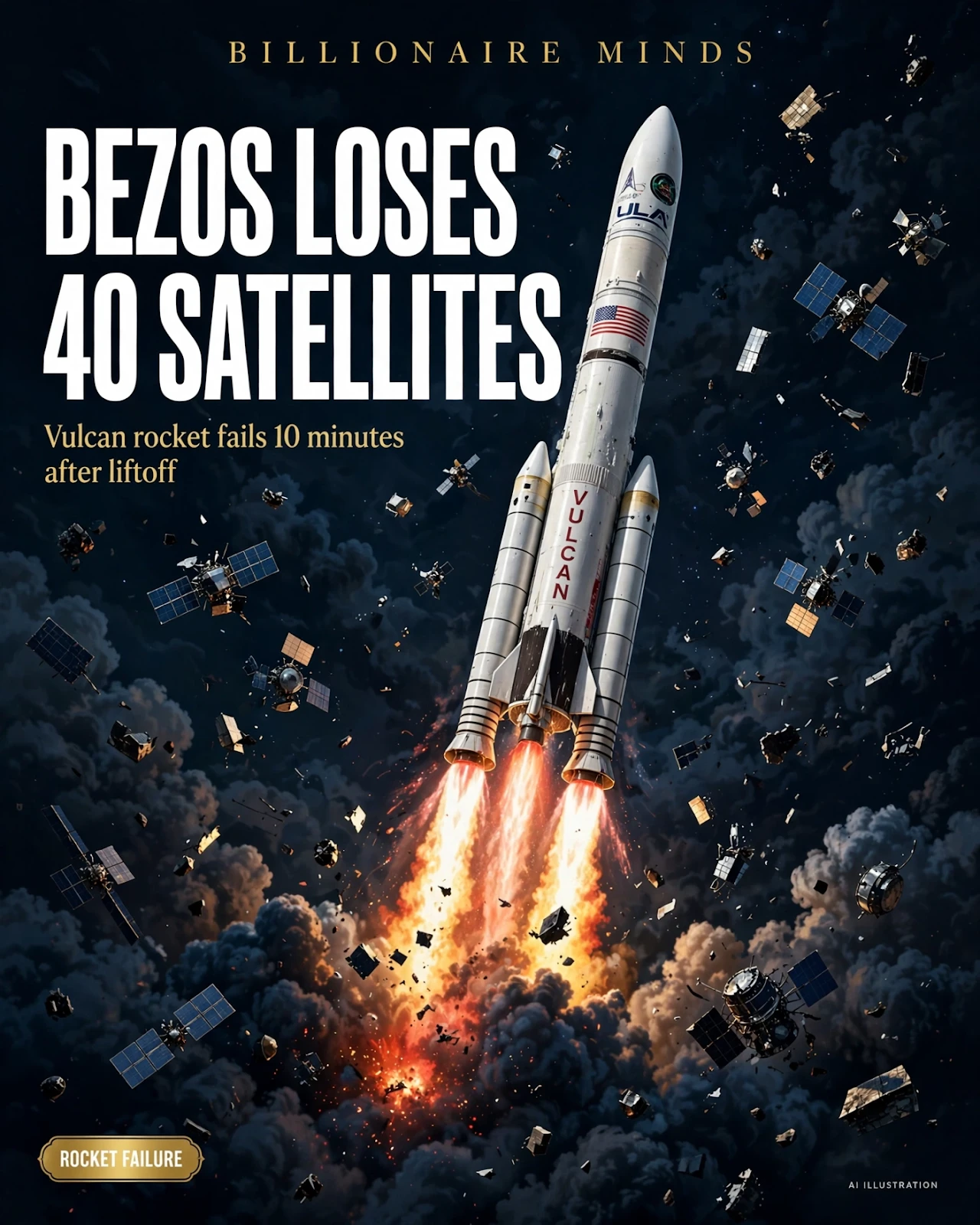
Jeff Bezos Loses 40 Satellites as Amazon's Vulcan Rocket Fails 10 Minutes After Liftoff

AI illustration of Amazon's Vulcan rocket failing after liftoff, with 40 Leo satellites scattered — Jeff Bezos loses 40 satellites in rocket failure

Jeff Bezos just watched 40 of his satellites burn up in the sky. A Vulcan rocket carrying Amazon's Leo internet satellites failed roughly 10 minutes after liftoff from Florida on Sunday, destroying its entire payload in the launch company's first-ever mission failure.

It is a brutal setback for the Amazon founder's long-running bid to build a satellite internet network to rival Elon Musk's Starlink — and the rocket that failed runs on engines built by Bezos's own space company.

Ten Minutes In, the Mission Was Over

The Vulcan rocket, owned by United Launch Alliance — the Boeing and Lockheed Martin joint venture — lifted off from Space Launch Complex 41 at Cape Canaveral Space Force Station carrying 40 satellites for Amazon's Leo network. About 10 minutes into the flight, it suffered an anomaly and failed to deliver the mission to orbit.

"Based on data received by our Launch Director, we confirm that the Vulcan vehicle launched from Space Launch Complex 41 suffered an anomaly 10 minutes into the flight and failed to deliver the Amazon mission to orbit," ULA said in a statement. "Every flight generates data, and every flight teaches us something. Since the anomaly just occurred, we don't have any specific data yet to understand what occurred today."

The failure is expected to trigger a lengthy technical investigation that would keep the rocket grounded for months. It was Vulcan's fifth flight since its 2024 debut and its first in nine months, after a launch hiatus drawn out by separate technical investigations into its solid rocket boosters and its core BE-4 engines.

Bezos's Own Engines Are Under the Microscope

The BE-4 engines that power Vulcan's first stage are supplied by Blue Origin, the space company founded by Bezos. It is not yet clear whether the engines played a role in Sunday's failure — the anomaly appeared to occur after the second stage, carrying the Amazon satellites, separated from the first-stage booster powered by the BE-4 engines. Blue Origin is working with ULA on the investigation, according to a person familiar with the matter.

The engines already carry baggage: Blue Origin's New Glenn rocket suffered a launchpad explosion in May, and its investigation determined the engine was the cause. That led the company to modify the engines delivered to ULA for Vulcan, ULA spokesperson Jessica Rye told Reuters in August.

Amazon struck a measured tone. "There is risk with any launch, and that's especially true for inaugural missions like LV-01," the company said in a statement. "ULA has been a trusted partner for Amazon, and we believe they'll learn from this mission and deliver on their long-term plans for Vulcan."

The Race Against Starlink Just Got Harder

The failure is another blow to Amazon's slow climb into orbit. Since 2025, only 398 Leo satellites have been deployed across 14 launches — about 12% of the 3,236 satellites Amazon needs for global service coverage. The company had hoped to start initial internet service this year.

Meanwhile, Musk's Starlink already has more than 11,000 satellites in orbit and millions of customers worldwide. SpaceX's wide lead comes in part from having its own rocket to launch its satellites, while rivals like Amazon spend billions on external launches — and now, on launches that fail.

ULA, formed in 2006 from the merger of Boeing's Delta and Lockheed Martin's Atlas rocket programs, had held a 100% mission success record ever since. Sunday ended that run — and with Falcon 9, the world's most active rocket, nearing retirement and no longer accepting bookings, the failure could deepen a US launch bottleneck just as Amazon needs launches most.

Source: Indian Express (November 16, 2026), reporting Reuters. This is a fan/commentary summary of reported news; all figures are the sources' estimates. Image: AI illustration.

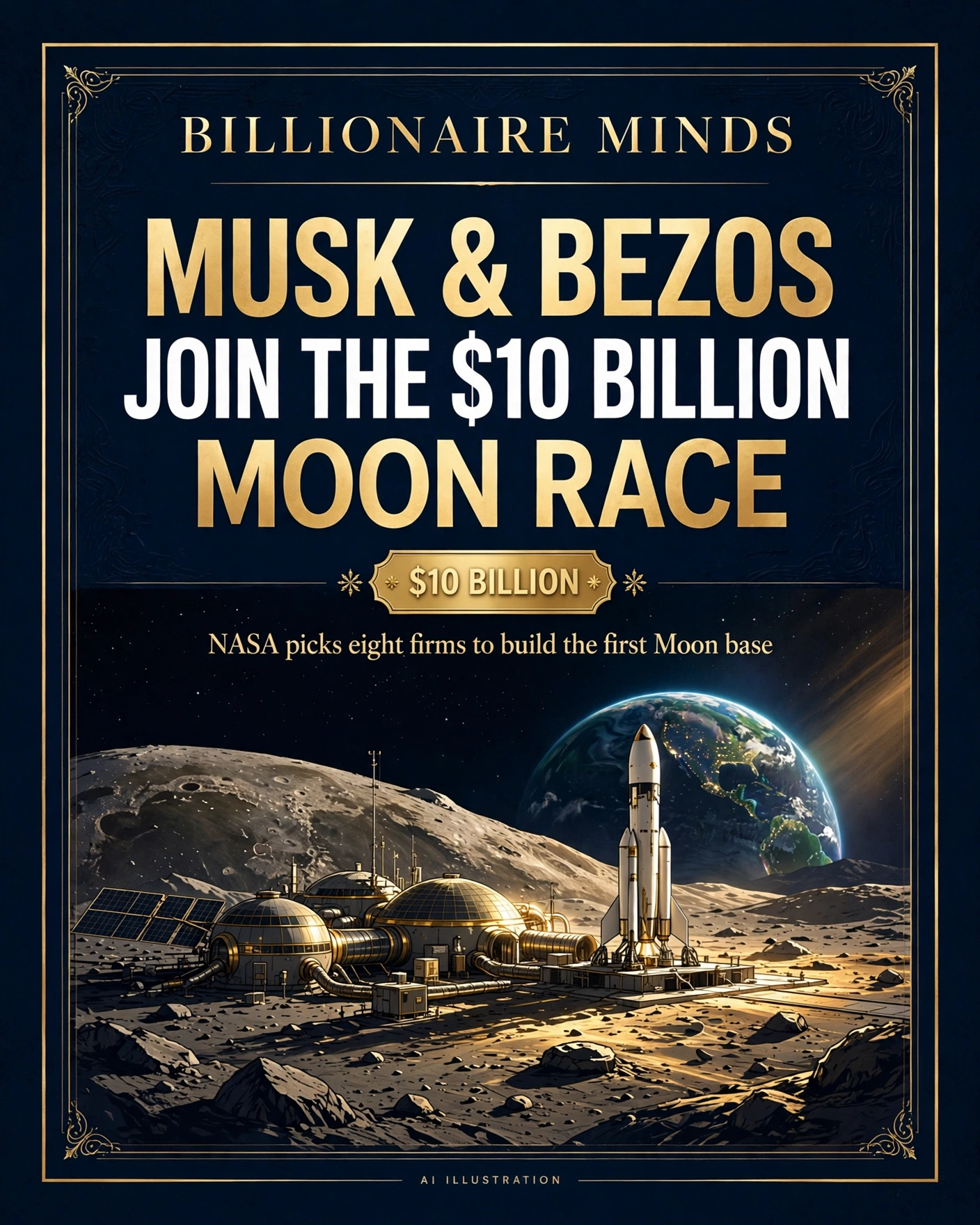
Musk and Bezos Just Won a Shot at NASA's $10 Billion Moon Base — the Lunar Gold Rush Is On

Stylized illustration of a lunar base on the Moon's surface with a rocket and Earth in the sky — NASA's $10 billion Moon base program

NASA has just turned the Moon into the biggest prize in the billionaire space race. On Saturday, November 7, the agency announced it has selected eight companies — including Elon Musk's SpaceX and Jeff Bezos's Blue Origin — to compete for lunar delivery contracts worth up to $10 billion over the next decade, laying the groundwork for a permanent base near the Moon's South Pole.

The $10 Billion Contract — and What It Really Means

The headline figure is a ceiling, not a cheque. Under the new Commercial Lunar Payload Services 2 (CLPS 2) framework, the eight firms are eligible to compete for future delivery task orders over a 10-year term, with a combined maximum value of $10 billion. Each company is guaranteed just $25,000 under its base contract — the real money flows only when NASA awards a specific delivery mission. The pool can grow to $15 billion if NASA exercises a five-year extension. Alongside SpaceX and Blue Origin, the winners are Firefly Aerospace, Intuitive Machines, ispace US, Lockheed Martin Space, Northrop Grumman Space Systems and Voyager Technologies. NASA also raised the ceiling on its existing CLPS contract from $2.6 billion to $4.2 billion.

Blue Origin's $94 Million Rover — and SpaceX's Starship Job

Blue Origin walked away with the day's only concrete payday: a $94 million base contract, with a further $140 million available on performance, to deliver NASA's nuclear-powered PROMISE rover to the lunar South Pole aboard its Mark 1 lander, targeting a late-2028 launch for an 18-month mission hunting for water ice. SpaceX, meanwhile, was selected to fly communications satellites aboard its Starship rocket into the region between Earth and the Moon in 2028. NASA also issued six transport task orders worth about $1.3 billion combined to Arrow Science and Technology, Blue Origin and Impulse Space.

Musk vs. Bezos — Now on the Moon

The announcement, made at the MAX POWER aerospace expo at Kennedy Space Center in Florida, puts the two richest space rivals on the same starting line — and the timing could not be sharper. Musk has spent recent weeks talking up a self-growing city on the Moon, while Bezos answered with a tortoise: a quiet nod to Blue Origin's "step by step, ferociously" motto. NASA Administrator Jared Isaacman captured the stakes in a statement: "When our astronauts return to the Moon, they will arrive with the first elements of the Moon Base already waiting for them on the surface." For Musk and Bezos, the race to build that base is now officially a $10 billion contest — and only one of them can win the biggest orders.

Source: The New York Ledger (Nov 8, 2026), reporting NASA Release 26-095; Public Rot contract analysis. AI illustration: stylized artwork, not a photograph.