Posts

Showing posts with the label NASA

Elon Musk's SpaceX Targets Friday the 13th for the First-Ever Double Rocket Catch

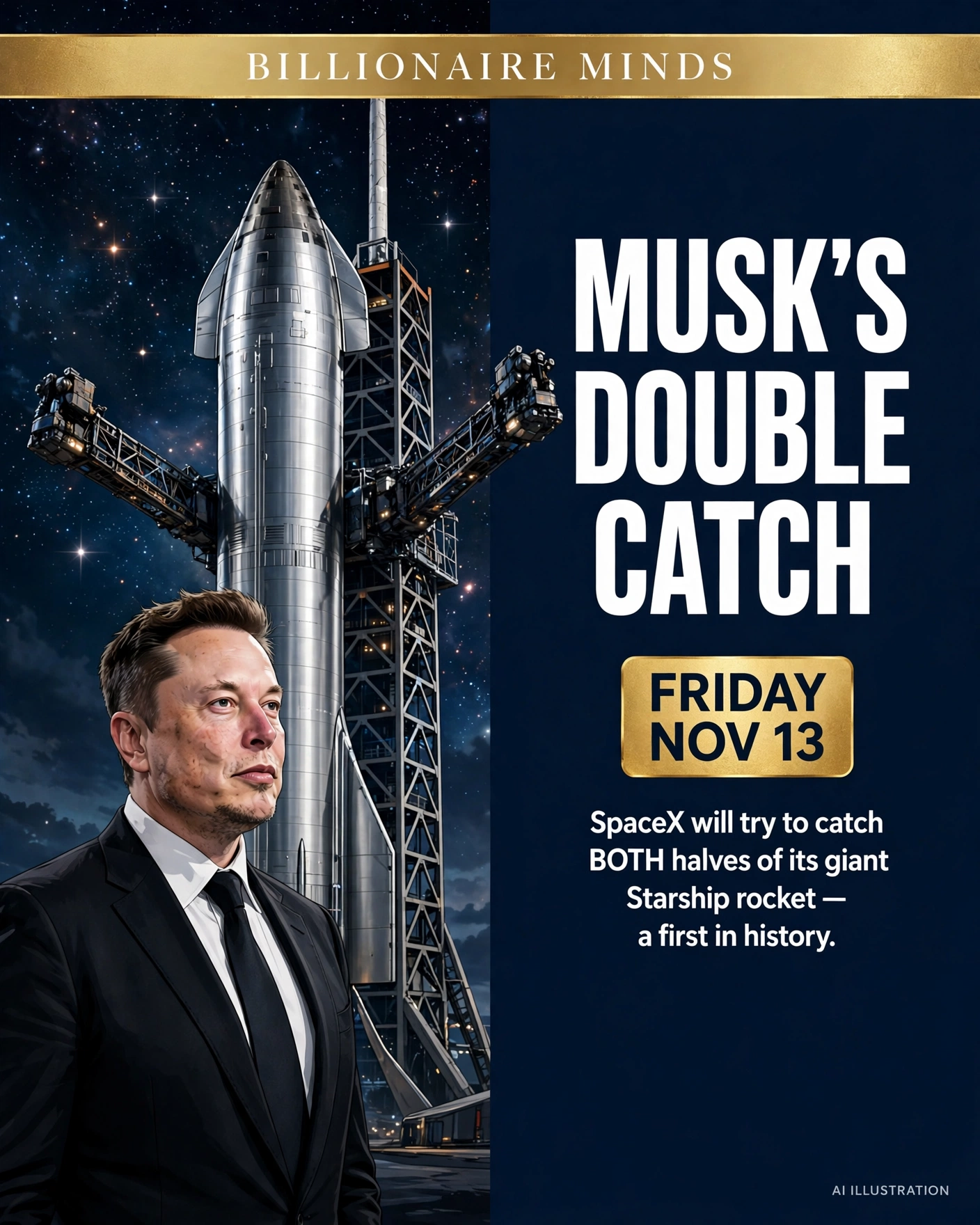
Stylized illustration of Elon Musk with SpaceX's giant Starship rocket and launch tower against a starry sky — SpaceX will try to catch both halves of the rocket on Friday, November 13

Elon Musk's SpaceX is one week away from the most audacious test flight in its history. On Friday, November 13, the company will attempt something no one has ever done: catch both halves of an orbital rocket and bring them home in one piece. "SpaceX will attempt to catch both the Super Heavy booster and Starship on the upcoming flight," Musk wrote on X on November 6. "If both are successful, it will mark the first time that all parts of an orbital rocket return to Earth intact. This is the critical breakthrough needed to make life multiplanetary."

Two catches, one flight

Flight 15 will fly Booster 22 and Ship 42 — both Block 3 vehicles — from Orbital Launch Pad 2 at Starbase, Texas, in a 75-minute window opening at 4:45 p.m. Central Time, pending final regulatory approval. After hot staging and separation, the Super Heavy booster is planned to return for a tower catch roughly six minutes and 35 seconds after liftoff. The Ship has the harder job: it will climb to a roughly 275-kilometre orbit, deploy 26 advanced Starlink V3 satellites, circle Earth about 14 times over more than 22 hours, then attempt a deorbit burn, a belly-flop reentry, a flip and a landing burn into the launch tower's chopstick arms at about T-plus 22 hours and 32 minutes. SpaceX has caught boosters three times before, on Flights 5, 7 and 8. The Ship has never been caught.

Why it matters — and what it is worth

Full recovery is the economics of Musk's space empire. A rocket that can be caught, inspected, refurbished and reflown quickly slashes the cost of every launch — and the high launch cadence it enables is what Starlink, lunar missions and eventually Mars settlement all depend on. Musk told investors at last week's Baron conference that SpaceX aims to pass a $100 billion annualized revenue run rate in December, and the Starlink satellites riding on Flight 15 are the revenue engine behind that number. Musk put the odds of pulling off the first double catch at "more likely than not" — and if the Ship's health checks fail, it will splash down in the Pacific instead, with the booster falling back to the Gulf of Mexico. Either way, a steady stream of further flights is already scheduled. Friday the 13th, it turns out, could be the luckiest day in rocket history.

Source: Teslarati, November 8, 2026 (Musk X post November 6; SpaceX VP of Launch Kiko Dontchev at the UP.Summit, November 5); Business Today, November 7, 2026. This is a fan/commentary summary of reported news; all figures are the sources' estimates. Portrait: AI illustration.

Musk and Bezos Just Won a Shot at NASA's $10 Billion Moon Base — the Lunar Gold Rush Is On

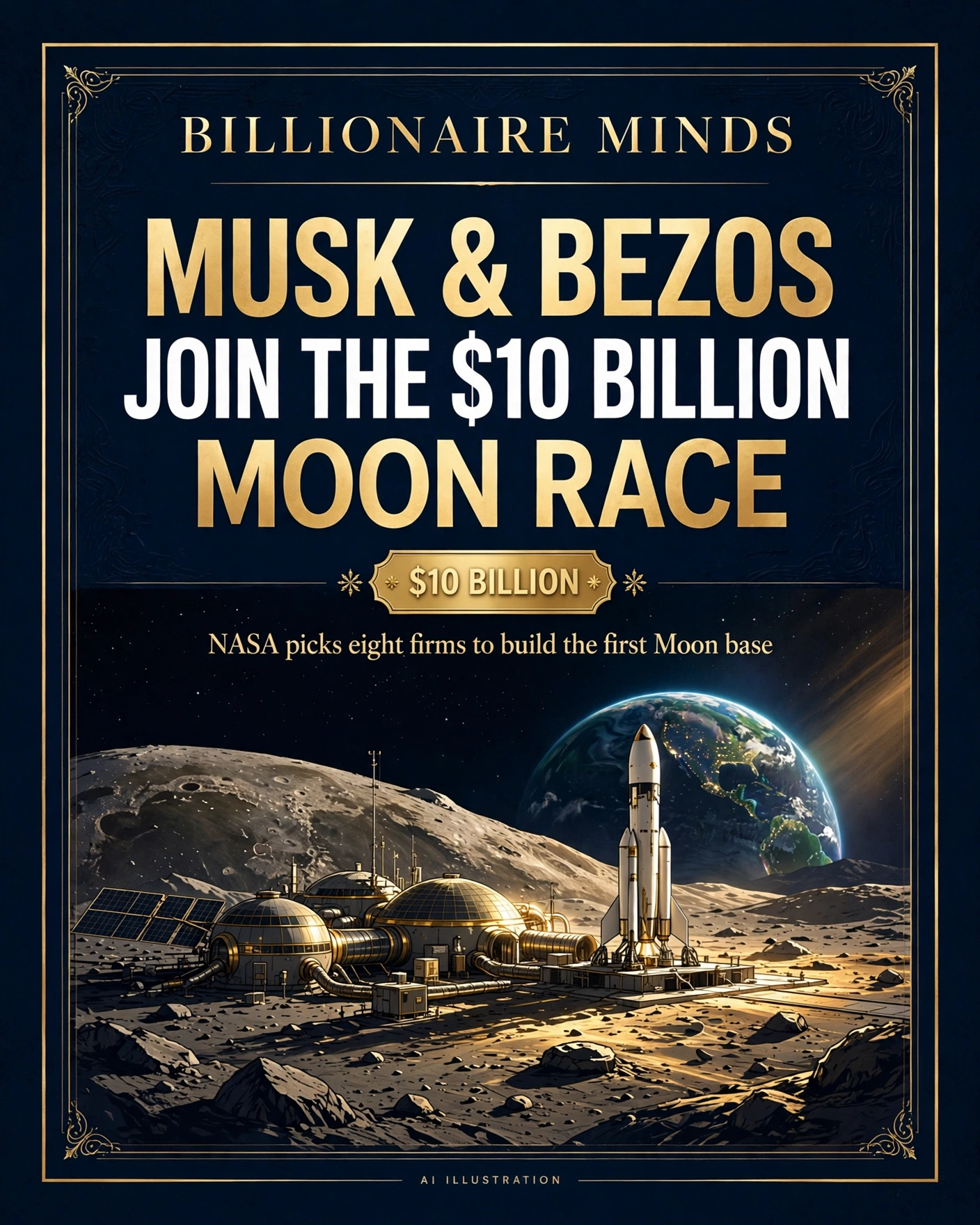
Stylized illustration of a lunar base on the Moon's surface with a rocket and Earth in the sky — NASA's $10 billion Moon base program

NASA has just turned the Moon into the biggest prize in the billionaire space race. On Saturday, November 7, the agency announced it has selected eight companies — including Elon Musk's SpaceX and Jeff Bezos's Blue Origin — to compete for lunar delivery contracts worth up to $10 billion over the next decade, laying the groundwork for a permanent base near the Moon's South Pole.

The $10 Billion Contract — and What It Really Means

The headline figure is a ceiling, not a cheque. Under the new Commercial Lunar Payload Services 2 (CLPS 2) framework, the eight firms are eligible to compete for future delivery task orders over a 10-year term, with a combined maximum value of $10 billion. Each company is guaranteed just $25,000 under its base contract — the real money flows only when NASA awards a specific delivery mission. The pool can grow to $15 billion if NASA exercises a five-year extension. Alongside SpaceX and Blue Origin, the winners are Firefly Aerospace, Intuitive Machines, ispace US, Lockheed Martin Space, Northrop Grumman Space Systems and Voyager Technologies. NASA also raised the ceiling on its existing CLPS contract from $2.6 billion to $4.2 billion.

Blue Origin's $94 Million Rover — and SpaceX's Starship Job

Blue Origin walked away with the day's only concrete payday: a $94 million base contract, with a further $140 million available on performance, to deliver NASA's nuclear-powered PROMISE rover to the lunar South Pole aboard its Mark 1 lander, targeting a late-2028 launch for an 18-month mission hunting for water ice. SpaceX, meanwhile, was selected to fly communications satellites aboard its Starship rocket into the region between Earth and the Moon in 2028. NASA also issued six transport task orders worth about $1.3 billion combined to Arrow Science and Technology, Blue Origin and Impulse Space.

Musk vs. Bezos — Now on the Moon

The announcement, made at the MAX POWER aerospace expo at Kennedy Space Center in Florida, puts the two richest space rivals on the same starting line — and the timing could not be sharper. Musk has spent recent weeks talking up a self-growing city on the Moon, while Bezos answered with a tortoise: a quiet nod to Blue Origin's "step by step, ferociously" motto. NASA Administrator Jared Isaacman captured the stakes in a statement: "When our astronauts return to the Moon, they will arrive with the first elements of the Moon Base already waiting for them on the surface." For Musk and Bezos, the race to build that base is now officially a $10 billion contest — and only one of them can win the biggest orders.

Source: The New York Ledger (Nov 8, 2026), reporting NASA Release 26-095; Public Rot contract analysis. AI illustration: stylized artwork, not a photograph.

Musk Says SpaceX Will Out-Earn NASA's Entire Budget This Quarter — $24.8 Billion in 3 Months

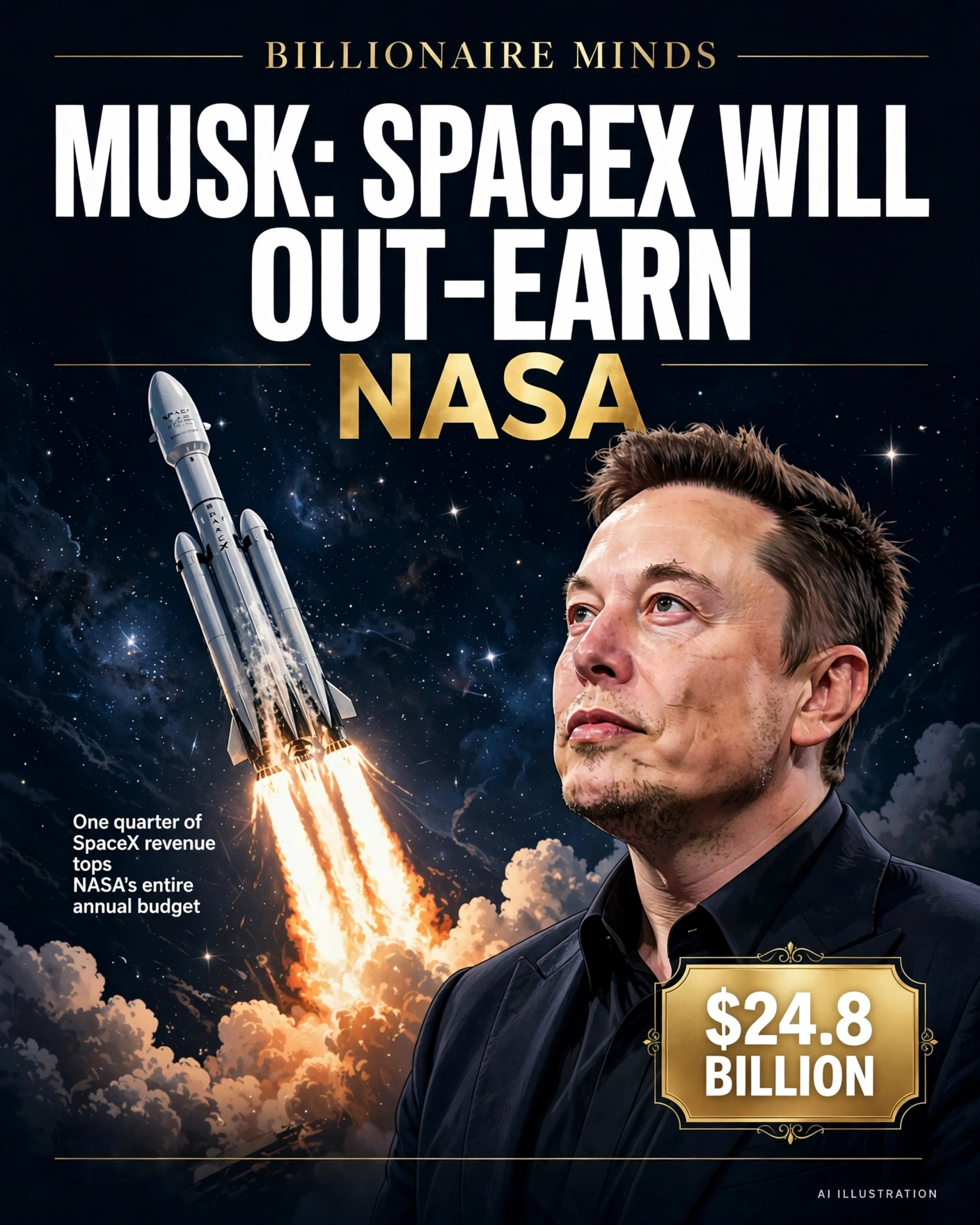
Elon Musk looking up at a SpaceX rocket launching into a starry sky — he says SpaceX will earn $24.8 billion this quarter, more than NASA's entire annual budget

Image: AI illustration.

Elon Musk just put a number on SpaceX's transformation — and it is bigger than NASA's entire year. Speaking virtually at the 33rd Annual Baron Investment Conference in New York on Friday, Musk said SpaceX's fourth-quarter revenue should rise roughly 70 percent from the third quarter, putting sales near $24.8 billion. Then he drove the point home on X: "SpaceX revenue this quarter alone will be substantially higher than NASA's entire annual budget!" NASA received $24.4 billion in regular fiscal 2026 appropriations, according to a Congressional Budget Office assessment — so on that measure, one quarter of SpaceX now tops a full year of NASA.

The AI business is now bigger than the rockets

The forecast builds on a third quarter in which SpaceX reported $14.58 billion in revenue, up 161 percent from a year earlier. The surprise is what is driving it: the company's Super Intelligence unit, which leases AI computing capacity to other developers, generated $7.56 billion — more than half of total revenue and the company's largest segment for the first time. Connectivity, home to Starlink, brought in $5.25 billion, and space operations $1.77 billion. Anthropic has replaced NASA as SpaceX's single largest customer, accounting for about 34.5 percent of third-quarter revenue. Musk also gave a first launch date for StarMind, SpaceX's planned space-based AI computing network: 2027.

Washington is becoming a footnote

Musk used the moment to answer the midterm-election question hanging over his companies. Government contracts made up 16.6 percent of SpaceX revenue last quarter, he said, and will fall below 10 percent this quarter — and under 5 percent within a year. "Happy to cancel any that the government doesn't want. Just say the word!" he posted on X. The pitch landed with investors: SpaceX shares finished Friday up 8.6 percent at $134.27, rebounding from a two-day slide that had wiped more than $420 billion off the combined market value of Tesla and SpaceX after Democrats swept Congress. Musk repeated his goal of reaching a $100 billion annualized revenue rate by December — and said it could exceed $500 billion by December 2027 — while cautioning investors: "This is not a promise. This is what I think will happen. This is my best guess." The rocket company that once survived on NASA contracts is now telling the world it can out-earn the agency in a single quarter.

Source: Benzinga via MarketSpeaker; TipRanks; Gizmodo; The Currency Analytics, November 6–7, 2026. This is a fan/commentary summary of reported news; all figures are the sources' estimates.