Posts

Showing posts with the label Mark Zuckerberg

Sergey Brin Compares California to Soviet Russia — and He's Spent $57 Million Fighting the Billionaire Tax

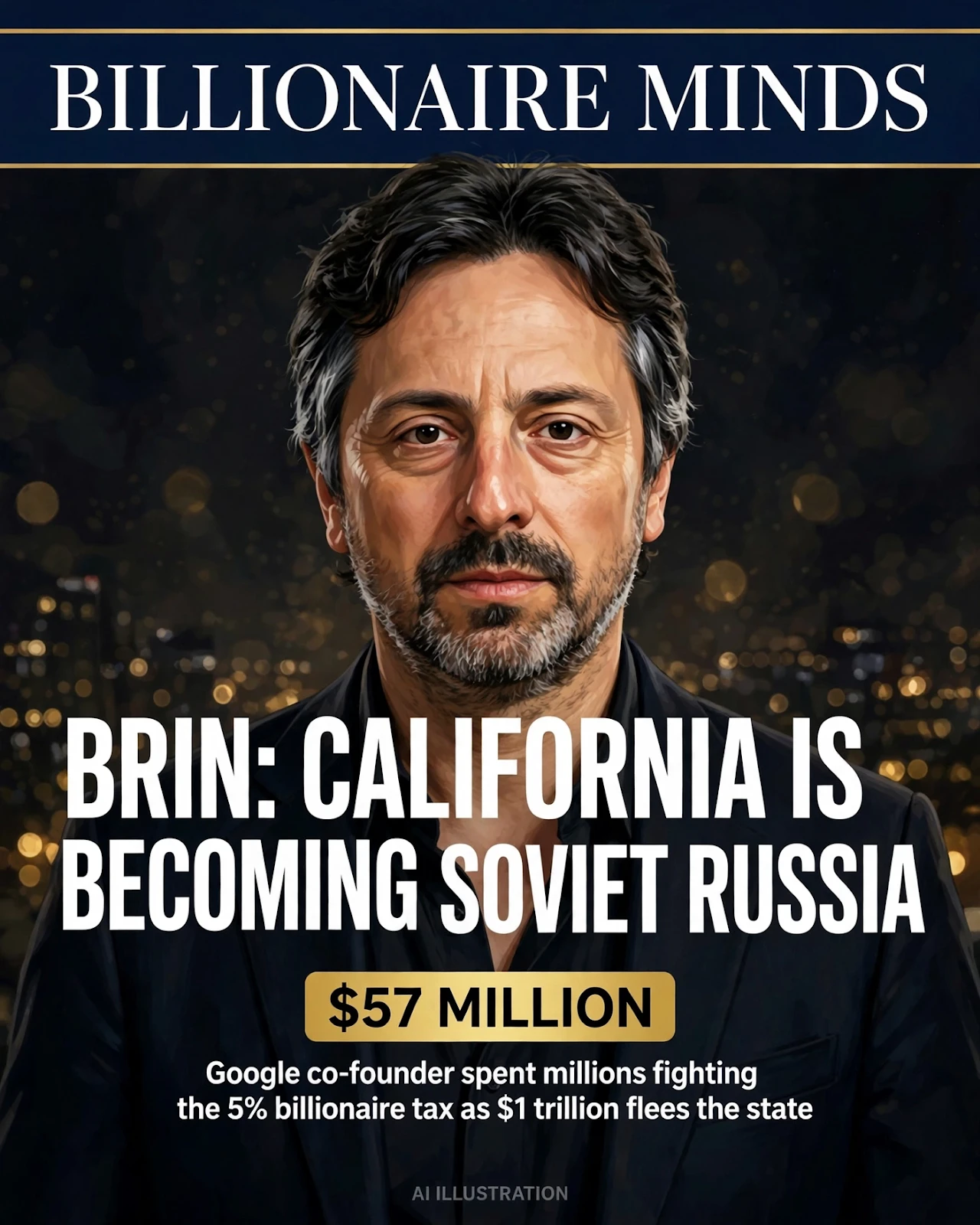
Sergey Brin — the Google co-founder compares California's proposed billionaire tax to Soviet Russia

Google co-founder Sergey Brin has broken his silence on California's proposed billionaire tax — and his comparison is striking. The man who fled the Soviet Union as a six-year-old says the Golden State is heading down the same road, and he has already spent $57 million trying to stop it.

In a rare statement to the New York Times, Brin said: "I fled socialism with my family in 1979 and know the devastating, oppressive society it created in the Soviet Union. I don't want California to end up in the same place."

The 5% Tax That Sparked a Billionaire Exodus

The proposal is a one-time, 5% tax on the wealth of California residents with assets worth at least $1.1 billion. The union behind it says it has collected nearly 1.6 million signatures — almost twice the 875,000 needed — and has submitted them to election officials to get the measure on the November ballot.

Supporters say the money is needed to compensate for federal healthcare funding cuts, with about 90% earmarked for public health services. But opponents — including Democratic Governor Gavin Newsom — warn that driving billionaires out of the state will do more harm than good for California's economy and budget.

$1 Trillion Has Already Left

The exodus is already underway. Billionaires worth a combined $1 trillion have fled California as the wealth tax inches closer to the ballot. Google co-founder Larry Page, worth $281.9 billion, has moved or axed more than 45 California companies and bought a mansion in Miami. Brin himself, worth $260.1 billion, has terminated or moved 15 California companies and snapped up property in Florida and Nevada. Meta CEO Mark Zuckerberg, worth $231.4 billion, is also leaving.

PayPal co-founder Peter Thiel was among the first to go — and has donated $3 million to the fight against the tax. Oracle founder Larry Ellison, worth $217.9 billion, sold his Pacific Heights mansion on Billionaire's Row for $45 million. Car loan magnate Don Hankey called the tax "ridiculous" before leaving, former Uber CEO Travis Kalanick confirmed his move, and DoorDash co-founder Andy Fang called the proposal "stupid."

Not Every Billionaire Agrees

Some of California's richest residents are openly critical but staying put. Mercor co-founder Brendan Foody called parts of the proposal "insane" but says he must stay because his employees and customers are in San Francisco. LinkedIn co-founder Reid Hoffman called it "badly designed" and "horrendous" for innovation, while Anthropic co-founder Dario Amodei described it as "poorly designed" and Vinod Khosla called it "very dumb" — but none of them has announced plans to leave.

And one prominent voice breaks ranks entirely: Nvidia CEO Jensen Huang, the seventh-richest person in the world at $180 billion, has said he is "perfectly fine" with the proposed tax.

For Brin, though, the fight is personal. He arrived in America as a refugee from Soviet socialism — and he is spending a fortune to make sure California never becomes the place his family escaped.

Source: Forbes (Nov 18, 2026), reporting the New York Times. Portrait image is an AI illustration.

After Huang's Shock Exit, Investors Ask the $1 Trillion Question: Who Replaces Musk and Zuckerberg?

Stylized illustration of two tech founders back to back under a neon question mark — who replaces Elon Musk and Mark Zuckerberg after Jensen Huang's Nvidia exit

Jensen Huang's shock departure from Nvidia has done more than wipe billions off the chipmaker's value. It has forced investors to ask a question Silicon Valley's most powerful companies have spent years avoiding: what happens if Elon Musk or Mark Zuckerberg suddenly aren't there?

Huang built Nvidia into the world's most valuable company and then walked away after an investigation into his relationships with employees and a suspected Chinese intelligence asset. His exit has put a spotlight on a problem facing every founder-led giant — succession planning.

The question nobody at Tesla or Meta wants to answer

Tesla, SpaceX and Meta remain heavily dependent on their founders, and their own financial disclosures admit it. SpaceX warned investors in its filing ahead of its public listing that losing Musk — through death, disability or another circumstance — could disrupt its management structure and affect its ability to execute its business strategy. The company cautioned that finding a replacement with Musk's combination of skills and experience could be a lengthy and uncertain process, with no assurance it could find a suitable successor in time, or at all.

Ross Gerber, an investor in SpaceX who has previously raised concerns about Tesla's succession planning, believes the Nvidia episode could be particularly unsettling for Musk. "This Jensen thing is probably the biggest fear that Elon has," Gerber told The Washington Post.

Musk's $1 trillion pay deal has a succession clause

There is another twist. Tesla's massive compensation package for Musk — potentially worth $1 trillion and designed to keep him involved through the middle of the next decade — requires him to develop a succession planning framework to qualify for its final two award tranches. But a requirement to plan is not the same as having a ready replacement, and Tesla has not publicly demonstrated a clear succession framework.

Zuckerberg holds the votes — and no public plan

Meta faces the same problem. Its filings warn that Zuckerberg becoming unavailable could have a materially adverse impact on operations, and he holds a majority of the company's voting power — giving him decisive influence over shareholder decisions, including the appointment of directors. Yet Meta's filings do not disclose a succession plan for the chief executive position.

The other side: Apple proved founders can be replaced

A founder's departure does not automatically mean collapse. Apple continued to expand after Steve Jobs died in 2011, with Tim Cook leading it through a period of substantial growth, and Microsoft, Amazon and Alphabet have all moved beyond their founders as chief executives. As Dipal Dutta, CEO at RedoQ, told NDTV: "Technology companies are often driven by the vision of their founders. For long-term success, this inspiration must be sustainable."

The stakes are enormous. Tesla, Meta and Nvidia collectively employ at least 200,000 people and account for almost 10 per cent of the S&P 500's market value, while SpaceX is valued at nearly $1.9 trillion. For investors, the question is no longer hypothetical — it is the $1 trillion question.

Source: NDTV, reporting The Washington Post. Image: AI illustration.

Italy Fines Zuckerberg's Meta $887 Million for Reading Your Photos — Weeks After a $25 Billion US Judgment

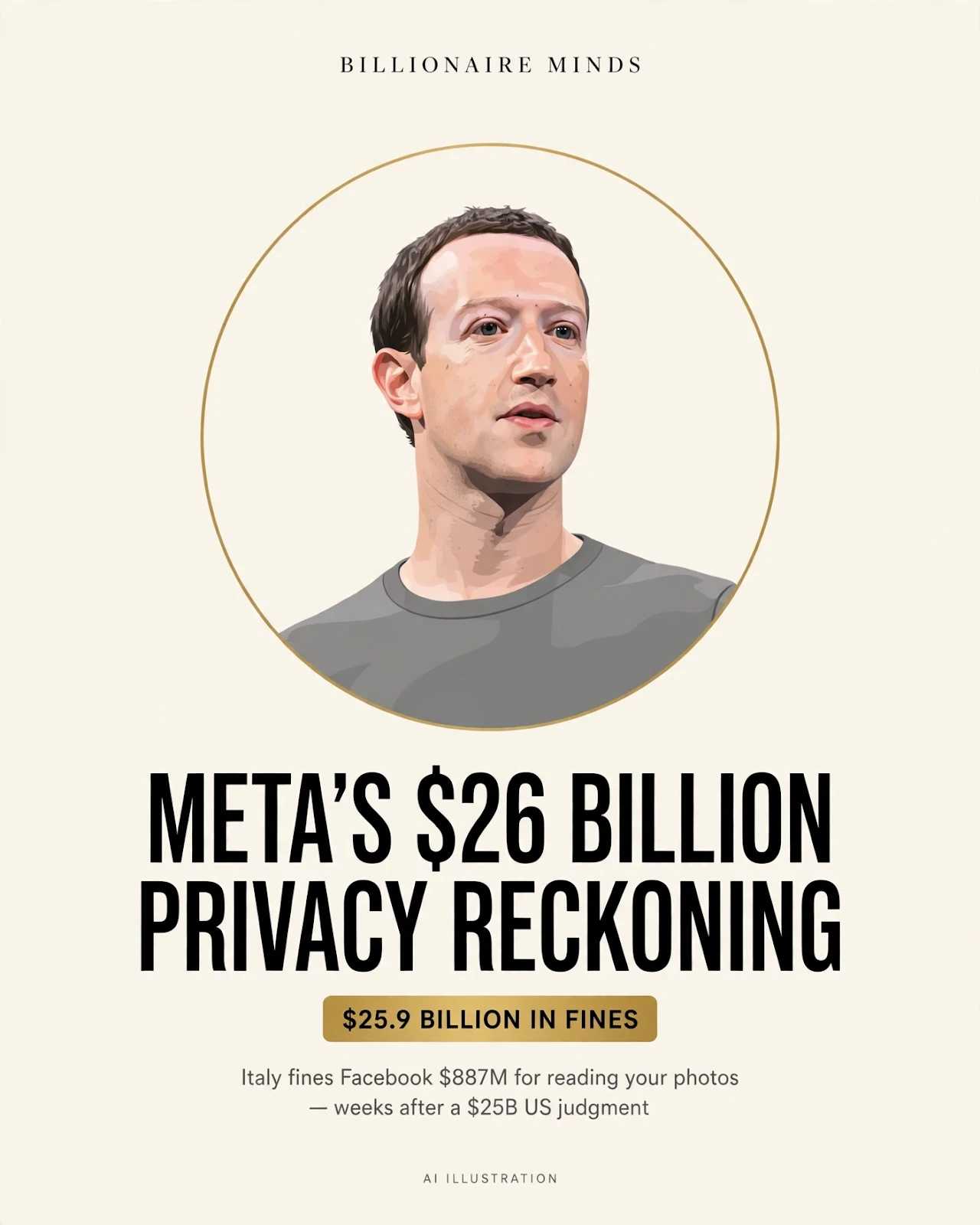
Mark Zuckerberg — Meta fined $887 million in Italy for reading users' photos, weeks after a $25 billion US judgment

Mark Zuckerberg's Meta just got handed a bill that keeps growing. Italy has fined the Facebook parent €805 million — about $887 million — for reading users' phone photos without asking. It comes weeks after a US judge ordered Meta to pay $25 billion in New Mexico. Together, that is roughly $25.9 billion in privacy penalties.

Italy: Facebook read 20 million photo galleries

Italy's data protection authority, the Garante, said the Facebook app on Android phones read photos, videos and their metadata from about 20 million Italian users — without their specific consent — to power a feature that suggests gallery photos as post ideas. The feature has run since 2023. The regulator said a single app-wide permission, a vague notice and a default-on setting did not add up to valid consent, and cited Meta's "lack of co-operation". Meta has 60 days to switch the feature off by default and ask users for separate, specific consent. The fine is about 0.47% of Meta's worldwide turnover and among the largest an Italian authority has ever imposed on a tech company. Meta calls the fine disproportionate and says it will appeal.

New Mexico: a $25 billion judgment

The Italian fine is the smaller half of the bill. In October, a New Mexico judge ordered Meta to pay $25 billion in civil penalties after a jury found the company made 26 misleading statements about how it handles Facebook user data. The case traces back to Cambridge Analytica, which harvested data from as many as 87 million Facebook users. Jurors counted nearly 43.9 million violations of the state's consumer-protection law — a maximum exposure of almost $219.5 billion — before the judge set the total at $25 billion, plus 15% annual interest until it is paid. Meta says it will appeal that ruling too.

What it means for Zuckerberg

For Zuckerberg, worth more than $220 billion, the two rulings are a reminder that Meta's data practices are now priced in billions, not millions. Meta booked a $9.9 billion charge in its September quarter for a separate multi-state settlement, on $64.6 billion of quarterly revenue — so a $25.9 billion privacy bill is real money even for the world's fourth-richest man. The question now is whether the appeals shrink the numbers, or whether regulators keep raising them.

Source: Times of India, November 14, 2026, reporting Italy's Garante and Reuters/NYT on the New Mexico judgment. This is a fan/commentary summary of reported news; all figures are the sources' estimates. The portrait on this post is a stylised AI illustration, not a photograph of Mark Zuckerberg.

Sergey Brin Spent $57 Million Fighting California's Billionaire Tax — and Says the State Is Becoming Soviet Russia

Sergey Brin — Google co-founder who spent $57 million fighting California's proposed billionaire tax, warning the state is becoming Soviet Russia.

Google co-founder Sergey Brin has gone to war with California's proposed billionaire tax — and he is not mincing words. In a rare statement to The New York Times, the $260 billion tech titan compared the Golden State to the country his family fled nearly five decades ago.

"I Fled Socialism"

"I fled socialism with my family in 1979 and know the devastating, oppressive society it created in the Soviet Union. I don't want California to end up in the same place," Brin told the Times. Brin, who was 6 years old when his family left the Soviet Union, has spent $57 million fighting the measure — and he is far from alone.

The $1 Trillion Exodus

The proposed tax — a one-time 5% levy on California residents with assets worth at least $1.1 billion — has already pushed billionaires worth a combined $1 trillion out of the state. Brin's fellow Google co-founder Larry Page, worth $281.9 billion, has moved or dissolved more than 45 California companies and bought a mansion in Miami. Brin himself has terminated or moved 15 companies and snapped up property in Florida and Nevada. Meta chief Mark Zuckerberg, worth $231.4 billion, is also leaving, while Oracle founder Larry Ellison sold his Pacific Heights mansion for $45 million.

The Tax at the Center of the Fight

The union behind the measure said on Tuesday it had collected nearly 1.6 million signatures — almost twice the 875,000 needed to put it on the November ballot — and has submitted them for verification. Supporters say the tax is needed to offset federal healthcare funding cuts, with about 90% of the money going to public health services. But even California Governor Gavin Newsom opposes it, warning that driving billionaires out will do more harm than good for the state's economy and budget.

Even Billionaires Are Split

Not every billionaire agrees with Brin. Nvidia co-founder Jensen Huang has said he is "perfectly fine" with the proposed tax. But the exodus figures tell their own story: Miami luxury home prices have jumped 67% in five years, and Palm Beach prices have soared 90.5% as California's richest residents head east. Whether the tax reaches the ballot or not, the message from the billionaire class is already clear — and it is written in moving trucks.

Source: Forbes, reporting The New York Times. The portrait image on this post is an AI-generated illustration.


Zuckerberg's Secret Robot Max: Meta Quietly Built a Humanoid for Your Home — With China's Help

Mark Zuckerberg beside Meta's humanoid robot Max — AI illustration

Mark Zuckerberg wants artificial intelligence walking around your home — literally. Meta has quietly built a humanoid robot called Max, a five-foot-tall machine designed to see, hear and move through a living room, according to a report by The Information, picked up by Reuters and featured on the BBC's AI Decoded programme on November 8.

Built in three months — with China's help

Max was assembled in about three months in partnership with Fourier, a Chinese robotics company based in Shanghai. The prototype stands about 1.5 metres tall, weighs roughly 48 kilograms, and runs on Nvidia's Jetson Thor chip. Its five-fingered hands can grip small, light objects like bottles and toys, and it is designed to hear a voice from five metres away, spot a wave from three, and hold eye contact — the very human skills a home robot needs.

Research only — for now

Meta has confirmed the collaboration but says the project is research only, with no plans to sell the robots. Max was shown to employees at an internal event in late August, and a second-generation model, Max 2, is already in development — with more dexterous hands, a projector, and extra sensors to handle stairs, the obstacle that stops most legged robots in a real home. Meta is also hiring in Shanghai and Shenzhen, including for large-scale manufacturing.

The timing is no accident. Silicon Valley is now racing to give AI a body, and Zuckerberg — worth more than $200 billion as Meta's chief executive — is betting that the next frontier for artificial intelligence is not on a screen, but standing in your living room.

Source: The Information, October 31, 2026, via Reuters and Interesting Engineering, November 7, 2026; BBC News AI Decoded, November 8, 2026. This is a fan/commentary summary of reported news; all figures are the sources' estimates. Portrait: AI illustration.

Mark Zuckerberg's 10-Year-Old Daughter Is Already Vibe-Coding Apps — But Mom Vetoed Her Dating Site

Mark Zuckerberg's 10-year-old daughter Maxima vibe-coding apps on a laptop — AI illustration

The world's fifth-richest man has a coder in the house — and she's ten years old. Mark Zuckerberg and Priscilla Chan's eldest daughter, Maxima, is already building apps with artificial intelligence, according to a new interview Chan gave to the investment podcast Colossus, reported by The Economic Times on November 8.

The dating site that got a hard no

Maxima has been experimenting with "vibe-coding" — describing what she wants in plain language and letting AI tools write the code. Her parents encourage the building, but Chan has drawn a firm line: nothing Maxima makes can go live on the internet. That rule has already killed one idea.

"She's quite limited, because Mom doesn't let her build things that are open to the internet. Like, she wanted to build a dating site. That was a no," Chan said.

A builder's instinct, inherited

What Maxima has built so far already sounds like a startup founder's first portfolio: a messaging app, apps in the spirit of the early web hub GeoCities, and a game inspired by FarmVille — and, like her father, she thinks in business terms. Each project came with its own marketing and sales plan.

Chan says the drive was never taught. "She just has a desire to build things that is innate, that we didn't teach her. It just came. She's delighted by the idea of bringing something into the world," she said.

The youngest Zuckerbergs are already building

The interest is no accident of the household. Zuckerberg has previously talked about introducing his daughters to coding through Scratch, robotics and 3D printing, and the family has experimented with Replit, Kano, Raspberry Pi and Nvidia Jetson devices. Maxima's younger sister August has used Meta AI to illustrate and trailer a book she wrote, The Mermaid Crystal.

Zuckerberg, worth more than $200 billion as Meta's chief executive, built his own empire from a dorm-room project. If Maxima keeps building at this pace — dating sites excepted — the family's next founder may already be at the keyboard.

Source: The Economic Times, November 8, 2026, reporting Priscilla Chan's interview with Colossus. This is a fan/commentary summary of reported news; all figures are the sources' estimates. Portrait: AI illustration.

Mark Zuckerberg Passes Michael Dell on the Billionaire Rankings With $212.4 Billion Fortune

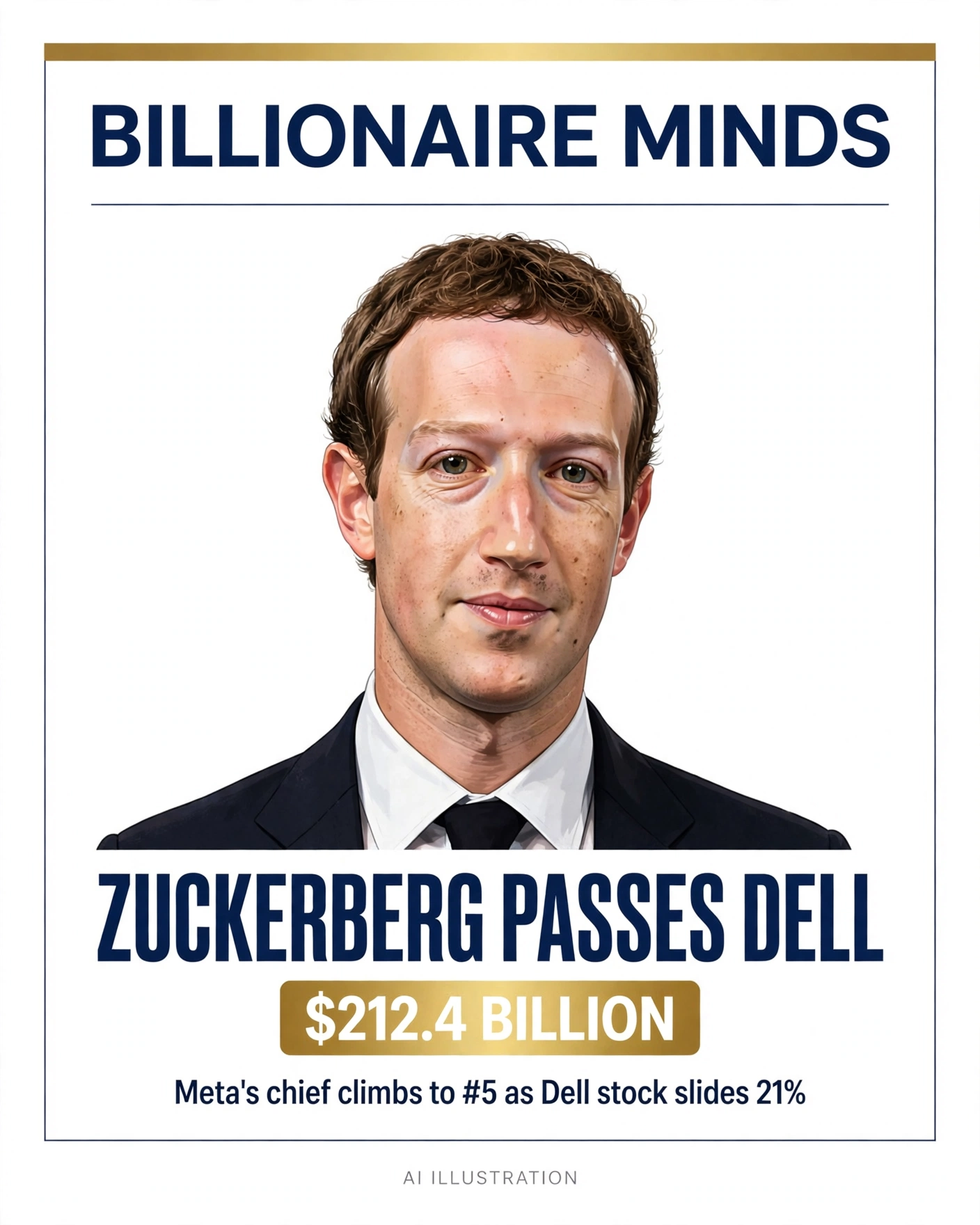
Mark Zuckerberg — now the world's fifth-richest person at $212.4 billion after passing Michael Dell on Forbes' real-time billionaire list

Mark Zuckerberg has just leapfrogged Michael Dell on Forbes' real-time billionaire list. The Meta founder and CEO now sits fifth with an estimated $212.4 billion fortune — ahead of Dell, at $199.6 billion.

The shake-up follows the Democrats' midterm sweep on Tuesday, which flipped Congress and rattled the market's bets on the AI boom.

A $20 Billion Swing in Four Days

Dell was the world's fourth-richest person as recently as early Tuesday morning, worth an estimated $218.5 billion. Since then he has lost nearly $20 billion and slid two spots down the ranking. Google co-founder Sergey Brin has also passed him and now sits fourth at $220.4 billion.

Over the last five days, Meta shares are up 1.14 percent and Google shares are up 1.67 percent — while Dell Technologies stock has plunged more than 21 percent.

Why Dell Fell While Meta Rose

Investors fear the new Democratic majority will move aggressively to regulate data-center construction and the AI sector. That is bad news for Dell, an AI-centric hardware company whose fortunes ride on the data-center buildout.

Meta and Google look more diversified by comparison — Google even announced a $17 billion data center in Wyoming, a sign investors are less nervous about its AI future.

The New Top Five

Zuckerberg's climb past Dell is the clearest sign yet that the post-midterm market is picking winners and losers. For Dell, the question is whether the sell-off is a midterm overreaction — or the start of a longer repricing of the AI hardware trade.

Source: Inc.com, reporting Forbes' real-time billionaire list. Portrait: AI illustration.