Posts

Showing posts with the label Starlink

Ambani and Mittal Just Declared War on Musk's Starlink — a 1,600-Satellite Rival

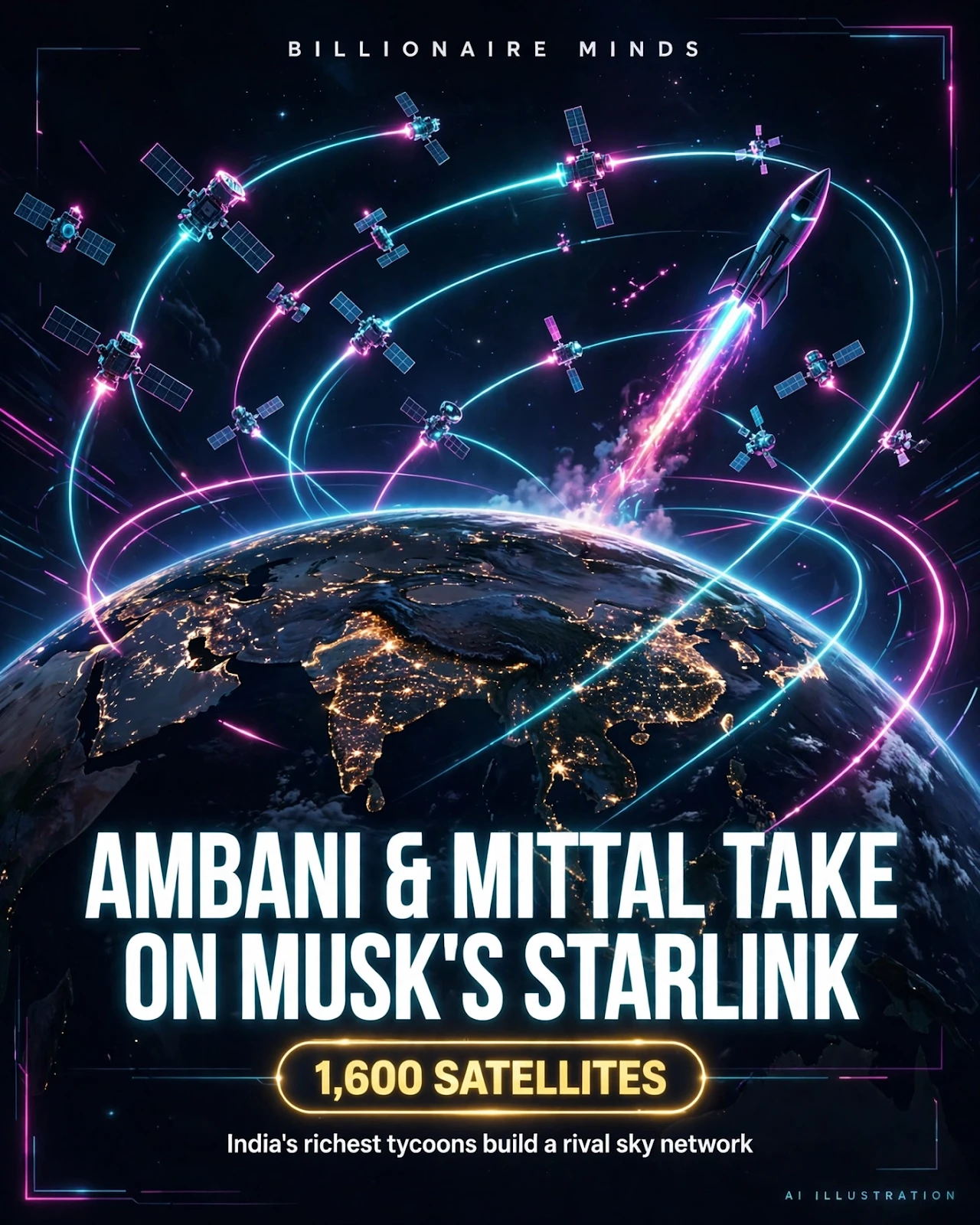
Stylized illustration of satellites orbiting Earth — Ambani and Mittal take on Musk's Starlink with a 1,600-satellite rival network

Two of India's richest men are taking the fight to Elon Musk — in orbit. Mukesh Ambani's Reliance Industries is planning a 1,600-satellite low Earth orbit constellation to rival Starlink, while telecom tycoon Sunil Mittal is backing Eutelsat's OneWeb as the independent alternative. The billionaire space race just got a lot more crowded.

Ambani's 1,600-Satellite Plan

Reliance is in talks with Indian satellite manufacturers, technology startups and larger industrial groups, offering to fund the infrastructure needed to scale up production. India currently produces fewer than 15 satellites a year — the constellation would need output of around 200 a year. The plan combines domestic manufacturing with imports, including at least 400 satellites from the US. Reliance is discussing procurement with two US companies and evaluating suppliers in Europe, while ruling out China as a source. A test mission is targeted for September 2027, with wider deployment from early 2028; completion has slipped from 2030 to 2035.

Mittal's OneWeb Bet

Meanwhile, Sunil Mittal is backing Eutelsat Communications' OneWeb, which is building a global satellite-internet network independent of both the US and China. "Countries can't rely on another country," Mittal told Bloomberg TV. OneWeb has around 650 satellites — far fewer than Starlink — and Bharti Airtel, India's second-largest telecom operator, was an early investor in 2015, joining the UK government in a $1 billion rescue in 2020 and investing another $500 million since.

The Gap They Have to Close

The commercial gap remains substantial. Starlink serves at least 13.6 million customers worldwide and generated more than $5 billion in connectivity revenue in the three months ended September. Eutelsat's LEO business, including OneWeb, generated just €70.9 million ($81.5 million) in the same period. Amazon is also developing a network of thousands of satellites. For Ambani and Mittal, the stakes go beyond broadband — satellite networks are increasingly vital for remote connectivity, communications and military operations, making control a matter of strategic autonomy. Starlink's planned India entry remains subject to regulatory and security scrutiny, strengthening the case for homegrown alternatives.

Source: BusinessToday, November 18, 2026. Image: AI illustration.

Musk Taunts Bezos After SpaceX's Historic Starship Flight — and a Rocket Failure Just Wrecked 40 of Amazon's Satellites

Elon Musk and Jeff Bezos in a stylized space-race face-off — Musk taunts Bezos after SpaceX's Starship flight while a rocket failure destroys 40 Amazon satellites

Elon Musk is not letting a historic weekend in space slide — and he used it to take a very public swipe at Jeff Bezos. Hours after SpaceX pulled off its most ambitious orbital feat yet, Musk went on X and asked the question no one at Blue Origin wanted to hear: if throwing money at rockets was all it took, why can't Bezos' billions buy a reliable launch?

The jab landed on Sunday, November 15, and it came with receipts. The same morning, a rival rocket carrying Amazon's own satellites failed minutes after liftoff — destroying 40 of them.

Starship's Historic Flight Set the Stage

On November 13, SpaceX's Starship flew its 15th test flight. Ship 42 entered orbit, deployed 26 next-generation Starlink V3 satellites, completed multiple orbits around Earth, and returned to its Texas launch site roughly 22.5 hours after liftoff on November 14 — an unprecedented orbital engineering feat, and arguably SpaceX's biggest accomplishment to date.

Musk wasted no time. When a critic on X argued that anyone could build reusable rockets simply by throwing enough money at the problem, Musk dismantled the argument by pointing straight at Bezos and Blue Origin.

"Let's take this gentleman's argument at face value that anyone can throw money at rockets and get something like Starship, Falcon, or Dragon," Musk wrote on Sunday. "Perhaps he can explain to everyone how SpaceX is able to catch giant starships from orbit with chopsticks and deliver 85% of all Earth payload to orbit with Falcon, while Blue Origin, which started before SpaceX and was funded by the immensely wealthy Jeff Bezos, is not yet able to launch reliably? I am genuinely curious."

Bezos Had a Head Start — and Billions More

The numbers back up Musk's taunt. Bezos founded Blue Origin in September 2000 — nearly two years before Musk established SpaceX in May 2002 — and has personally funnelled billions of dollars from Amazon stock sales into the venture. Despite the head start, SpaceX's Falcon fleet now hauls around 75% of global orbital tonnage, according to industry data cited by FourWeekMBA.

Musk didn't stop with Bezos. In the second half of his Sunday post, he aimed at Washington's legacy aerospace contractors: "And why is it that Boeing and Lockheed Martin, despite receiving several times more government funding than SpaceX, are so far behind?"

NASA's own numbers tell the story. In 2014, the agency awarded Boeing $4.2 billion to develop the Starliner crew capsule and SpaceX $2.6 billion to develop Crew Dragon. A decade later, SpaceX routinely ferries astronauts to the International Space Station, while Boeing has grappled with propulsion failures and more than $1.85 billion in Starliner charges, according to CNBC.

The Rocket Failure That Proved Musk's Point

Hours before Musk posted, a United Launch Alliance Vulcan Centaur rocket — the Boeing-Lockheed joint venture — malfunctioned within 10 minutes of liftoff on Sunday morning and failed to reach orbit, destroying all 40 commercial satellites aboard, according to Space.com.

Those 40 lost satellites belonged to Amazon's Leo network, previously known as Project Kuiper — Amazon's $10 billion-plus low-Earth-orbit broadband network designed to go head-to-head with SpaceX's Starlink, according to GeekWire.

Bezos is determined to diversify Amazon's launch options rather than rely solely on Musk's Falcon 9 rockets to deploy a planned 3,236-satellite constellation. That is why Amazon secured the largest commercial launch procurement in aerospace history, with contracts from ULA and Blue Origin — including 38 missions on ULA's Vulcan rocket. Sunday's mishap happened on the very first of those 38 contracted Vulcan flights.

What This Means for the Billionaire Space Race

The failure leaves Amazon's satellite broadband rollout bottlenecked by the exact launch struggles Musk just called out. SpaceX, meanwhile, keeps expanding its commercial grip on low Earth orbit — a dominance that underpins the company's roughly $1.9 trillion valuation and Musk's position as the world's richest person, worth around $890 billion by Forbes' real-time estimates, with Bezos second at about $377 billion.

For Bezos, the weekend was a brutal reminder that in the space race, billions in capital no longer buy a technological moat. For Musk, it was the perfect stage to say so out loud.

Image: AI illustration. This article is commentary on publicly reported events.

Source: TheStreet — "Elon Musk calls out Jeff Bezos over SpaceX rivals"

Ramaphosa Tells Musk to 'Give Back' to South Africa — the R12 vs R1 Schooling Gap Behind the Starlink Standoff

South African President Cyril Ramaphosa challenges billionaire Elon Musk to give back to South Africa — apartheid spent R12 on Musk's schooling for every R1 on his own, while Starlink stays locked out

South Africa's president has a message for the world's richest man: remember where you came from — and give something back. Speaking in California on Monday, Cyril Ramaphosa told ABC News that Elon Musk owes much of his success to the education he received growing up in South Africa, and that the billionaire should help develop the country he left at 17.

The R12 vs R1 line

Ramaphosa put it in stark numbers. "When the apartheid government spent R12 on his education, it spent R1 on my education," he said, arguing Musk has never fully grasped what apartheid did to Black South Africans. "I have met Elon Musk in the past, and I've been awed by his brilliance, but also I would like to chat to him about him remembering his country, because even as one is a citizen of a new country, you should still be loyal to your old country." His message to Musk in the room: "What you've become today is from your own origins, where you were initially educated... he should be one of those who would say, I would like to contribute to the development of South Africa and give back to this country."

Why Starlink still can't launch in South Africa

The clash sits on top of a long-running business standoff. Starlink still has no licence to operate in South Africa: the law requires individual licence-holders to have at least 30% ownership by historically disadvantaged groups, and SpaceX has refused to give up a 30% stake in its local operation. Musk has called the ownership rules "openly racist ownership laws." Communications minister Solly Malatsi has pushed an alternative — equity-equivalent investment instead of a share transfer — and Starlink has offered to connect 5,000 rural schools, but the regulator says changing the rules needs an act of parliament, and a business lobby group took the dispute to court on November 9. A meeting between Ramaphosa and Musk was discussed during the president's Silicon Valley visit — but their diaries did not line up.

Source: ITWeb. The portrait image above is a stylized AI illustration, not a photograph of Cyril Ramaphosa or Elon Musk.

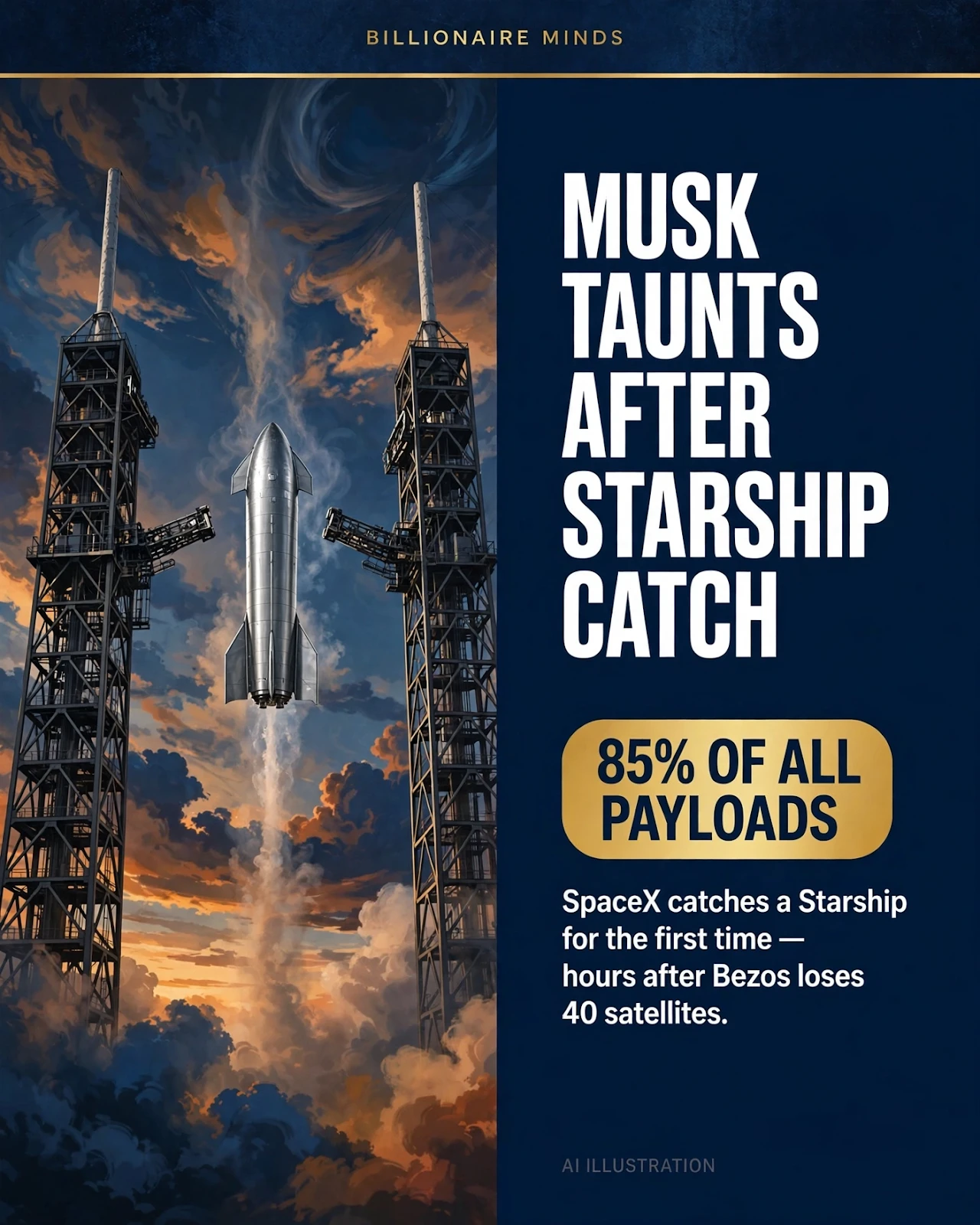
Musk Taunts Bezos After SpaceX's First Starship Catch — "Anyone Can Throw Money at Rockets"

AI illustration of SpaceX's Starship rocket being caught by launch tower arms — Elon Musk taunts Jeff Bezos after the first Starship catch

Elon Musk did not wait long to enjoy the moment. Hours after SpaceX caught a Starship returning from orbit for the first time, the world's richest man took to X to ask why his billionaire rivals — Jeff Bezos, Boeing and Lockheed Martin — still cannot match him, even with fortunes behind them.

It was the second act of a brutal weekend for Bezos. Hours before the catch, a Vulcan rocket failed 10 minutes after liftoff and destroyed 40 of Amazon's Leo internet satellites — the story this blog covered earlier today.

The Catch That Started It

On Saturday, two steel arms on SpaceX's launch tower in Texas caught Ship 42 as it returned from orbit — the first time a Starship has ever been caught. SpaceX had hoped to catch both halves of the rocket on Flight 15; the Super Heavy booster diverted to the Gulf after Friday's launch, but Ship 42 reached orbit, deployed 26 Starlink satellites, and about 22 and a half hours after liftoff descended through the clouds and settled between the tower's two arms.

Musk inspected the ship himself. "I hugged ship 42 upon its return," he posted, adding that it "could probably be reflown with a few weeks of refurbishment." He also teased the next version: "Starship V4 will be ~70m long, which is roughly a 40% length increase and allows >60% more propellant load."

"Anyone Can Throw Money at Rockets"

Soon after the catch, Musk challenged the idea that money alone buys a space program. "Let's take this gentleman's argument at face value that anyone can throw money at rockets and get something like Starship, Falcon or Dragon," he wrote on X.

He pointed at Bezos's Blue Origin, which started before SpaceX and had Bezos's fortune behind it, and asked why it still struggles to launch reliably when, by his estimate, SpaceX's Falcon rockets carry 85% of the world's payload to orbit by mass. United Launch Alliance, the Boeing and Lockheed Martin joint venture, carries less than 5% as much payload to orbit as SpaceX, he said.

When ULA confirmed the loss of the 40 Amazon satellites, Musk struck a different tone: "Sorry to hear this. Hope you are back to flight soon." He also questioned what Boeing had achieved with federal funding for its Starliner capsule: in 2014, NASA awarded Boeing up to $4.2 billion and SpaceX up to $2.6 billion to fly astronauts to the International Space Station. SpaceX now makes those trips regularly; Boeing's next Starliner flight, targeted for December or January, is set to carry cargo without a crew.

The Market Heard Him

Shares of SpaceX (SPCX) rose nearly 1% overnight after the catch, after climbing 3% last week — its strongest weekly gain in more than a month. Google CEO Sundar Pichai watched the catch live and posted: "Congrats @SpaceX for that starship catch, still feels like science fiction!" ARK's chief futurist Brett Winton noted the catch drops the cost per kilogram to orbit to roughly $100, from $1,000.

Walter Isaacson, Musk's biographer, recalled December 2020, when Musk first suggested the launchpad arms could catch a returning Starship: "I will always remember the looks on the engineers' faces in the Starbase conference room." Six years later, the arms caught one — and Musk made sure his rivals knew it.

Source: Stocktwits (November 16, 2026). This is a fan/commentary summary of reported news; all figures are the sources' estimates. Image: AI illustration.

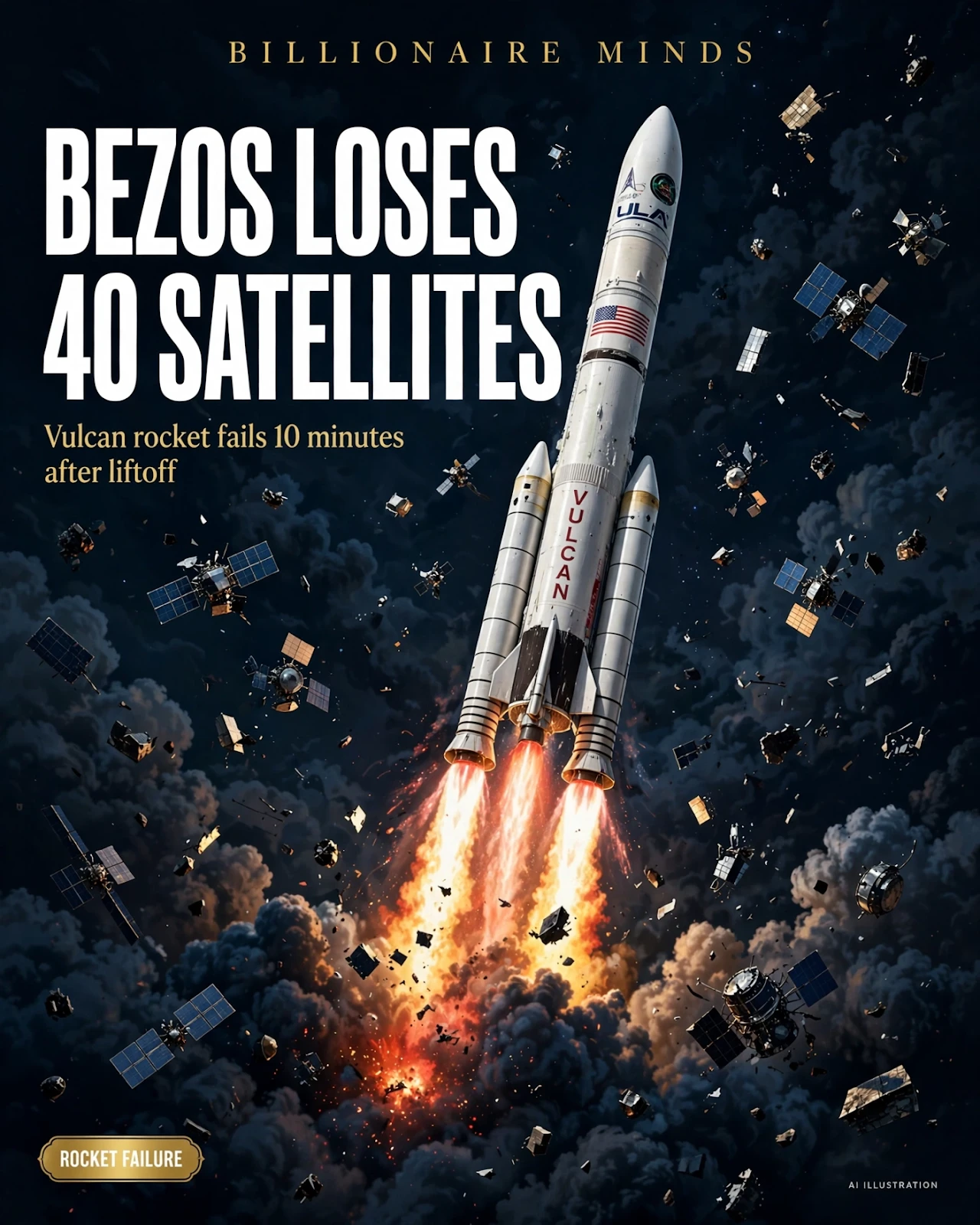
Jeff Bezos Loses 40 Satellites as Amazon's Vulcan Rocket Fails 10 Minutes After Liftoff

AI illustration of Amazon's Vulcan rocket failing after liftoff, with 40 Leo satellites scattered — Jeff Bezos loses 40 satellites in rocket failure

Jeff Bezos just watched 40 of his satellites burn up in the sky. A Vulcan rocket carrying Amazon's Leo internet satellites failed roughly 10 minutes after liftoff from Florida on Sunday, destroying its entire payload in the launch company's first-ever mission failure.

It is a brutal setback for the Amazon founder's long-running bid to build a satellite internet network to rival Elon Musk's Starlink — and the rocket that failed runs on engines built by Bezos's own space company.

Ten Minutes In, the Mission Was Over

The Vulcan rocket, owned by United Launch Alliance — the Boeing and Lockheed Martin joint venture — lifted off from Space Launch Complex 41 at Cape Canaveral Space Force Station carrying 40 satellites for Amazon's Leo network. About 10 minutes into the flight, it suffered an anomaly and failed to deliver the mission to orbit.

"Based on data received by our Launch Director, we confirm that the Vulcan vehicle launched from Space Launch Complex 41 suffered an anomaly 10 minutes into the flight and failed to deliver the Amazon mission to orbit," ULA said in a statement. "Every flight generates data, and every flight teaches us something. Since the anomaly just occurred, we don't have any specific data yet to understand what occurred today."

The failure is expected to trigger a lengthy technical investigation that would keep the rocket grounded for months. It was Vulcan's fifth flight since its 2024 debut and its first in nine months, after a launch hiatus drawn out by separate technical investigations into its solid rocket boosters and its core BE-4 engines.

Bezos's Own Engines Are Under the Microscope

The BE-4 engines that power Vulcan's first stage are supplied by Blue Origin, the space company founded by Bezos. It is not yet clear whether the engines played a role in Sunday's failure — the anomaly appeared to occur after the second stage, carrying the Amazon satellites, separated from the first-stage booster powered by the BE-4 engines. Blue Origin is working with ULA on the investigation, according to a person familiar with the matter.

The engines already carry baggage: Blue Origin's New Glenn rocket suffered a launchpad explosion in May, and its investigation determined the engine was the cause. That led the company to modify the engines delivered to ULA for Vulcan, ULA spokesperson Jessica Rye told Reuters in August.

Amazon struck a measured tone. "There is risk with any launch, and that's especially true for inaugural missions like LV-01," the company said in a statement. "ULA has been a trusted partner for Amazon, and we believe they'll learn from this mission and deliver on their long-term plans for Vulcan."

The Race Against Starlink Just Got Harder

The failure is another blow to Amazon's slow climb into orbit. Since 2025, only 398 Leo satellites have been deployed across 14 launches — about 12% of the 3,236 satellites Amazon needs for global service coverage. The company had hoped to start initial internet service this year.

Meanwhile, Musk's Starlink already has more than 11,000 satellites in orbit and millions of customers worldwide. SpaceX's wide lead comes in part from having its own rocket to launch its satellites, while rivals like Amazon spend billions on external launches — and now, on launches that fail.

ULA, formed in 2006 from the merger of Boeing's Delta and Lockheed Martin's Atlas rocket programs, had held a 100% mission success record ever since. Sunday ended that run — and with Falcon 9, the world's most active rocket, nearing retirement and no longer accepting bookings, the failure could deepen a US launch bottleneck just as Amazon needs launches most.

Source: Indian Express (November 16, 2026), reporting Reuters. This is a fan/commentary summary of reported news; all figures are the sources' estimates. Image: AI illustration.

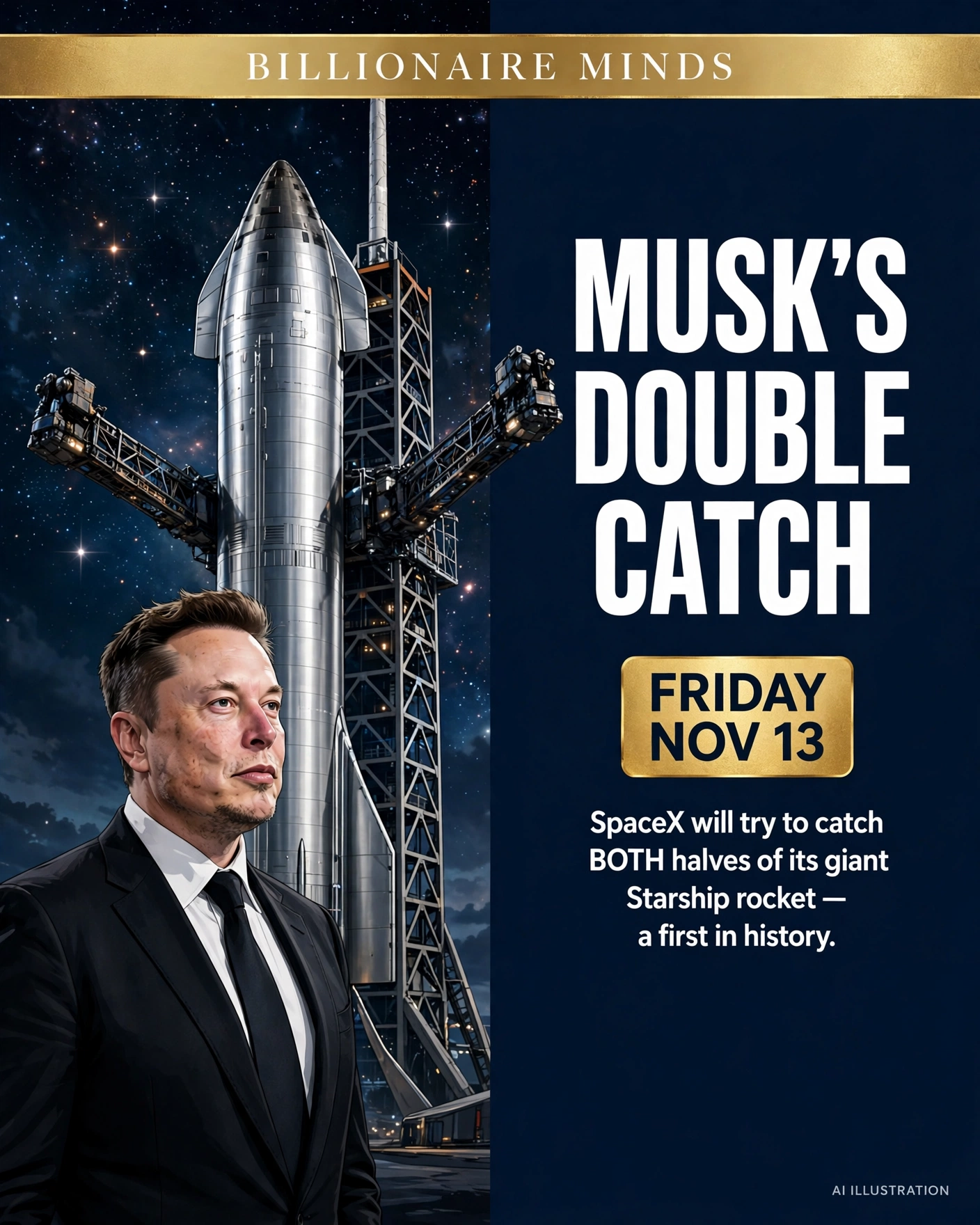
Elon Musk's SpaceX Targets Friday the 13th for the First-Ever Double Rocket Catch

Stylized illustration of Elon Musk with SpaceX's giant Starship rocket and launch tower against a starry sky — SpaceX will try to catch both halves of the rocket on Friday, November 13

Elon Musk's SpaceX is one week away from the most audacious test flight in its history. On Friday, November 13, the company will attempt something no one has ever done: catch both halves of an orbital rocket and bring them home in one piece. "SpaceX will attempt to catch both the Super Heavy booster and Starship on the upcoming flight," Musk wrote on X on November 6. "If both are successful, it will mark the first time that all parts of an orbital rocket return to Earth intact. This is the critical breakthrough needed to make life multiplanetary."

Two catches, one flight

Flight 15 will fly Booster 22 and Ship 42 — both Block 3 vehicles — from Orbital Launch Pad 2 at Starbase, Texas, in a 75-minute window opening at 4:45 p.m. Central Time, pending final regulatory approval. After hot staging and separation, the Super Heavy booster is planned to return for a tower catch roughly six minutes and 35 seconds after liftoff. The Ship has the harder job: it will climb to a roughly 275-kilometre orbit, deploy 26 advanced Starlink V3 satellites, circle Earth about 14 times over more than 22 hours, then attempt a deorbit burn, a belly-flop reentry, a flip and a landing burn into the launch tower's chopstick arms at about T-plus 22 hours and 32 minutes. SpaceX has caught boosters three times before, on Flights 5, 7 and 8. The Ship has never been caught.

Why it matters — and what it is worth

Full recovery is the economics of Musk's space empire. A rocket that can be caught, inspected, refurbished and reflown quickly slashes the cost of every launch — and the high launch cadence it enables is what Starlink, lunar missions and eventually Mars settlement all depend on. Musk told investors at last week's Baron conference that SpaceX aims to pass a $100 billion annualized revenue run rate in December, and the Starlink satellites riding on Flight 15 are the revenue engine behind that number. Musk put the odds of pulling off the first double catch at "more likely than not" — and if the Ship's health checks fail, it will splash down in the Pacific instead, with the booster falling back to the Gulf of Mexico. Either way, a steady stream of further flights is already scheduled. Friday the 13th, it turns out, could be the luckiest day in rocket history.

Source: Teslarati, November 8, 2026 (Musk X post November 6; SpaceX VP of Launch Kiko Dontchev at the UP.Summit, November 5); Business Today, November 7, 2026. This is a fan/commentary summary of reported news; all figures are the sources' estimates. Portrait: AI illustration.

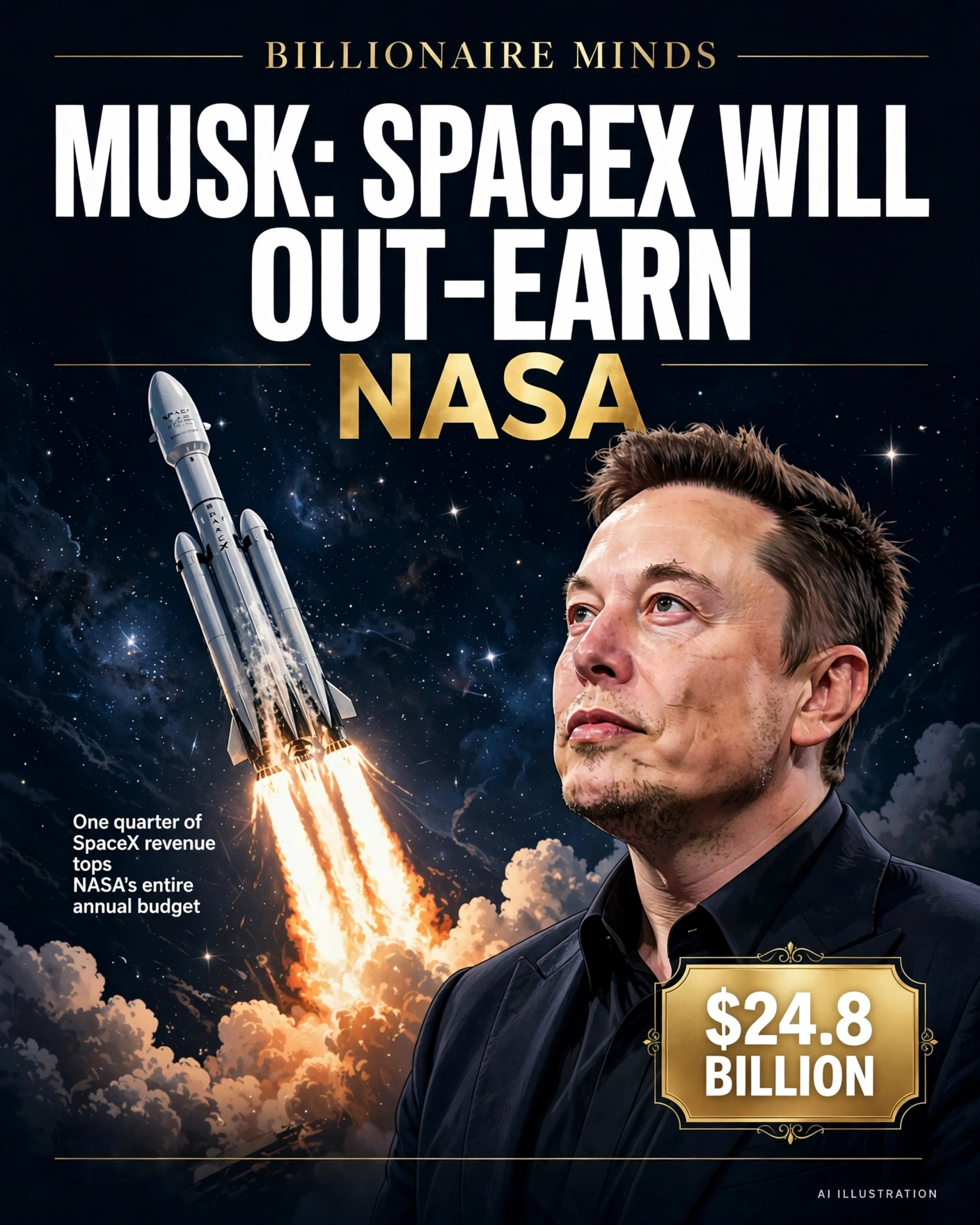
Musk Says SpaceX Will Out-Earn NASA's Entire Budget This Quarter — $24.8 Billion in 3 Months

Elon Musk looking up at a SpaceX rocket launching into a starry sky — he says SpaceX will earn $24.8 billion this quarter, more than NASA's entire annual budget

Image: AI illustration.

Elon Musk just put a number on SpaceX's transformation — and it is bigger than NASA's entire year. Speaking virtually at the 33rd Annual Baron Investment Conference in New York on Friday, Musk said SpaceX's fourth-quarter revenue should rise roughly 70 percent from the third quarter, putting sales near $24.8 billion. Then he drove the point home on X: "SpaceX revenue this quarter alone will be substantially higher than NASA's entire annual budget!" NASA received $24.4 billion in regular fiscal 2026 appropriations, according to a Congressional Budget Office assessment — so on that measure, one quarter of SpaceX now tops a full year of NASA.

The AI business is now bigger than the rockets

The forecast builds on a third quarter in which SpaceX reported $14.58 billion in revenue, up 161 percent from a year earlier. The surprise is what is driving it: the company's Super Intelligence unit, which leases AI computing capacity to other developers, generated $7.56 billion — more than half of total revenue and the company's largest segment for the first time. Connectivity, home to Starlink, brought in $5.25 billion, and space operations $1.77 billion. Anthropic has replaced NASA as SpaceX's single largest customer, accounting for about 34.5 percent of third-quarter revenue. Musk also gave a first launch date for StarMind, SpaceX's planned space-based AI computing network: 2027.

Washington is becoming a footnote

Musk used the moment to answer the midterm-election question hanging over his companies. Government contracts made up 16.6 percent of SpaceX revenue last quarter, he said, and will fall below 10 percent this quarter — and under 5 percent within a year. "Happy to cancel any that the government doesn't want. Just say the word!" he posted on X. The pitch landed with investors: SpaceX shares finished Friday up 8.6 percent at $134.27, rebounding from a two-day slide that had wiped more than $420 billion off the combined market value of Tesla and SpaceX after Democrats swept Congress. Musk repeated his goal of reaching a $100 billion annualized revenue rate by December — and said it could exceed $500 billion by December 2027 — while cautioning investors: "This is not a promise. This is what I think will happen. This is my best guess." The rocket company that once survived on NASA contracts is now telling the world it can out-earn the agency in a single quarter.

Source: Benzinga via MarketSpeaker; TipRanks; Gizmodo; The Currency Analytics, November 6–7, 2026. This is a fan/commentary summary of reported news; all figures are the sources' estimates.