
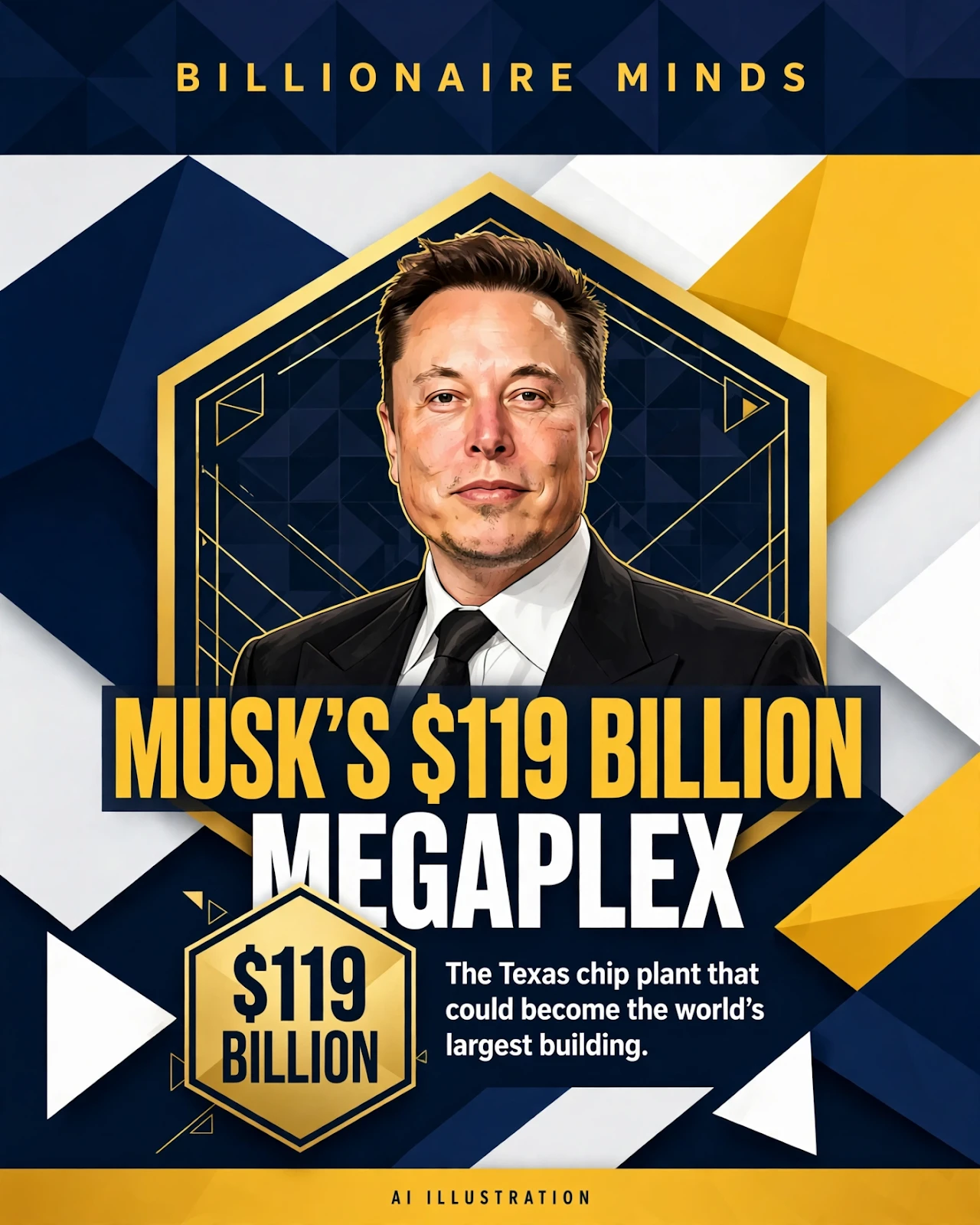
Elon Musk is building something so big it could dwarf the largest building on Earth. The project is called Terafab — a joint venture between SpaceX and Tesla — and it is rising in a quiet corner of rural Texas, about 70 miles northwest of Houston.
If it is finished as planned, the industrial complex would cover 100 million square feet. Architectural Digest has reported that would make it more than five times larger than China's New Century Global Centre, one of the largest buildings in the world.
A $119 Billion Bet on Chips
The goal is to make the advanced chips that artificial intelligence, self-driving cars, humanoid robots and space technology will need in the years ahead — all under one roof, including logic chips, memory and advanced packaging. The chips would supply Tesla's autonomous vehicles, its Optimus robots and SpaceX's space programmes.
Texas Governor Greg Abbott's office announced on August 6 that the first phase alone would involve more than $16.8 billion of investment and create about 3,000 jobs. The full ambition is far larger: tax incentive filings reported by local broadcaster KBTX put total investment at about $119 billion across four phases, with construction running until 2036 and more than 4,000 direct jobs. Those figures are projections — not money already spent.
Why Texas, Why Now
Reuters reported in October that Musk is aiming for volume production by the third quarter of 2028. Musk himself called that timeline highly ambitious and said it was uncertain whether it could be met.
Land acquisition has moved fast. KBTX reported on November 10 that WIT TECH LLC, a company linked to the project, now holds more than 10,000 acres in the county, up from about 7,700 acres in August. A Musk-linked company has also bought a water pumping station on the Navasota River.
The public incentives behind the project have drawn close scrutiny. The Houston Chronicle reported that two local school districts gave preliminary approval in July to property tax deals worth an estimated $1.66 billion in future tax relief, phased in through 2046. A separate agreement with Grimes County requires SpaceX to invest at least $5 billion by 2030 and create 1,800 permanent jobs by 2035 — though the company can walk away at any time with 30 days' written notice, with a maximum penalty of $60 million.
The Pushback
Hopes for jobs have come with local concerns about water, power, roads, the environment and the rural way of life. County Judge Joe Fauth has said the plant will not draw on groundwater, instead using recycled surface water from the Gibbons Creek Reservoir and generating its own power, separate from the state grid. Some community groups are still pressing for stronger safeguards and greater transparency.
The fight over transparency has reached the courts. In September, SpaceX sued the Texas attorney general and Grimes County to block the release of certain records, and on November 9 it amended its petition to also challenge the release of documents requested by KBTX.
Texas politics adds a new layer of uncertainty. In the November 3 election, Democrat Gina Hinojosa defeated Abbott and will take office in January as the state's first Democratic governor since 1995. She campaigned against corporate incentives, but has since struck a more conciliatory tone, saying she could have a strong working relationship with Musk "on our terms" — while calling for strict rules on water, power and community rights for data centres.
Whether Terafab ends up the world's largest building or not, one thing is clear: the world's richest man is betting $119 billion that the future of AI will be built in rural Texas.
Source: Geo TV. Image: AI illustration.

