Posts

Showing posts with the label Facebook

Italy Fines Zuckerberg's Meta $887 Million for Reading Your Photos — Weeks After a $25 Billion US Judgment

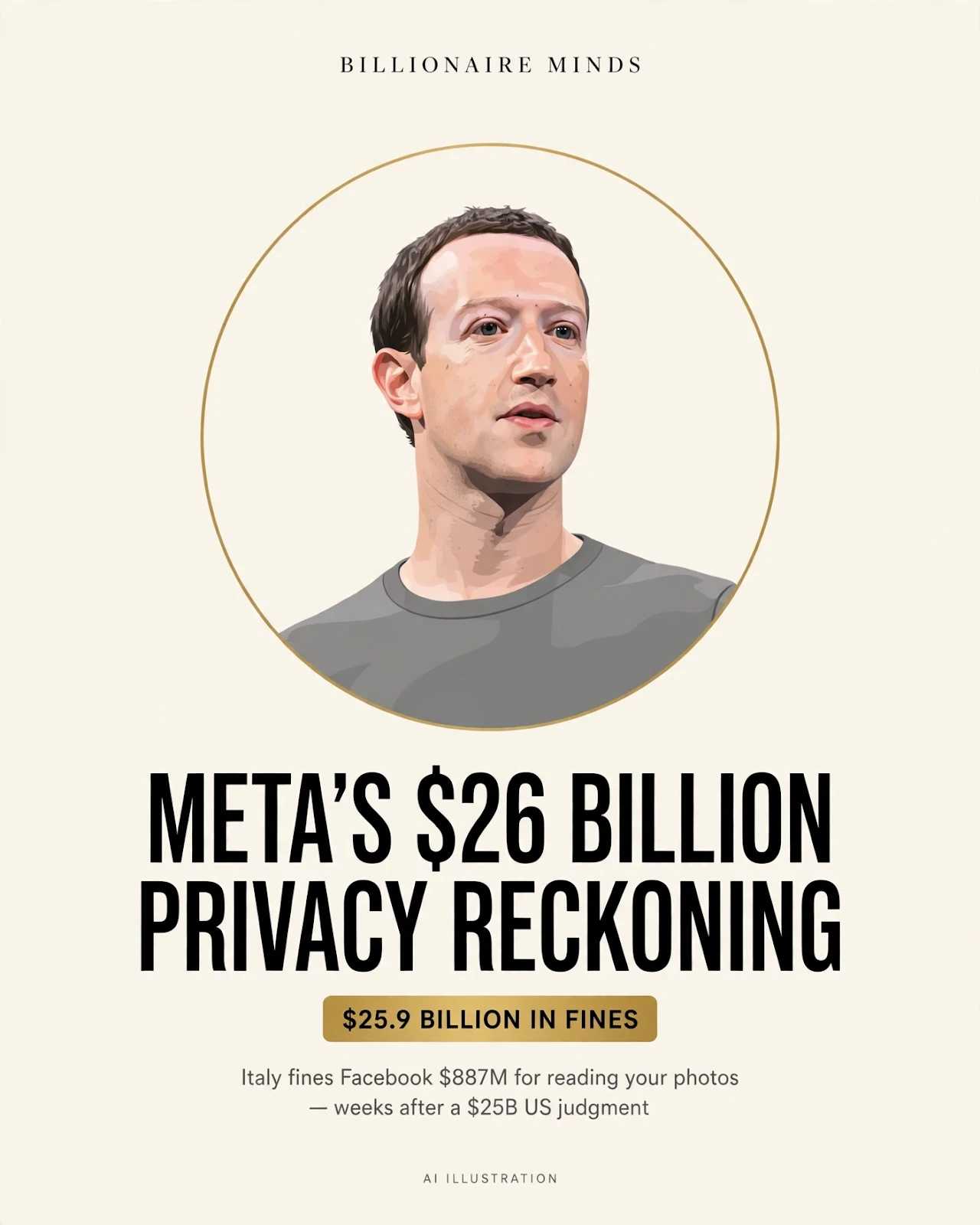
Mark Zuckerberg — Meta fined $887 million in Italy for reading users' photos, weeks after a $25 billion US judgment

Mark Zuckerberg's Meta just got handed a bill that keeps growing. Italy has fined the Facebook parent €805 million — about $887 million — for reading users' phone photos without asking. It comes weeks after a US judge ordered Meta to pay $25 billion in New Mexico. Together, that is roughly $25.9 billion in privacy penalties.

Italy: Facebook read 20 million photo galleries

Italy's data protection authority, the Garante, said the Facebook app on Android phones read photos, videos and their metadata from about 20 million Italian users — without their specific consent — to power a feature that suggests gallery photos as post ideas. The feature has run since 2023. The regulator said a single app-wide permission, a vague notice and a default-on setting did not add up to valid consent, and cited Meta's "lack of co-operation". Meta has 60 days to switch the feature off by default and ask users for separate, specific consent. The fine is about 0.47% of Meta's worldwide turnover and among the largest an Italian authority has ever imposed on a tech company. Meta calls the fine disproportionate and says it will appeal.

New Mexico: a $25 billion judgment

The Italian fine is the smaller half of the bill. In October, a New Mexico judge ordered Meta to pay $25 billion in civil penalties after a jury found the company made 26 misleading statements about how it handles Facebook user data. The case traces back to Cambridge Analytica, which harvested data from as many as 87 million Facebook users. Jurors counted nearly 43.9 million violations of the state's consumer-protection law — a maximum exposure of almost $219.5 billion — before the judge set the total at $25 billion, plus 15% annual interest until it is paid. Meta says it will appeal that ruling too.

What it means for Zuckerberg

For Zuckerberg, worth more than $220 billion, the two rulings are a reminder that Meta's data practices are now priced in billions, not millions. Meta booked a $9.9 billion charge in its September quarter for a separate multi-state settlement, on $64.6 billion of quarterly revenue — so a $25.9 billion privacy bill is real money even for the world's fourth-richest man. The question now is whether the appeals shrink the numbers, or whether regulators keep raising them.

Source: Times of India, November 14, 2026, reporting Italy's Garante and Reuters/NYT on the New Mexico judgment. This is a fan/commentary summary of reported news; all figures are the sources' estimates. The portrait on this post is a stylised AI illustration, not a photograph of Mark Zuckerberg.

Billionaire Yusaku Maezawa Loses Landmark Case Against Meta Over Celebrity Scam Ads


A Tokyo court has dismissed a landmark lawsuit by Japanese billionaire Yusaku Maezawa against Meta, ruling that the platform operator is not directly liable for fraudulent investment ads that used his name and face to lure victims.

The one-yen lawsuit

Maezawa, founder of Zozotown — Japan's largest online clothing retailer — filed the suit in 2024, saying Meta was "not making efforts" to stop the scam ads. He demanded just one yen in damages, saying he wanted to clarify whether the company's actions were legal. Fraudsters commonly used his image without permission: one typical ad captioned his photo, "Started with 10,000 yen ($63). Gained 1.3 million yen in four days."

What the court decided

The Tokyo District Court on Tuesday turned down Maezawa's claims, ruling that Meta "is merely a platform operator and was not directly involved in the posting of the ads," according to broadcaster TBS. Meta had argued that unidentified posters placed the advertisements and that it had no obligation to constantly monitor content to detect rights-infringing material, public broadcaster NHK reported. The court did, however, acknowledge that Maezawa's publicity rights and portrait rights had been infringed.

Why this ruling matters

The decision is a test case for whether big tech platforms can be held responsible when scammers hijack a celebrity's identity — a problem that has hit billionaires and stars around the world, from deepfake investment ads to fake crypto endorsements. Maezawa's lawyer told reporters after the ruling that "the number of scam ads has not decreased, and even now we are detecting a considerable number of scam ads featuring Mr. Maezawa." He warned the verdict could leave victims feeling that "even if you fight in court, it's useless" — and quietly resigning themselves to their losses.

Sources: The Sun Malaysia, reporting AFP, NHK and TBS. This is a fan/commentary summary of reported news; all figures are the sources' estimates. Image: AI illustration.

Mark Cuban Calls Out Facebook Over AI Deepfake Scam Ads — and a $16 Billion Question

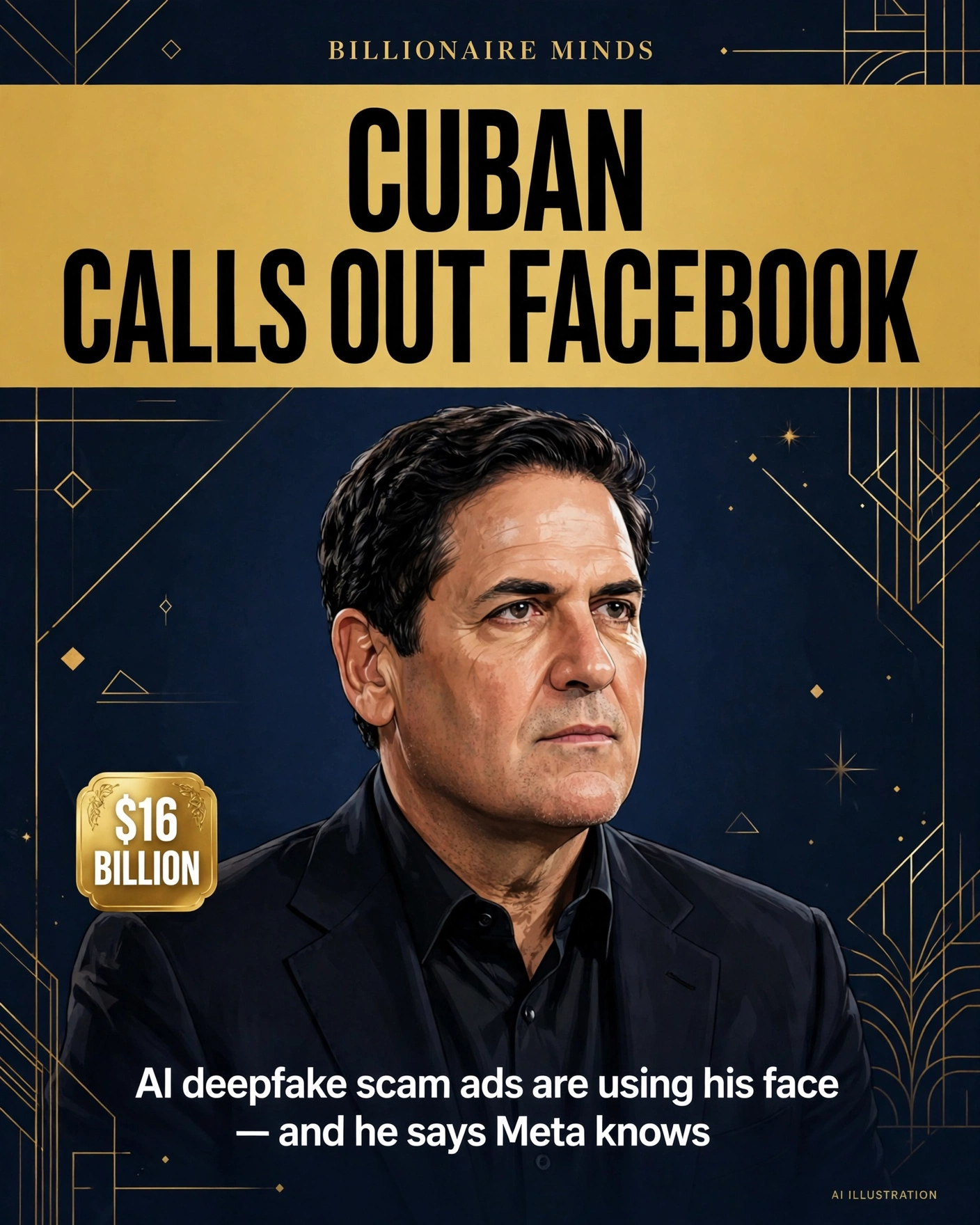
Mark Cuban — the billionaire says AI deepfake ads on Facebook use his face to sell a fake diabetes cure

Billionaire Mark Cuban has had enough. The Shark Tank star says scammers are using AI-generated copies of his face and voice in Facebook ads to sell a fake diabetes cure he never endorsed — and he accuses Meta of letting the ads keep running.

The $294 cure he never sold

Cuban described the scam on an August 21 appearance on the Pivot podcast with Kara Swisher and Scott Galloway. He said he hears from older Americans every week — some asking whether his diabetes cure works, others telling him they already paid $294 for a treatment advertised with his likeness. He never sold it, never endorsed it, and the ads reportedly use AI-generated video and audio of him. Cuban called Facebook "the worst of the worst" for allowing the ads to circulate despite his efforts to flag them. Some of the ads even carry fine print admitting the person shown is AI-generated.

The $16 billion question

Cuban's complaint landed alongside a much bigger number. Reuters reported in November 2025 on internal Meta documents estimating that roughly $16 billion — about 10% of the company's 2024 revenue — came from ads promoting scams and prohibited products. The documents reportedly said users see around 15 billion "higher-risk" scam ads per day, and that Meta's automated systems required an advertiser to be pegged at least 95% likely a scammer before a ban. Meta spokesman Andy Stone disputed the figures, calling the $16 billion estimate "rough and overly-inclusive," and said scam-ad complaints fell 58% over 18 months, with more than 134 million scam ads removed in 2025.

Why seniors are the target

The stakes are real. FBI data shows Americans aged 60 and older reported about $7.75 billion in losses in 2025, with more than 201,000 complaints — and AI-assisted scams are already showing up in the numbers. The FTC has previously warned about scammers using doctored images of Shark Tank personalities to push questionable products. Cuban's message is blunt: if a billionaire's face can be faked to sell a cure, anyone's can — and the platform profiting from the ads is the one that has to stop them.

Source: FinanceBuzz, November 5, 2026; Gadget Review, November 6, 2026; Reuters, November 2025. Image: AI-generated stylized illustration.

Palmer Luckey: The 34-Year-Old Who Sold Oculus for $2 Billion — and Built a $61 Billion Defense Empire

Palmer Luckey — sold Oculus to Facebook for $2 billion at 21, now worth $5.9 billion as his defense company Anduril hits a $90 billion valuation

At 21, Palmer Luckey sold the virtual reality company he built as a teenager to Facebook for $2 billion. At 34, he is worth an estimated $5.9 billion — and his second company may be an even bigger success.

From a teenager's garage to a $2 billion exit

Luckey grew up in Long Beach, California, home-schooled by his mother, taking apart old headsets and game consoles. He built an early version of the Oculus Rift at just 16 and founded Oculus VR in 2012. Two years later, Facebook acquired the company in a deal worth approximately $2 billion in cash and stock. He left Facebook in 2017 — and instead of returning to consumer tech, he turned to defense.

Anduril: the $90 billion defense bet

That same year, Luckey co-founded Anduril Industries, which builds AI-powered defense systems — autonomous drones, sensors, surveillance and border-monitoring technology for the U.S. military and its allies. Anduril was valued at $61 billion in May 2026 after raising $5 billion, more than doubling its valuation in under a year, according to Forbes. Fortune reported this month that an employee tender offer valued the company at $90 billion. Anduril is also planning a $1 billion factory in Ohio.

The billionaire who refuses to leave California

California is now debating Proposition 40, a proposed billionaire tax, and some of the state's richest residents — including Google co-founders Sergey Brin and Larry Page — are reportedly leaving. Luckey opposes the tax, but he is staying. "California is something special," he said, per Fortune. For a founder who never finished university and built his fortune from a garage project, it is a fitting stance: the state that made him is the one he is not willing to give up on.

Source: Times of India, November 6, 2026, reporting Forbes figures; Fortune, November 2, 2026. Image: AI-generated stylized illustration.