Posts

Showing posts with the label Wall Street

Nvidia Doubles Sales Without Huang — $115.8 Billion Quarter and a $130 Billion Guide as the Board Closes the Door on His Return

Nvidia doubles sales without Jensen Huang — $115.8 billion revenue in its first quarter under interim CEO Colette Kress

Nvidia just delivered its first earnings report without Jensen Huang — and the numbers barely noticed he was gone. Revenue for the quarter ended October 25 more than doubled to $115.8 billion, up 103% from a year ago and roughly $6.7 billion above what Wall Street expected. Adjusted earnings hit $2.68 a share against a $2.47 forecast, and net income more than doubled to $65.3 billion.

The data-center business did the heavy lifting: $107.6 billion, up 110%, with sales to AI clouds and enterprise customers up 195%. New Vera Rubin systems began shipping in the quarter and added nearly $20 billion of revenue on their own. Shares rose about 2.4% in after-hours trading after the release.

A $130 Billion Guide — and No Way Back for Huang

The outlook was even louder than the quarter. Nvidia guided fourth-quarter revenue to $130 billion, comfortably above the roughly $125 billion analysts expected, in a quarter that includes an extra week. Interim CEO Colette Kress — who is also chief financial officer — told investors "the momentum is real" and raised the fiscal 2028 growth outlook to about 75%.

Then came the line that closed the book on the saga of the past week. Board chair Harvey Jones told the earnings call the board does not intend to reinstate Huang, ending the campaign to bring the founder back after his November 12 resignation. The message from Nvidia's first post-Huang quarter is blunt: the machine prints money with or without him.

Source: Motley Fool / MLQ.ai / Zacks / BeInCrypto

Image: AI illustration. This is a commentary post based on public reporting.

Sam Bankman-Fried's $500 Million Bet Would Be Worth $35 Billion This Week — But He's in Prison

Stylized illustration of Sam Bankman-Fried behind prison bars — his $500 million Anthropic bet would be worth $35 billion at this week's IPO

This Thursday, Anthropic — the AI company behind the Claude chatbot — is expected to start trading on the Nasdaq at a valuation approaching $1.4 trillion. It would be one of the biggest IPOs in Wall Street history. And one early investor should have been heading into the greatest Thanksgiving of his life.

His name is Sam Bankman-Fried. In late 2021, his trading firm Alameda Research put $500 million into a little-known AI research startup, buying roughly a 13.5% stake. Had those shares survived the collapse of FTX, they would be worth about $35 billion at the top of Anthropic's IPO price range. Instead, Bankman-Fried is serving a 25-year prison sentence in California — and the shares are long gone.

The $35 Billion That Slipped Away

The math is stark. FTX's bankruptcy estate sold the entire Anthropic position in 2024 for a combined $1.34 billion — roughly two-thirds of the stake went for $884 million in March 2024, with the rest following later. After Anthropic's 10-for-1 stock split in September 2026, that same position would equal about 445.4 million shares. At the IPO range of $70 to $78 a share, it would be worth $31.2 billion to $34.7 billion — a 70-fold return on the original $500 million.

The New York Times reported on November 16 that Bankman-Fried has repeatedly expressed frustration with the administrators who sold the stake, and he even cited the Anthropic investment in a long-shot appeal to the Supreme Court in September. The Financial Times puts the missed value even higher, at roughly $37 billion.

Who Got the Bargain Instead

The buyers of the bankruptcy sale got one of the great bargains in investing history. Quant trading giant Jane Street — fittingly, the first place Bankman-Fried ever worked — was among the firms that picked up the shares at what Fortune called firesale prices. Amazon, which has poured $18 billion into Anthropic since 2023, and Google, with a $33 billion commitment, are among the giants riding the IPO to a windfall.

Anthropic is set to price its shares on Wednesday, November 18, and begin trading Thursday, November 19, under the ticker ANT. The deal is already oversubscribed, with orders several times the 825 million shares on offer.

The Fine Print on the $35 Billion

One honest caveat: the $35 billion is a thought experiment, not money that was ever Bankman-Fried's to keep. The stake belonged to FTX and Alameda entities, and any value would have gone to the bankruptcy estate and creditors — and Bankman-Fried was convicted in March 2024 on seven counts of fraud and conspiracy, with a roughly $11 billion forfeiture order standing. His convictions were upheld by a federal appeals court in June 2026.

Still, the irony is hard to beat: the man once called crypto's golden boy made what may be the single greatest venture bet of the decade — and the only person who will not see a cent of it is the man who made it.

Source: Celebrity Net Worth, reporting The New York Times and Anthropic's IPO filings. The portrait image on this post is an AI-generated illustration.

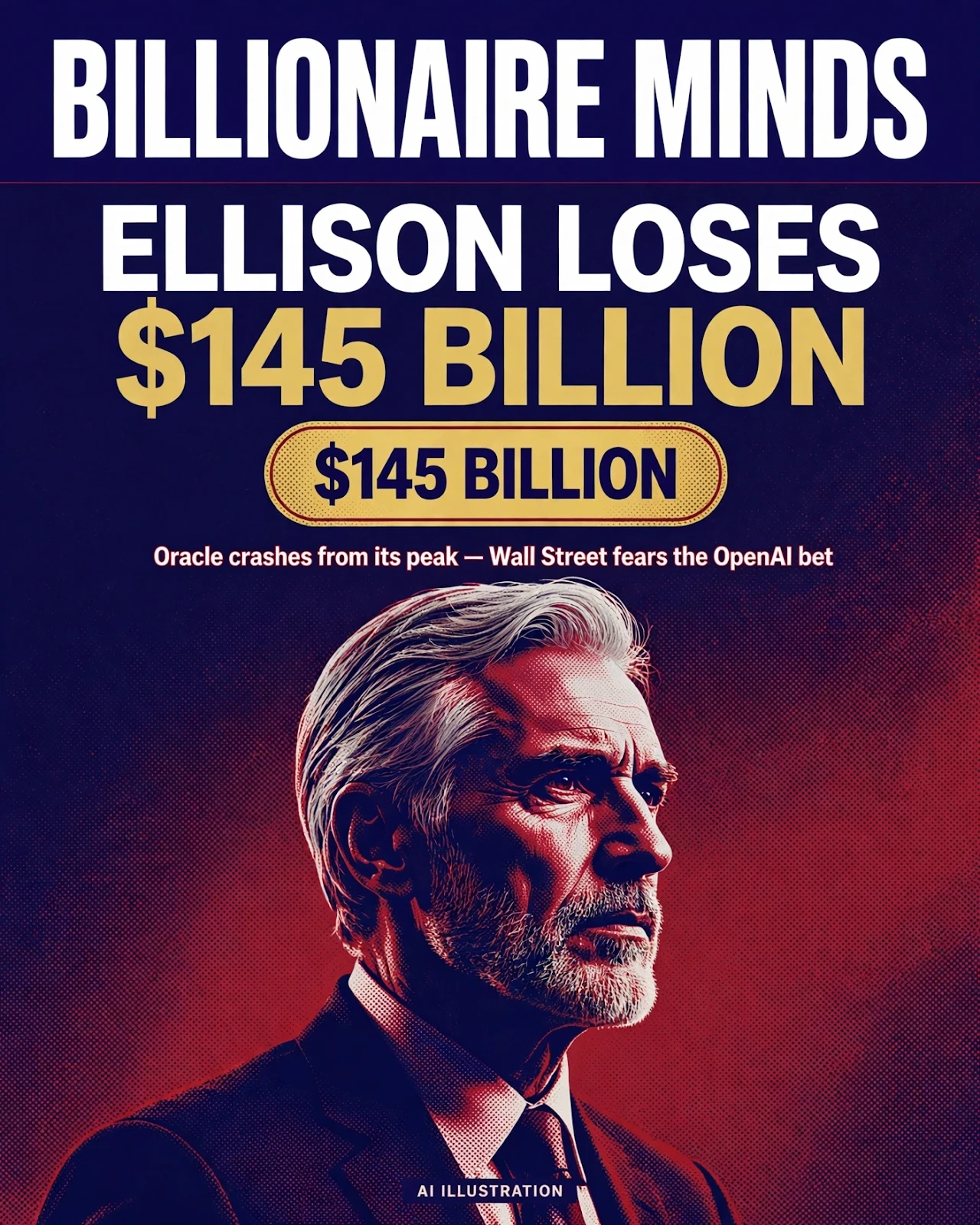
Larry Ellison Has Lost $145 Billion as Oracle Crashes From Its Peak — Wall Street Fears the OpenAI Bet

Larry Ellison — Oracle's co-founder has lost about $145 billion as Oracle stock crashes from its peak, with Wall Street worried about its OpenAI bet.

Larry Ellison, the co-founder of Oracle, has watched roughly $145 billion of his fortune evaporate as Oracle's stock crashes from its peak. The Motley Fool reports the wipeout is tied directly to Ellison's enormous stake in the company — about 1.16 billion shares, roughly 40% of Oracle, making him its largest shareholder by far.

Oracle's Slide Keeps Getting Worse

Oracle's shares are down roughly 44% over the past year and about 50% from their high, and the slide is still going — the stock fell another 4.99% on Monday, November 16, closing at $119.09. Just two weeks ago, Forbes had Ellison at $153.3 billion and ranked 11th richest in the world after Oracle dropped 7% in a day. Since then, the sell-off has only deepened.

The $300 Billion OpenAI Question

Wall Street's worry is not just the share price — it is what Oracle is betting on. The company reported a backlog of roughly $664 billion at the end of last quarter, and at least $300 billion of it is widely estimated to come from a single customer: OpenAI, the maker of ChatGPT. That means around half of Oracle's contracted future business depends on one company. If OpenAI ever scaled back or walked away, much of that backlog could be voided — cancellation fees would help, but there is no guarantee the contracts are ever fulfilled.

Growth Is Real — So Is the Spending

Oracle's business is still growing fast: revenue rose 30% to $19.3 billion in its latest quarter, cloud sales jumped 62% to $11.6 billion, and earnings per share climbed 30%. But the AI build-out is burning cash — Oracle spent $28 billion on data centres last quarter against $23 billion of operating cash flow, leaving free cash flow of roughly negative $5 million. The company expects $90–95 billion of capital spending this year, carries about $125 billion of debt, and will likely keep posting negative free cash flow in the near term. For Ellison, whose fortune is tied to Oracle's shares, that spending spree is the price of the AI bet — and the reason $145 billion has already vanished.

Source: Motley Fool. The portrait image above is a stylized AI illustration, not a photograph of Larry Ellison.

SpaceX's 12% Slide Just Made Musk's Tesla Buyout a Lot More Expensive — Tesla Investors Would Own the Combined Company

Elon Musk's dream of folding Tesla into SpaceX just hit a very expensive snag — and the stock market did it. SpaceX shares have fallen roughly 12% since the company reported strong third-quarter results on October 21, while Tesla stock has stayed flat over the same stretch. That gap has quietly rewritten the price of the biggest merger in stock market history.

The math just flipped

Most Wall Street analysts expect SpaceX to act as the buyer in an all-stock deal, paying a premium for Tesla. But a lower SpaceX share price means the rocket company must hand over far more stock to buy the carmaker. At a 15% premium at current prices, SpaceX would have to give Tesla investors about 3.2 SpaceX shares for each Tesla share — and based on fully diluted share counts from FactSet, that exchange rate would leave Tesla shareholders owning more than 50% of the combined company.

Compare that with earlier this year, when SpaceX traded at $200 a share. Back then, a 15% premium would have cost just 2.3 SpaceX shares per Tesla share, leaving SpaceX investors with roughly 57% of the merged business. The 12% slide has flipped majority control to the other side of the table.

A $3.5 trillion question with no deal yet

Talk of a tie-up jumped after Musk told investors on October 20 that the boards of both companies had formed special committees to review a deal. Bringing the two together would create an AI giant controlling power generation, chip making, AI models, software agents and humanoid robots. Barclays has even put a $450-a-share value on Tesla in a deal — roughly a 20% premium — and called the merger a key part of the Tesla bull case.

But there is still no agreement, no merger proposal and no shareholder vote scheduled. Any deal would need approval from a majority of all outstanding Tesla shares, and Musk himself cannot take part in the committees' discussions because he leads both companies.

The warning sign is already flashing elsewhere. Traders recently punished chipmaker Marvell and optical firm Lumentum after the pair announced an all-stock merger in early November — Marvell's share price sat well below its 52-week high, so it had to issue far more shares to pay the same price. SpaceX faces the same hurdle. Unless its shares bounce back soon, the sheer cost of issuing so much new stock could stall the buyout talks altogether — and leave Musk's mega-merger on the launch pad.

Source: TipRanks (Nov 12, 2026); The Motley Fool / Barclays (Nov 1, 2026). SpaceX is valued at roughly $2 trillion and Tesla at about $1.5 trillion. No merger agreement has been announced.


DraftKings Billionaire Jason Robins Bets $700 Million on Prediction Markets — and the Stock Crashes 29% in a Day

DraftKings CEO Jason Robins before a crashing stock chart — his $700 million prediction-markets bet sent the stock down 29% in a day

Image: AI illustration.

Jason Robins built DraftKings from $25,000 in a spare bedroom into a sports-betting giant. On Friday, he made the most expensive bet of his life — and Wall Street punished him for it within hours.

The $700 million gamble

DraftKings reported third-quarter results after the market closed on Thursday, November 5: revenue of $1.329 billion, up 16% on a year ago but short of the roughly $1.4 billion analysts expected, and a net loss that widened to $468.7 million. The real shock was the outlook. The company slashed its 2026 profit forecast to $175–275 million in adjusted EBITDA, down from $700–900 million — because it plans to spend $650–700 million this year building its prediction-markets business, with another $250–350 million to come in 2027.

DraftKings Predictions, launched in December 2025, lets users trade contracts on sports and real-world events. More than 1.6 million customers have used it this year, and October's annualized consumer volume hit $10.1 billion. Robins told analysts the spending is mostly marketing to win customers, and that the 2026 cohort should pay back in about 20 months. "The third quarter marked a pivotal moment for DraftKings, as the Predictions offering we have been building is now powering meaningful growth for our business," he said in the earnings release.

The worst day in DraftKings history

Investors did not buy it. On Friday, November 6, the shares plunged as much as 29% intraday — the worst drop in the company's history, worse than the day Covid shut down every sport in March 2020 — before closing down about 21% at $18.51. Around $3 billion of market value vanished in a single session, leaving the company worth roughly $8.4 billion. The stock is now down about 50% this year and has lost $16 billion of value since the end of August 2025.

The timing could hardly have been worse. Less than an hour after DraftKings released its results, the Commodity Futures Trading Commission ordered prediction-market operators to stop geofencing states — a direct threat to the joint sportsbook-and-predictions model Robins is betting on. Robins insists the company will earn the money back even if the courts rule against sports event contracts, by selling other products to prediction-market customers.

Robins, who became a billionaire when DraftKings went public in 2020, is staking more than $1 billion of his company's money on a business the courts could end in 2028. Wall Street just told him what it thinks of the odds.

Source: PYMNTS, Fast Company, The Profile, Casino.org, November 5–6, 2026. This is a fan/commentary summary of reported news; all figures are the sources' estimates. Portrait: AI illustration.