Posts

Showing posts with the label Technology

Ramaphosa Tells Musk to 'Give Back' to South Africa — the R12 vs R1 Schooling Gap Behind the Starlink Standoff

South African President Cyril Ramaphosa challenges billionaire Elon Musk to give back to South Africa — apartheid spent R12 on Musk's schooling for every R1 on his own, while Starlink stays locked out

South Africa's president has a message for the world's richest man: remember where you came from — and give something back. Speaking in California on Monday, Cyril Ramaphosa told ABC News that Elon Musk owes much of his success to the education he received growing up in South Africa, and that the billionaire should help develop the country he left at 17.

The R12 vs R1 line

Ramaphosa put it in stark numbers. "When the apartheid government spent R12 on his education, it spent R1 on my education," he said, arguing Musk has never fully grasped what apartheid did to Black South Africans. "I have met Elon Musk in the past, and I've been awed by his brilliance, but also I would like to chat to him about him remembering his country, because even as one is a citizen of a new country, you should still be loyal to your old country." His message to Musk in the room: "What you've become today is from your own origins, where you were initially educated... he should be one of those who would say, I would like to contribute to the development of South Africa and give back to this country."

Why Starlink still can't launch in South Africa

The clash sits on top of a long-running business standoff. Starlink still has no licence to operate in South Africa: the law requires individual licence-holders to have at least 30% ownership by historically disadvantaged groups, and SpaceX has refused to give up a 30% stake in its local operation. Musk has called the ownership rules "openly racist ownership laws." Communications minister Solly Malatsi has pushed an alternative — equity-equivalent investment instead of a share transfer — and Starlink has offered to connect 5,000 rural schools, but the regulator says changing the rules needs an act of parliament, and a business lobby group took the dispute to court on November 9. A meeting between Ramaphosa and Musk was discussed during the president's Silicon Valley visit — but their diaries did not line up.

Source: ITWeb. The portrait image above is a stylized AI illustration, not a photograph of Cyril Ramaphosa or Elon Musk.
Italy Fines Zuckerberg's Meta $887 Million for Reading Your Photos — Weeks After a $25 Billion US Judgment

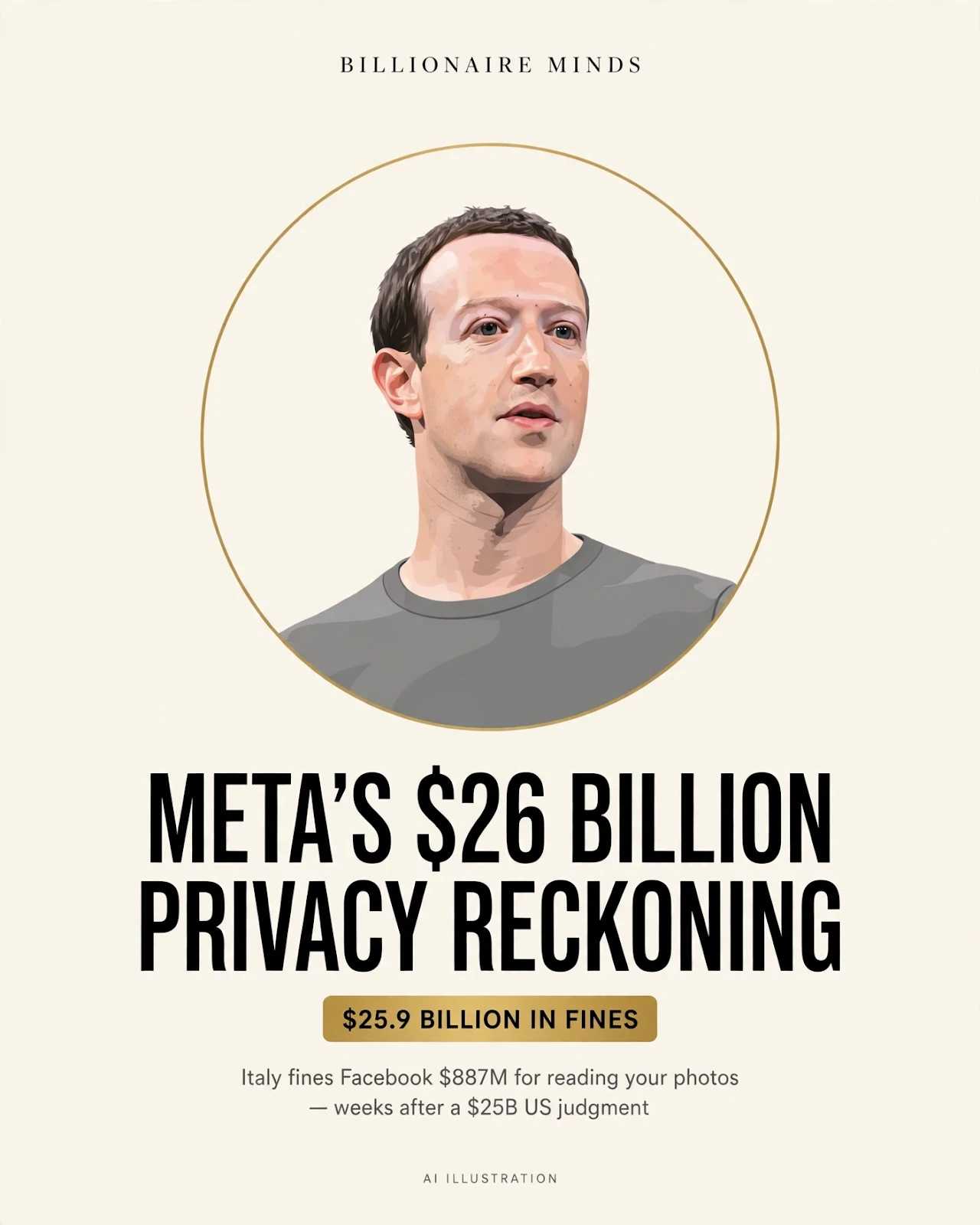
Mark Zuckerberg — Meta fined $887 million in Italy for reading users' photos, weeks after a $25 billion US judgment

Mark Zuckerberg's Meta just got handed a bill that keeps growing. Italy has fined the Facebook parent €805 million — about $887 million — for reading users' phone photos without asking. It comes weeks after a US judge ordered Meta to pay $25 billion in New Mexico. Together, that is roughly $25.9 billion in privacy penalties.

Italy: Facebook read 20 million photo galleries

Italy's data protection authority, the Garante, said the Facebook app on Android phones read photos, videos and their metadata from about 20 million Italian users — without their specific consent — to power a feature that suggests gallery photos as post ideas. The feature has run since 2023. The regulator said a single app-wide permission, a vague notice and a default-on setting did not add up to valid consent, and cited Meta's "lack of co-operation". Meta has 60 days to switch the feature off by default and ask users for separate, specific consent. The fine is about 0.47% of Meta's worldwide turnover and among the largest an Italian authority has ever imposed on a tech company. Meta calls the fine disproportionate and says it will appeal.

New Mexico: a $25 billion judgment

The Italian fine is the smaller half of the bill. In October, a New Mexico judge ordered Meta to pay $25 billion in civil penalties after a jury found the company made 26 misleading statements about how it handles Facebook user data. The case traces back to Cambridge Analytica, which harvested data from as many as 87 million Facebook users. Jurors counted nearly 43.9 million violations of the state's consumer-protection law — a maximum exposure of almost $219.5 billion — before the judge set the total at $25 billion, plus 15% annual interest until it is paid. Meta says it will appeal that ruling too.

What it means for Zuckerberg

For Zuckerberg, worth more than $220 billion, the two rulings are a reminder that Meta's data practices are now priced in billions, not millions. Meta booked a $9.9 billion charge in its September quarter for a separate multi-state settlement, on $64.6 billion of quarterly revenue — so a $25.9 billion privacy bill is real money even for the world's fourth-richest man. The question now is whether the appeals shrink the numbers, or whether regulators keep raising them.

Source: Times of India, November 14, 2026, reporting Italy's Garante and Reuters/NYT on the New Mexico judgment. This is a fan/commentary summary of reported news; all figures are the sources' estimates. The portrait on this post is a stylised AI illustration, not a photograph of Mark Zuckerberg.

Lisa Su Named CEO of the Year as AMD Briefly Tops $1 Trillion — While Nvidia Hunts for a New Boss

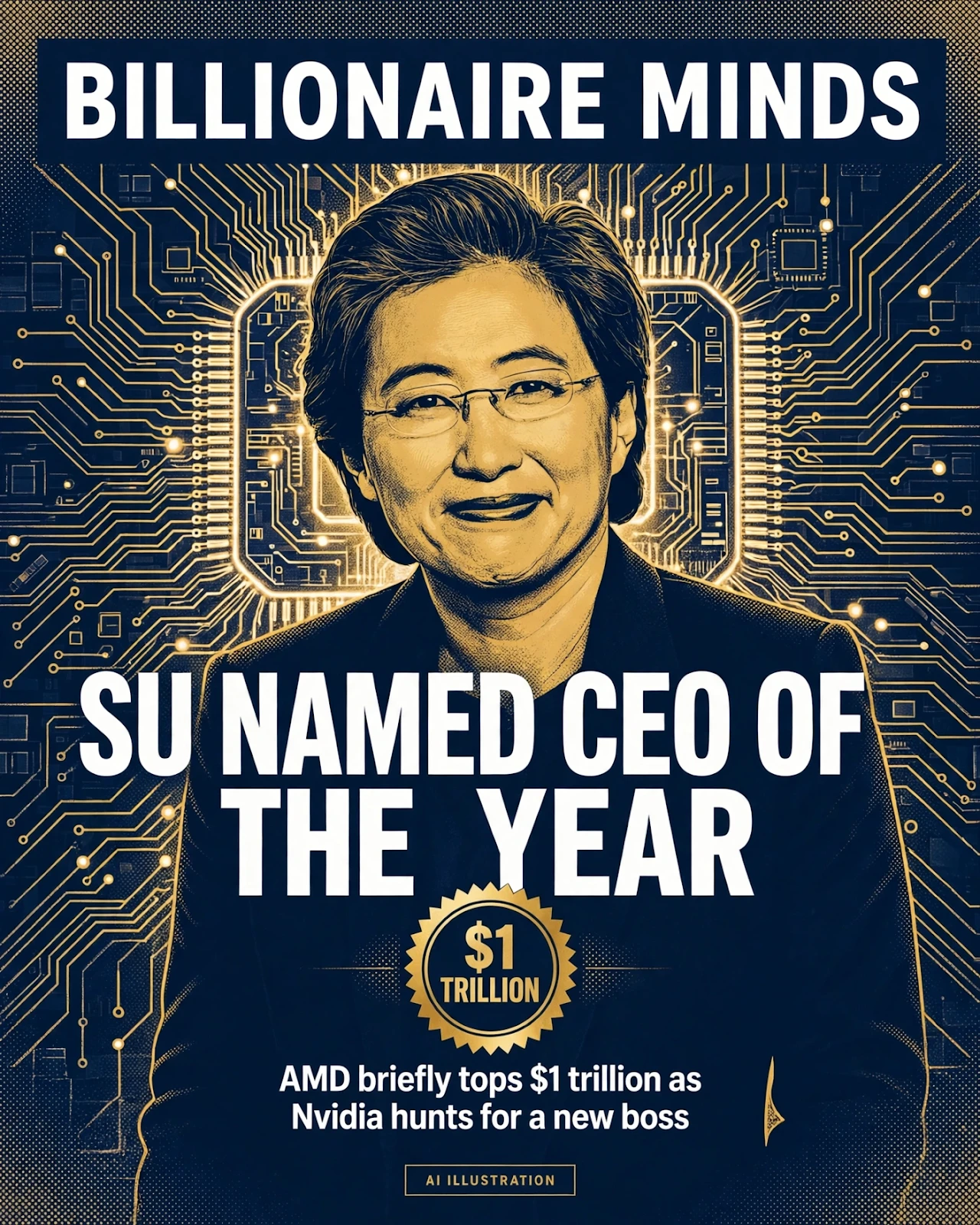
AMD CEO Lisa Su — named 2026 CEO of the Year as AMD shares surged 158% and briefly pushed the chipmaker past a $1 trillion market value

AMD chief executive Lisa Su has been named Yahoo Finance's 2026 CEO of the Year, capping a year in which AMD shares surged 158% and the chipmaker's market value briefly crossed $1 trillion.

A $1 Trillion Milestone — and a $3 Billion Fortune

Yahoo Finance announced the honour on November 12, pointing to the 158% surge in AMD shares and an $8.2 billion deal to acquire Fei-Fei Li's World Labs. Forbes' live tracker put Su's own fortune at $3 billion as of November 13 — up $302 million in a single day — ranking her 1,408th among the world's billionaires. AMD also reported record third-quarter 2026 revenue of $13.4 billion, including $8.5 billion from data centres, the engine of its AI push.

The Rival Without a Boss

Nvidia, AMD's biggest rival in AI accelerators, is hunting for a new chief executive after co-founder Jensen Huang resigned on November 12, with chief financial officer Colette Kress named interim CEO. Media speculation has listed Su — a distant relative of Huang, both born in Taiwan — among possible successors, but there is no indication she has been approached or plans to leave AMD. Nvidia reports quarterly results on November 17, its first earnings under Kress.

The Comeback CEO

Su, 57, took over AMD in 2014, when the company was struggling, and rebuilt it into a major AI infrastructure supplier — expanding its Meta partnership in October, agreeing the $8.2 billion World Labs acquisition in September, and unveiling sixth-generation EPYC processors on November 10. She also received the 2026 National Medal of Science in October, the United States' highest recognition for scientists and engineers. For now, she leads Nvidia's most important challenger at the exact moment its biggest competitor must manage an unexpected leadership transition.

Source: Gulf News (updated November 16, 2026), reporting Yahoo Finance and Forbes. This is a fan/commentary summary of reported news; all figures are the sources' estimates. Image: AI illustration.

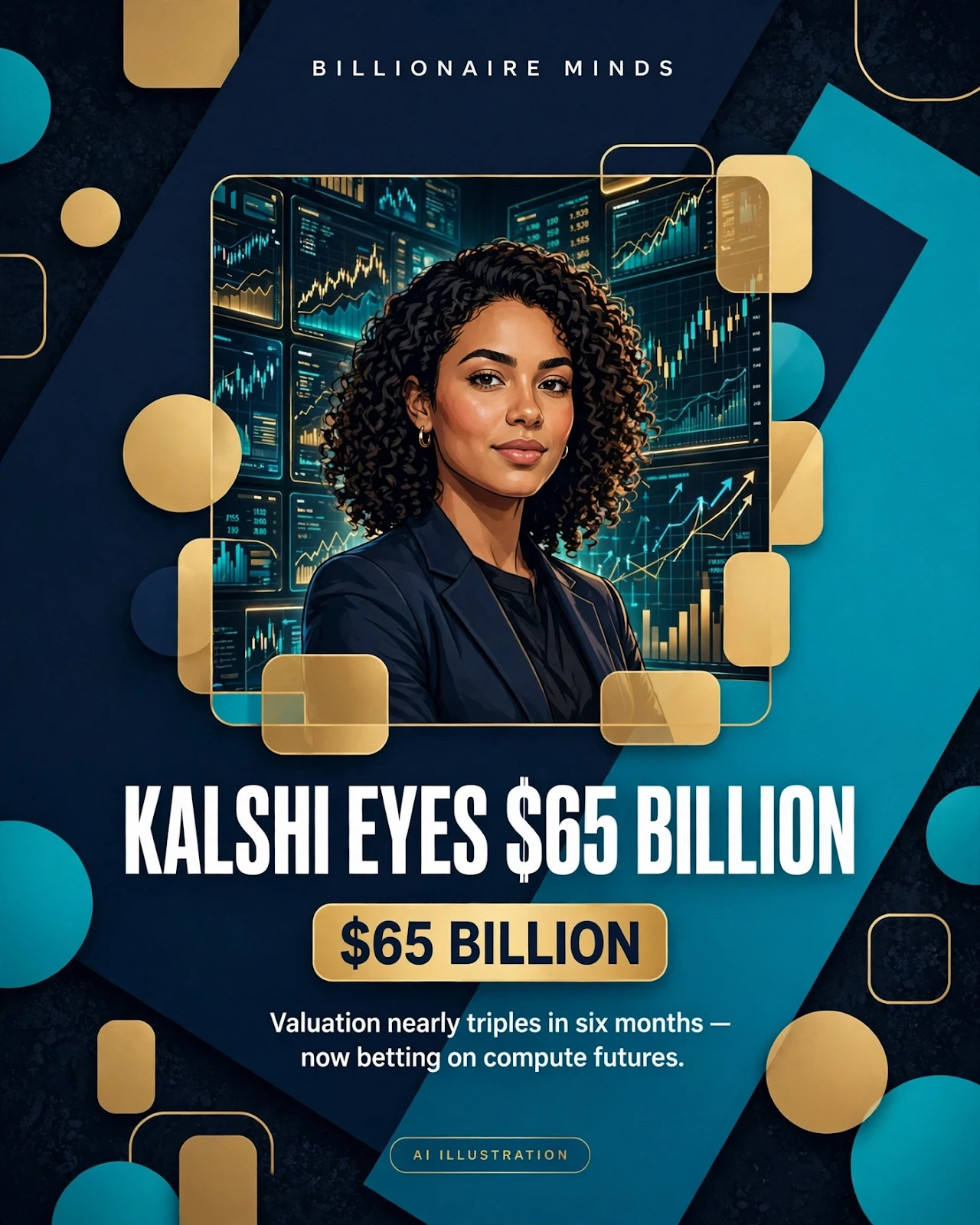
Kalshi Eyes a $65 Billion Valuation — the Prediction Market That Nearly Tripled in Six Months

Kalshi co-founder Luana Lopes Lara — the prediction market eyes a $65 billion valuation, nearly triple its May level, to build a compute-futures platform

Kalshi is in talks to raise fresh money at a $65 billion valuation — barely two weeks after a funding round valued the prediction market at $40 billion, and nearly triple the $22 billion it was worth in May.

A $65 Billion Valuation — Up 62.5% in Two Weeks

Bloomberg reported on Thursday, November 12, that Kalshi is seeking more private capital ahead of an anticipated initial public offering, and Reuters confirmed the same day that the raise would fund a new platform for trading compute futures — contracts tied to the rental price of graphics processors and cloud computing capacity. The size of the new raise and the investors involved have not been made public, and Kalshi has not commented. A $65 billion valuation would be 62.5% above the level set in late October and almost triple the $22 billion valuation from May.

From Betting Markets to the AI Compute Race

Kalshi said on October 29 that it had raised $1 billion at a $40 billion post-money valuation in a round co-led by Sequoia Capital and Wellington Management, with Andreessen Horowitz, Coatue and Morgan Stanley Investment Management among the other investors. That round was expected to be its last private raise before a possible IPO. The October fundraise came just over five months after Kalshi raised $1 billion in a Coatue-led round that valued the company at $22 billion. The move into compute futures is part of a broader push beyond event contracts and into products that compete more directly with traditional exchanges — Kalshi also named financial indexes and single-stock perpetual futures among its planned launches in October.

The Billionaire Behind the Bet

Kalshi was co-founded by Brazilian billionaire Luana Lopes Lara and Tarek Mansour. Forbes added both to its billionaires list in December 2025 after the $11 billion round and named Lopes Lara the world's youngest self-made woman billionaire. The valuation sprint — $22 billion in May, $40 billion in October, $65 billion now in talks — makes Kalshi one of the fastest-rising private companies of the year, and the compute-futures bet puts it squarely in the middle of the AI infrastructure boom.

Source: Billionaires.Africa (November 14, 2026); PYMNTS reporting Bloomberg (November 12, 2026); Reuters (November 12, 2026). This is a fan/commentary summary of reported news; all figures are the sources' estimates. Image: AI illustration.

Anthropic's $1.4 Trillion IPO Is 6x Oversubscribed — the Biggest Listing in History Is Days Away

Anthropic CEO Dario Amodei — the AI company's $1.4 trillion IPO is six times oversubscribed ahead of its November 19 Nasdaq debut.

Billionaire Dario Amodei is about to take Anthropic public — and Wall Street cannot get enough of it. The maker of the Claude chatbot has set its IPO price range at $70 to $78 a share, targeting a valuation of about $1.4 trillion, with orders running roughly six times the shares on offer.

The listing, set to price on Wednesday, November 18 and start trading on the Nasdaq on Thursday, November 19 under the ticker ANT, could become the biggest IPO in history. Anthropic is selling 825 million shares for up to $64.4 billion, and a concurrent $26 billion private placement from backers including Google, Nvidia and Microsoft could push the total past $90 billion.

A $1.4 trillion valuation — down from $2 trillion

The price range still sits well below the $2 trillion valuation some investors floated in early October, after a brutal selloff in AI stocks cooled the market. Amodei himself sounded deliberately cautious at a JPMorgan event on Friday, telling CEO Jamie Dimon the company wants to "underpromise and overdeliver" — and that he has been repeatedly advised never to let Anthropic be valued above what it is actually worth.

Even so, demand is overwhelming. Bankers are exploring pricing above the stated range, which could lift the fully diluted valuation beyond $1.5 trillion. The company reported $33.2 billion in revenue for the first nine months of 2026, with its operating loss narrowing to $1.3 billion from $5.2 billion a year earlier.

What the money is for — and who gets rich

Amodei told Dimon the listing's main purpose is building a cash buffer big enough to keep funding computing power, calling it the company's "deepest business dilemma." Anthropic carries about $895 billion in commitments, mostly for chips and computing capacity.

The listing will mint a new class of billionaires. Anthropic's seven co-founders each hold stakes of about 1.4 percent and would remain billionaires several times over even after pledging 80 percent of their personal equity to philanthropy. Amodei himself is worth an estimated $13 billion, while former Google chief Eric Schmidt's stake could be worth up to $20 billion at listing. One notable restriction: Anthropic is turning away share orders from institutional investors based in mainland China and Hong Kong.

Source: Bloomberg via The Telegraph, November 14, 2026; The Thursday Times; AJU Press; BusinessToday. This is a fan/commentary summary of reported news; all figures are the sources' estimates.

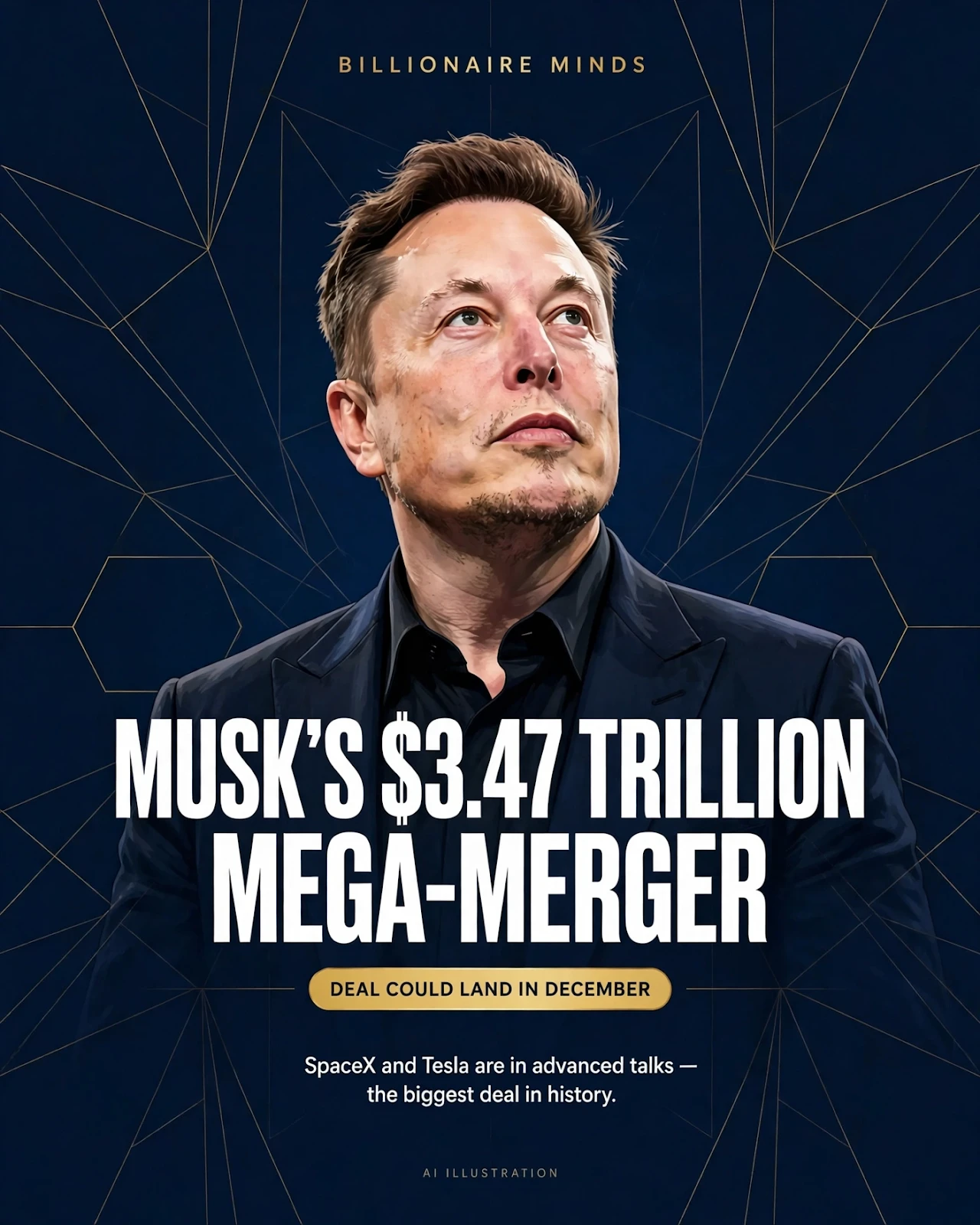
Musk's $3.47 Trillion Mega-Merger Is Moving Fast — SpaceX and Tesla Could Announce in December

Elon Musk — SpaceX and Tesla are in advanced merger talks on a $3.47 trillion deal that could be announced as early as December

Elon Musk is moving fast on the biggest deal in corporate history. SpaceX and Tesla are progressing in their merger negotiations, Bloomberg reported on Thursday, and the two companies could announce the combination as soon as December.

The deal would unite Musk's two largest companies — SpaceX, worth more than $1.9 trillion after its June IPO, and Tesla, worth about $1.5 trillion — into a single $3.47 trillion giant spanning rockets, satellites, electric cars, batteries, AI and humanoid robots.

The biggest deal in history

The boards and advisers of both companies are now hammering out the terms of the tie-up and the governance structure of the combined entity, according to people familiar with the matter. Musk said in October that both boards had formed special committees of independent directors to consider combining. Tesla shares jumped to a session high, rising as much as 1.9%, on Thursday, while SpaceX stock gained 0.5%.

An announcement could also slip into early 2027, the sources said. Bloomberg had earlier reported that the companies were pushing to announce a deal by the first half of next year, with the aim of closing it before the end of President Donald Trump's term. One factor under discussion is how many SpaceX shares Tesla investors would receive. Tesla is slated to hold its annual shareholder meeting on December 3.

Why Musk wants one company

The rationale, Bloomberg reports, is a shared ambition to leverage artificial intelligence across space, driverless cars and humanoid robots. The companies already cooperate closely, including a joint effort to build a semiconductor plant in Texas called Terafab. SpaceX has transformed from a rocket maker into a crucial supplier of AI infrastructure — including to Anthropic — and a top provider of satellite internet.

The obstacles standing in the way

The deal still faces steep hurdles. The companies must work out how to ring-fence Tesla's operations in China, while national security sensitivities around SpaceX's US government and defence contracts loom large. JPMorgan analyst Rajat Gupta called those "key dynamics that are at odds with each other" when it comes to winning regulatory and shareholder approval.

It will also be a major test of the political mood after the US midterm elections, in which Democrats took control of Congress and pledged to probe Musk's business and political dealings. But if the talks hold, December could deliver the largest merger the world has ever seen.

Source: Bloomberg via The Hindu BusinessLine (Nov 13, 2026); Reuters via bdnews24 (Nov 13, 2026). This is a fan/commentary summary of reported news. All figures are the sources' estimates. The portrait on this post is a stylised AI illustration, not a photograph of Elon Musk.

Nvidia's New Boss Is a Billionaire CFO — Colette Kress Takes Over the $4 Trillion AI Giant After Huang's Exit

Colette Kress, Nvidia's billionaire chief financial officer, now interim CEO of the $4 trillion AI chip giant after Jensen Huang's resignation

For 33 years, Nvidia had exactly one chief executive: Jensen Huang. That era ended on Thursday, November 12, 2026 — and the person now running the world's most valuable chipmaker is a 59-year-old billionaire most people have never heard of: Colette Kress.

Kress, Nvidia's chief financial officer and executive vice president since September 2013, was named interim CEO hours after Huang resigned. She keeps her CFO role while the board searches for a permanent successor, and longtime board member Harvey C. Jones has become the company's first chairman.

The CFO who became a billionaire

Kress is one of the very few chief financial officers in history to become a billionaire. She crossed the $1 billion mark in July 2025, according to the Bloomberg Billionaires Index, and Forbes ranked her 32nd on its 2026 list of America's Richest Self-Made Women with an estimated fortune of $1.2 billion as of June. Her wealth comes almost entirely from Nvidia stock accumulated over 13 years of executive pay — she beneficially owned about 4.4 million shares as of March 2026, and her total compensation last year was $14.34 million.

From $4 billion to $216 billion in revenue

Kress joined Nvidia in 2013, when the company's annual revenue was about $4.1 billion. In fiscal 2026 it hit $215.9 billion — a more than 5,000% jump driven by the AI chip boom. Before Nvidia, she spent nearly 25 years in senior finance roles at Cisco and Microsoft. She studied finance at the University of Arizona and holds an MBA from Southern Methodist University.

What she inherits — and what's next

Kress takes over a company under extraordinary pressure. Huang resigned after admitting an extramarital affair and apologising to employees; US intelligence reportedly suspects the woman involved of ties to Beijing, an allegation that has not been proven, and Nvidia's board has launched an independent investigation. Nvidia shares have fallen sharply in recent days, and the company reports third-quarter results on November 17 — Kress's first earnings call as chief executive.

Source: NY Post (Nov 12, 2026); Indian Express (Nov 12, 2026); Economic Times (Nov 12, 2026); Celebrity Net Worth (Nov 12, 2026). Net worth figures are estimates and move with Nvidia's share price. The espionage allegation is reported as a suspicion by US intelligence and has not been proven.

SpaceX's 12% Slide Just Made Musk's Tesla Buyout a Lot More Expensive — Tesla Investors Would Own the Combined Company

Elon Musk's dream of folding Tesla into SpaceX just hit a very expensive snag — and the stock market did it. SpaceX shares have fallen roughly 12% since the company reported strong third-quarter results on October 21, while Tesla stock has stayed flat over the same stretch. That gap has quietly rewritten the price of the biggest merger in stock market history.

The math just flipped

Most Wall Street analysts expect SpaceX to act as the buyer in an all-stock deal, paying a premium for Tesla. But a lower SpaceX share price means the rocket company must hand over far more stock to buy the carmaker. At a 15% premium at current prices, SpaceX would have to give Tesla investors about 3.2 SpaceX shares for each Tesla share — and based on fully diluted share counts from FactSet, that exchange rate would leave Tesla shareholders owning more than 50% of the combined company.

Compare that with earlier this year, when SpaceX traded at $200 a share. Back then, a 15% premium would have cost just 2.3 SpaceX shares per Tesla share, leaving SpaceX investors with roughly 57% of the merged business. The 12% slide has flipped majority control to the other side of the table.

A $3.5 trillion question with no deal yet

Talk of a tie-up jumped after Musk told investors on October 20 that the boards of both companies had formed special committees to review a deal. Bringing the two together would create an AI giant controlling power generation, chip making, AI models, software agents and humanoid robots. Barclays has even put a $450-a-share value on Tesla in a deal — roughly a 20% premium — and called the merger a key part of the Tesla bull case.

But there is still no agreement, no merger proposal and no shareholder vote scheduled. Any deal would need approval from a majority of all outstanding Tesla shares, and Musk himself cannot take part in the committees' discussions because he leads both companies.

The warning sign is already flashing elsewhere. Traders recently punished chipmaker Marvell and optical firm Lumentum after the pair announced an all-stock merger in early November — Marvell's share price sat well below its 52-week high, so it had to issue far more shares to pay the same price. SpaceX faces the same hurdle. Unless its shares bounce back soon, the sheer cost of issuing so much new stock could stall the buyout talks altogether — and leave Musk's mega-merger on the launch pad.

Source: TipRanks (Nov 12, 2026); The Motley Fool / Barclays (Nov 1, 2026). SpaceX is valued at roughly $2 trillion and Tesla at about $1.5 trillion. No merger agreement has been announced.


Jensen Huang Lost His $36 Million CEO Job — But He'll Still Pocket $811 Million a Year From Nvidia

Jensen Huang — the former Nvidia CEO will still earn $811 million a year in dividends from his Nvidia shares

Jensen Huang just lost the job he held for 33 years. The money, it turns out, is not going anywhere.

Nvidia announced on Thursday, November 12, that Huang had resigned as president, CEO and a member of the board, effective immediately — ending one of the longest and most successful CEO runs in American corporate history. He co-founded the chipmaker in 1993 and built it into a $4 trillion AI giant.

But while the title is gone, the fortune keeps paying out. Huang still owns roughly 3.6% of Nvidia — and those shares throw off an extraordinary stream of dividend income.

The $811 Million Dividend Windfall

According to Huang's September 18, 2026 SEC Form 4 filing, he held 811,521,160 Nvidia shares directly and through family trusts and companies. In May, Nvidia raised its quarterly cash dividend from $0.01 per share to $0.25 per share — and at that rate, his holdings generate $202.9 million every quarter.

That works out to $811.5 million a year. Averaged across the year, it is more than $2.2 million a day — whether he works or not.

And the number could be even bigger. Nvidia's March 2026 proxy statement listed 870.6 million shares under Huang's beneficial ownership, including 58.7 million shares held by the Jen-Hsun and Lori Huang Foundation. At the current dividend rate, that larger stake would pay $870.6 million a year.

More Than 500 Times His Old Salary

For scale, Huang's total pay package as CEO was valued at $36.3 million in fiscal 2026 — a $1.5 million base salary, $6 million in cash incentives, $24.8 million in stock awards and about $4 million in other compensation. His dividend income alone is roughly 22 times that entire package, and more than 500 times his base salary.

His net worth has still taken a hit. At Nvidia's $3.85 trillion market value, Huang is worth around $138 billion — down from roughly $210 billion in May, when the company's market cap briefly touched $6 trillion. But at $2.2 million a day in dividends, the former CEO hardly needs the paycheck.

As a teenager, Huang worked at Denny's for $2.65 an hour. Three decades later, the company he built over coffee at that same chain pays him more in a single day than most people earn in a lifetime.

Source: Celebrity Net Worth, reporting Nvidia's announcement, SEC filings and the company's March 2026 proxy statement. The portrait on this post is a stylised AI illustration, not a photograph of Jensen Huang.

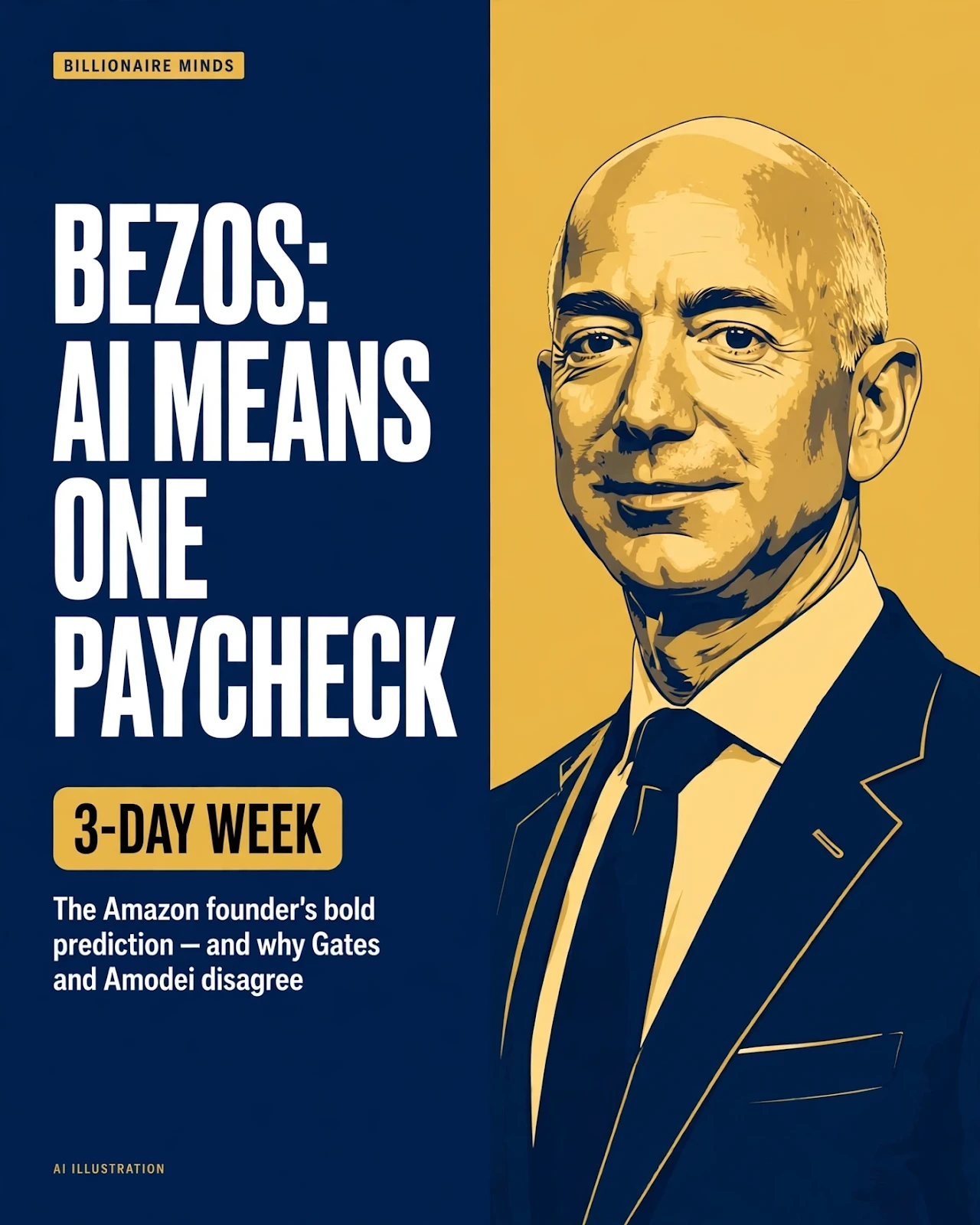
Jeff Bezos Says AI Will Let Families Live on One Paycheck — and Work Just 3 Days a Week

Stylized AI illustration of Amazon founder Jeff Bezos in a dark suit, under the headline 'Bezos: AI Means One Paycheck' with a 3-Day Week badge

Jeff Bezos thinks artificial intelligence is about to change the way American families live — not by taking jobs, but by making one income enough. Speaking with Fox News' Bret Baier on the factory floor of his rocket company Blue Origin in Cape Canaveral, Florida, the Amazon founder predicted AI-driven productivity gains could let two-income households live on a single paycheck — or let workers support a family on a three-day week.

"You're not going to need to have a two-earner household. If you want it, fine. If you don't want to have it, one of the people might drop out," Bezos said. Instead of mass unemployment, he expects a labor shortage, with employers competing for people who can afford to work less. "It's going to actually be difficult to hire people," he said.

A prediction he's made before

Bezos made a similar argument in June at VivaTech in Paris, where he said AI will create more jobs, not fewer. The stakes are large: in 2025, both parents worked full-time in 52% of U.S. different-sex couples with children under 18, up from 31% in 1975, according to Pew Research Center. A one-paycheck norm would reverse a half-century shift in how American families earn and spend.

The skeptics: Amodei and Gates

Not every AI leader shares Bezos' optimism. Anthropic CEO Dario Amodei warned in May 2025 that AI could eliminate roughly half of all entry-level white-collar jobs within five years and push unemployment to 10% to 20%. Microsoft co-founder Bill Gates has floated a two-day workweek, but in an August essay he warned the AI shift will be "one of the most turbulent times in human history" and that world leaders are unprepared for its risks.

Bezos has $6.2 billion behind the bet

Bezos is co-founder and co-CEO of Project Prometheus, an AI startup that launched with $6.2 billion in funding to apply AI to engineering and manufacturing in computing, aerospace and automobiles. "We're going to make the tools so easy to use that anyone will be able to be an engineer," he told Baier. But skeptics note a basic condition: productivity gains become shorter hours only if the savings reach employees. Amazon itself — No. 1 on the 2026 Fortune 500 with more than $700 billion in revenue — has cut about 30,000 corporate roles since late 2025 while planning more than $200 billion in capital spending this year, mostly on data centers.

Source: Fortune (November 12, 2026), reporting Bezos' Fox News interview with Bret Baier. The portrait on this post is a stylised AI illustration, not a photograph of Jeff Bezos.

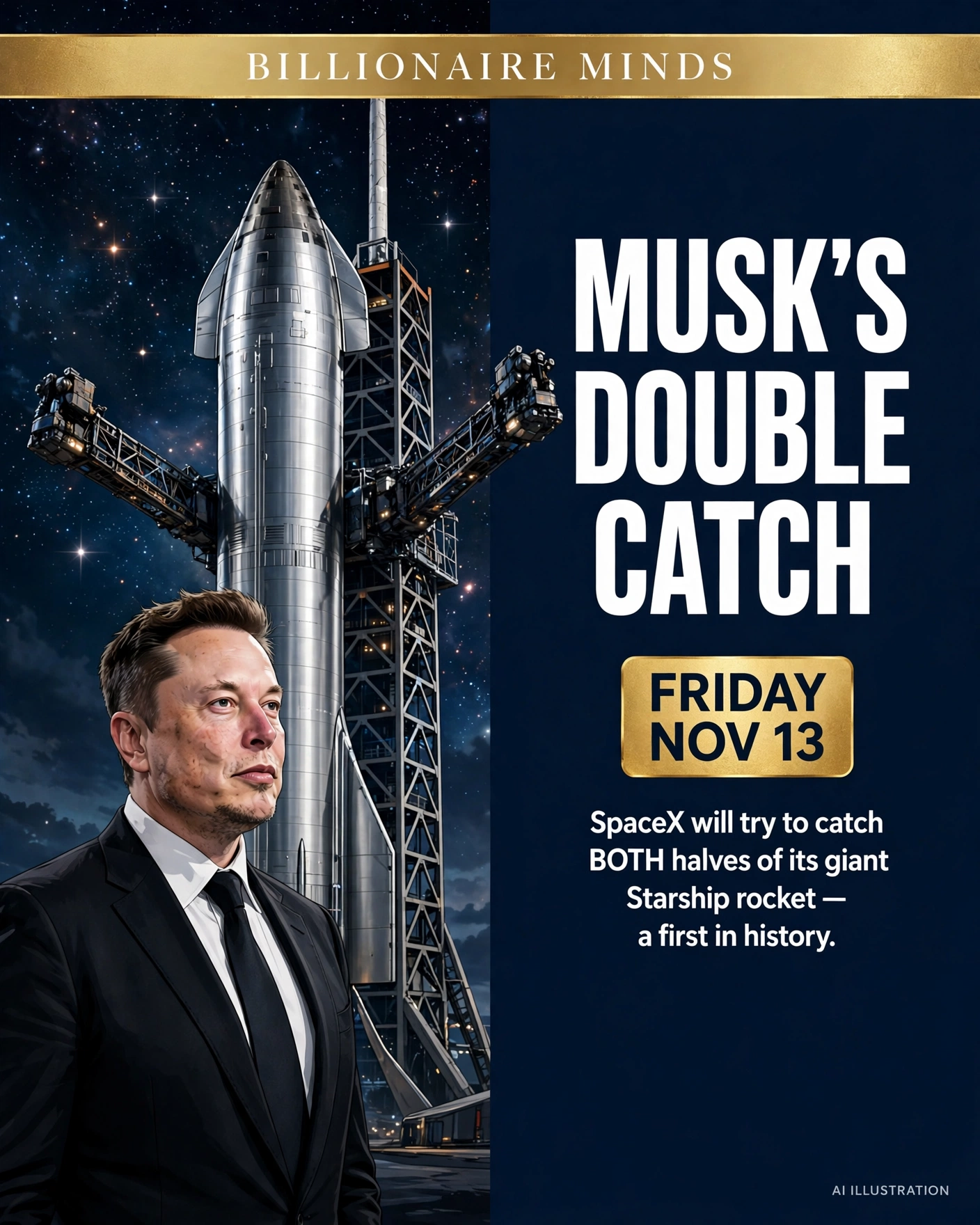
Elon Musk's SpaceX Targets Friday the 13th for the First-Ever Double Rocket Catch

Stylized illustration of Elon Musk with SpaceX's giant Starship rocket and launch tower against a starry sky — SpaceX will try to catch both halves of the rocket on Friday, November 13

Elon Musk's SpaceX is one week away from the most audacious test flight in its history. On Friday, November 13, the company will attempt something no one has ever done: catch both halves of an orbital rocket and bring them home in one piece. "SpaceX will attempt to catch both the Super Heavy booster and Starship on the upcoming flight," Musk wrote on X on November 6. "If both are successful, it will mark the first time that all parts of an orbital rocket return to Earth intact. This is the critical breakthrough needed to make life multiplanetary."

Two catches, one flight

Flight 15 will fly Booster 22 and Ship 42 — both Block 3 vehicles — from Orbital Launch Pad 2 at Starbase, Texas, in a 75-minute window opening at 4:45 p.m. Central Time, pending final regulatory approval. After hot staging and separation, the Super Heavy booster is planned to return for a tower catch roughly six minutes and 35 seconds after liftoff. The Ship has the harder job: it will climb to a roughly 275-kilometre orbit, deploy 26 advanced Starlink V3 satellites, circle Earth about 14 times over more than 22 hours, then attempt a deorbit burn, a belly-flop reentry, a flip and a landing burn into the launch tower's chopstick arms at about T-plus 22 hours and 32 minutes. SpaceX has caught boosters three times before, on Flights 5, 7 and 8. The Ship has never been caught.

Why it matters — and what it is worth

Full recovery is the economics of Musk's space empire. A rocket that can be caught, inspected, refurbished and reflown quickly slashes the cost of every launch — and the high launch cadence it enables is what Starlink, lunar missions and eventually Mars settlement all depend on. Musk told investors at last week's Baron conference that SpaceX aims to pass a $100 billion annualized revenue run rate in December, and the Starlink satellites riding on Flight 15 are the revenue engine behind that number. Musk put the odds of pulling off the first double catch at "more likely than not" — and if the Ship's health checks fail, it will splash down in the Pacific instead, with the booster falling back to the Gulf of Mexico. Either way, a steady stream of further flights is already scheduled. Friday the 13th, it turns out, could be the luckiest day in rocket history.

Source: Teslarati, November 8, 2026 (Musk X post November 6; SpaceX VP of Launch Kiko Dontchev at the UP.Summit, November 5); Business Today, November 7, 2026. This is a fan/commentary summary of reported news; all figures are the sources' estimates. Portrait: AI illustration.

Jeff Bezos's $1,450 Astro Flopped — Now Amazon Is Building a New Home Robot

Stylized illustration of a friendly humanoid home robot in a living room, with Amazon's Astro robot faded behind it — Amazon is building a new home robot after Astro flopped

Jeff Bezos made a bold bet in 2017: he told Amazon's top device executives to build a robot for the home. The result was Astro, a $1,450 Alexa-powered tablet on wheels that could roam the house, recognise faces and act as a roving security monitor. It rolled on stage at Amazon's fall 2021 event — and then quietly stalled. Astro never left its invite-only list, shipping to just a few thousand customers, and its business version was shut down less than a year after launch. Now, Amazon is trying again.

Astro: the $1,450 bet that never left the invite list

For the people who did buy one, Astro became a mixed blessing. One owner in North Carolina told CNBC she still uses it to check on pets and appliances, but mostly it has become "a party trick and a trip hazard" that gets sent back to its charging dock most days. Amazon executives had discussed giving Astro an arm to pick things up, and former consumer robotics chief Ken Washington said he pushed for a bipedal robot — but leadership disagreed. Bezos himself sat in on show-and-tells: Washington recalls the founder was "disappointed with the lack of functionality" but impressed by Astro's ability to map and navigate an undefined space under any lighting.

The second attempt: Fauna, Sprout and a new robotics group

According to a CNBC analysis of job posts published November 8, Amazon has spent the past several months assembling a new team to build a "new-to-world robot product." One since-removed engineering listing promised that "robots are about to step out of the movies and into our homes," describing a machine that navigates "dynamic home environments" and operates "autonomously alongside family members." Earlier this year Amazon redeployed much of the Astro team and hired an MIT roboticist, and in March it acquired New York-based Fauna Robotics — maker of Sprout, a 3.5-foot-tall humanoid with expressive yellow eyebrows — folding it into a new division called the Personal Robotics Group. A June job posting hinted at the goal: "create robots that are not just functional, but delightful."

A $40 billion race for the living room

Amazon is not alone. Tesla has been developing its Optimus humanoid since 2021, Apple is reportedly working on home robots, and venture capital poured $33.4 billion into robotics and physical AI companies in the first half of 2026 alone — more than all of 2025, according to PitchBook. Barclays forecasts the humanoid market, worth $2–3 billion today, could reach roughly $40 billion by 2035. Amazon spokesperson Brad Glasser told CNBC the company acquired Fauna because it is "committed to tackling the challenges that can unlock the personal robotics category." No product name, price or launch date has been disclosed — but after Astro, Bezos's robot dream is officially back on.

Source: CNBC, November 8, 2026. This is a fan/commentary summary of reported news; all figures are the sources' estimates. Portrait: AI illustration.

Zuckerberg's Secret Robot Max: Meta Quietly Built a Humanoid for Your Home — With China's Help

Mark Zuckerberg beside Meta's humanoid robot Max — AI illustration

Mark Zuckerberg wants artificial intelligence walking around your home — literally. Meta has quietly built a humanoid robot called Max, a five-foot-tall machine designed to see, hear and move through a living room, according to a report by The Information, picked up by Reuters and featured on the BBC's AI Decoded programme on November 8.

Built in three months — with China's help

Max was assembled in about three months in partnership with Fourier, a Chinese robotics company based in Shanghai. The prototype stands about 1.5 metres tall, weighs roughly 48 kilograms, and runs on Nvidia's Jetson Thor chip. Its five-fingered hands can grip small, light objects like bottles and toys, and it is designed to hear a voice from five metres away, spot a wave from three, and hold eye contact — the very human skills a home robot needs.

Research only — for now

Meta has confirmed the collaboration but says the project is research only, with no plans to sell the robots. Max was shown to employees at an internal event in late August, and a second-generation model, Max 2, is already in development — with more dexterous hands, a projector, and extra sensors to handle stairs, the obstacle that stops most legged robots in a real home. Meta is also hiring in Shanghai and Shenzhen, including for large-scale manufacturing.

The timing is no accident. Silicon Valley is now racing to give AI a body, and Zuckerberg — worth more than $200 billion as Meta's chief executive — is betting that the next frontier for artificial intelligence is not on a screen, but standing in your living room.

Source: The Information, October 31, 2026, via Reuters and Interesting Engineering, November 7, 2026; BBC News AI Decoded, November 8, 2026. This is a fan/commentary summary of reported news; all figures are the sources' estimates. Portrait: AI illustration.

Mark Zuckerberg's 10-Year-Old Daughter Is Already Vibe-Coding Apps — But Mom Vetoed Her Dating Site

Mark Zuckerberg's 10-year-old daughter Maxima vibe-coding apps on a laptop — AI illustration

The world's fifth-richest man has a coder in the house — and she's ten years old. Mark Zuckerberg and Priscilla Chan's eldest daughter, Maxima, is already building apps with artificial intelligence, according to a new interview Chan gave to the investment podcast Colossus, reported by The Economic Times on November 8.

The dating site that got a hard no

Maxima has been experimenting with "vibe-coding" — describing what she wants in plain language and letting AI tools write the code. Her parents encourage the building, but Chan has drawn a firm line: nothing Maxima makes can go live on the internet. That rule has already killed one idea.

"She's quite limited, because Mom doesn't let her build things that are open to the internet. Like, she wanted to build a dating site. That was a no," Chan said.

A builder's instinct, inherited

What Maxima has built so far already sounds like a startup founder's first portfolio: a messaging app, apps in the spirit of the early web hub GeoCities, and a game inspired by FarmVille — and, like her father, she thinks in business terms. Each project came with its own marketing and sales plan.

Chan says the drive was never taught. "She just has a desire to build things that is innate, that we didn't teach her. It just came. She's delighted by the idea of bringing something into the world," she said.

The youngest Zuckerbergs are already building

The interest is no accident of the household. Zuckerberg has previously talked about introducing his daughters to coding through Scratch, robotics and 3D printing, and the family has experimented with Replit, Kano, Raspberry Pi and Nvidia Jetson devices. Maxima's younger sister August has used Meta AI to illustrate and trailer a book she wrote, The Mermaid Crystal.

Zuckerberg, worth more than $200 billion as Meta's chief executive, built his own empire from a dorm-room project. If Maxima keeps building at this pace — dating sites excepted — the family's next founder may already be at the keyboard.

Source: The Economic Times, November 8, 2026, reporting Priscilla Chan's interview with Colossus. This is a fan/commentary summary of reported news; all figures are the sources' estimates. Portrait: AI illustration.

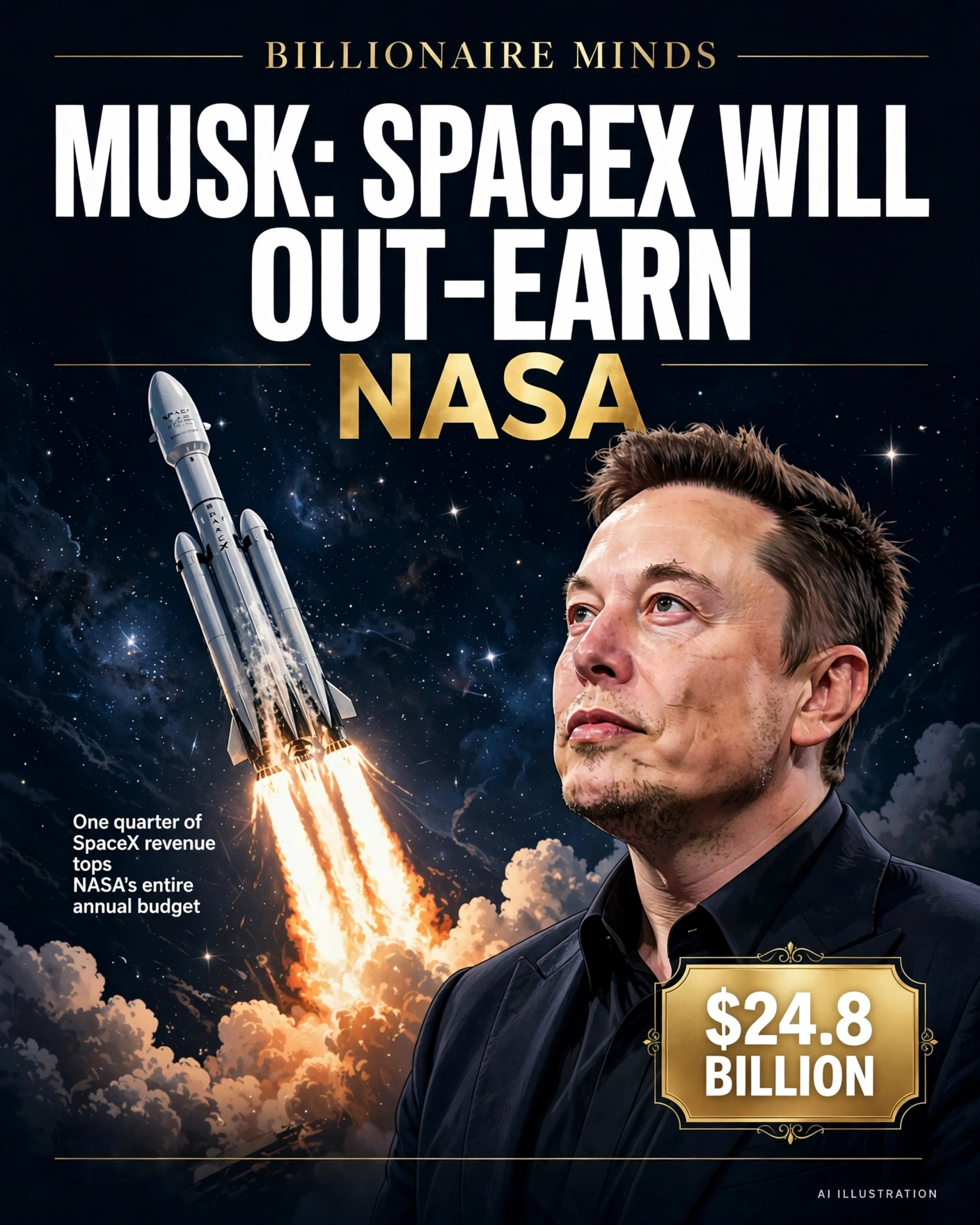
Musk Says SpaceX Will Out-Earn NASA's Entire Budget This Quarter — $24.8 Billion in 3 Months

Elon Musk looking up at a SpaceX rocket launching into a starry sky — he says SpaceX will earn $24.8 billion this quarter, more than NASA's entire annual budget

Image: AI illustration.

Elon Musk just put a number on SpaceX's transformation — and it is bigger than NASA's entire year. Speaking virtually at the 33rd Annual Baron Investment Conference in New York on Friday, Musk said SpaceX's fourth-quarter revenue should rise roughly 70 percent from the third quarter, putting sales near $24.8 billion. Then he drove the point home on X: "SpaceX revenue this quarter alone will be substantially higher than NASA's entire annual budget!" NASA received $24.4 billion in regular fiscal 2026 appropriations, according to a Congressional Budget Office assessment — so on that measure, one quarter of SpaceX now tops a full year of NASA.

The AI business is now bigger than the rockets

The forecast builds on a third quarter in which SpaceX reported $14.58 billion in revenue, up 161 percent from a year earlier. The surprise is what is driving it: the company's Super Intelligence unit, which leases AI computing capacity to other developers, generated $7.56 billion — more than half of total revenue and the company's largest segment for the first time. Connectivity, home to Starlink, brought in $5.25 billion, and space operations $1.77 billion. Anthropic has replaced NASA as SpaceX's single largest customer, accounting for about 34.5 percent of third-quarter revenue. Musk also gave a first launch date for StarMind, SpaceX's planned space-based AI computing network: 2027.

Washington is becoming a footnote

Musk used the moment to answer the midterm-election question hanging over his companies. Government contracts made up 16.6 percent of SpaceX revenue last quarter, he said, and will fall below 10 percent this quarter — and under 5 percent within a year. "Happy to cancel any that the government doesn't want. Just say the word!" he posted on X. The pitch landed with investors: SpaceX shares finished Friday up 8.6 percent at $134.27, rebounding from a two-day slide that had wiped more than $420 billion off the combined market value of Tesla and SpaceX after Democrats swept Congress. Musk repeated his goal of reaching a $100 billion annualized revenue rate by December — and said it could exceed $500 billion by December 2027 — while cautioning investors: "This is not a promise. This is what I think will happen. This is my best guess." The rocket company that once survived on NASA contracts is now telling the world it can out-earn the agency in a single quarter.

Source: Benzinga via MarketSpeaker; TipRanks; Gizmodo; The Currency Analytics, November 6–7, 2026. This is a fan/commentary summary of reported news; all figures are the sources' estimates.