Posts

Showing posts with the label India

Prem Watsa Sells His $370 Million IIFL Stake to Fund the $5.6 Billion IDBI Bank Takeover

Prem Watsa — Fairfax sold its entire IIFL Finance stake for $370 million to fund the $5.6 billion IDBI Bank takeover

Canadian billionaire Prem Watsa is cashing out to go bigger. His Fairfax Financial has sold its entire stake in Indian lender IIFL Finance in a $370 million block deal — and every dollar is earmarked for the biggest acquisition in the company's history.

A Clean Exit at a Premium

Fairfax sold more than 56 million IIFL Finance shares on November 18 at a floor price of 611 rupees each, valuing the deal at about 34.54 billion rupees ($370 million), according to a Reuters report citing a source with direct knowledge of the transaction. The sale ends Fairfax's 13.64% holding in the lender — a complete exit. IIFL shares jumped as much as 6.5% to 678.10 rupees after the deal was done.

The $5.6 Billion Prize

The money is headed straight for IDBI Bank. Fairfax was named the winning bidder for a 60.72% stake in the state-backed lender, valued at about 528.78 billion rupees ($5.6 billion) — the largest investment in Fairfax's history. The group plans to turn IDBI into a major universal bank, combining its lending and deposit operations with insurance distribution through Go Digit and investment banking and wealth management through its other Indian interests.

What's Next

The IDBI Bank acquisition still requires regulatory and government approvals, with Fairfax previously indicating that it expects the deal to close early next year. Watsa — often called Canada's Warren Buffett — has spent decades building Fairfax into a global insurance and investment group, and the IIFL sale shows how far he is willing to go to rearrange his portfolio for the one deal that matters most.

Source: Billionaires.Africa, reporting Reuters (November 18, 2026). Portrait image is an AI illustration.
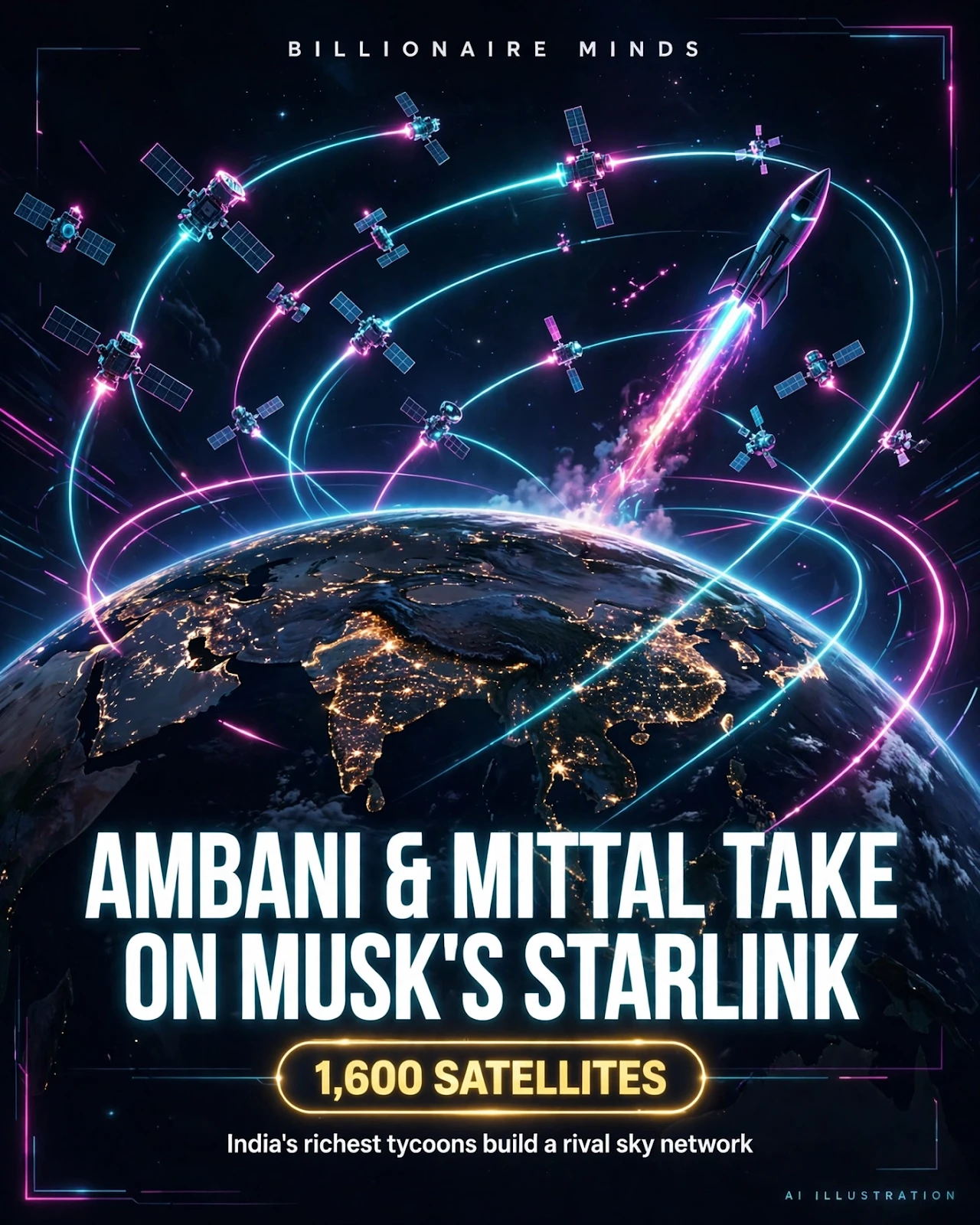

Ambani and Mittal Just Declared War on Musk's Starlink — a 1,600-Satellite Rival

Stylized illustration of satellites orbiting Earth — Ambani and Mittal take on Musk's Starlink with a 1,600-satellite rival network

Two of India's richest men are taking the fight to Elon Musk — in orbit. Mukesh Ambani's Reliance Industries is planning a 1,600-satellite low Earth orbit constellation to rival Starlink, while telecom tycoon Sunil Mittal is backing Eutelsat's OneWeb as the independent alternative. The billionaire space race just got a lot more crowded.

Ambani's 1,600-Satellite Plan

Reliance is in talks with Indian satellite manufacturers, technology startups and larger industrial groups, offering to fund the infrastructure needed to scale up production. India currently produces fewer than 15 satellites a year — the constellation would need output of around 200 a year. The plan combines domestic manufacturing with imports, including at least 400 satellites from the US. Reliance is discussing procurement with two US companies and evaluating suppliers in Europe, while ruling out China as a source. A test mission is targeted for September 2027, with wider deployment from early 2028; completion has slipped from 2030 to 2035.

Mittal's OneWeb Bet

Meanwhile, Sunil Mittal is backing Eutelsat Communications' OneWeb, which is building a global satellite-internet network independent of both the US and China. "Countries can't rely on another country," Mittal told Bloomberg TV. OneWeb has around 650 satellites — far fewer than Starlink — and Bharti Airtel, India's second-largest telecom operator, was an early investor in 2015, joining the UK government in a $1 billion rescue in 2020 and investing another $500 million since.

The Gap They Have to Close

The commercial gap remains substantial. Starlink serves at least 13.6 million customers worldwide and generated more than $5 billion in connectivity revenue in the three months ended September. Eutelsat's LEO business, including OneWeb, generated just €70.9 million ($81.5 million) in the same period. Amazon is also developing a network of thousands of satellites. For Ambani and Mittal, the stakes go beyond broadband — satellite networks are increasingly vital for remote connectivity, communications and military operations, making control a matter of strategic autonomy. Starlink's planned India entry remains subject to regulatory and security scrutiny, strengthening the case for homegrown alternatives.

Source: BusinessToday, November 18, 2026. Image: AI illustration.

Two 39-Year-Olds Just Became Billionaires as Their Trading Firm's Profits Nearly Tripled

Two 39-year-old founders of Graviton Research Capital just became billionaires as the trading firm's Singapore profits nearly tripled

Two 39-year-old friends from college just joined the billionaire club — and they did it by trading faster than almost anyone else on the planet.

Bloomberg reports that Graviton Research Capital, the high-frequency trading firm founded by IIT-Delhi classmates Ankit Gupta and Nishil Gupta, nearly tripled profits at its Singapore unit — a surge big enough to push both founders past the billion-dollar mark.

From a Gurugram startup to a global trading machine

Graviton was founded in 2014 and is headquartered in Gurugram, India. What started as a small quantitative trading outfit has grown into a firm trading across global markets, with offices in Mumbai, Singapore, Hong Kong, Tokyo, London and New York. Its Singapore subsidiary, set up in 2018 to reach international venues, is now the engine of its growth — and the source of the profit jump that minted two new billionaires.

Why this matters

High-frequency trading is one of the most secretive corners of finance: firms use algorithms and super-fast systems to spot tiny price differences across markets, thousands of times a second. Graviton built its name as one of India's fastest-growing firms in the field — and now its founders are proof of how lucrative that speed can be. As the firm hires aggressively and expands globally, the two 39-year-olds have gone from classmates with a trading idea to members of one of the world's most exclusive clubs.

Source: Bloomberg Markets, November 16, 2026. This is a fan/commentary summary of reported news; all figures are the sources' estimates. Image is an AI illustration.

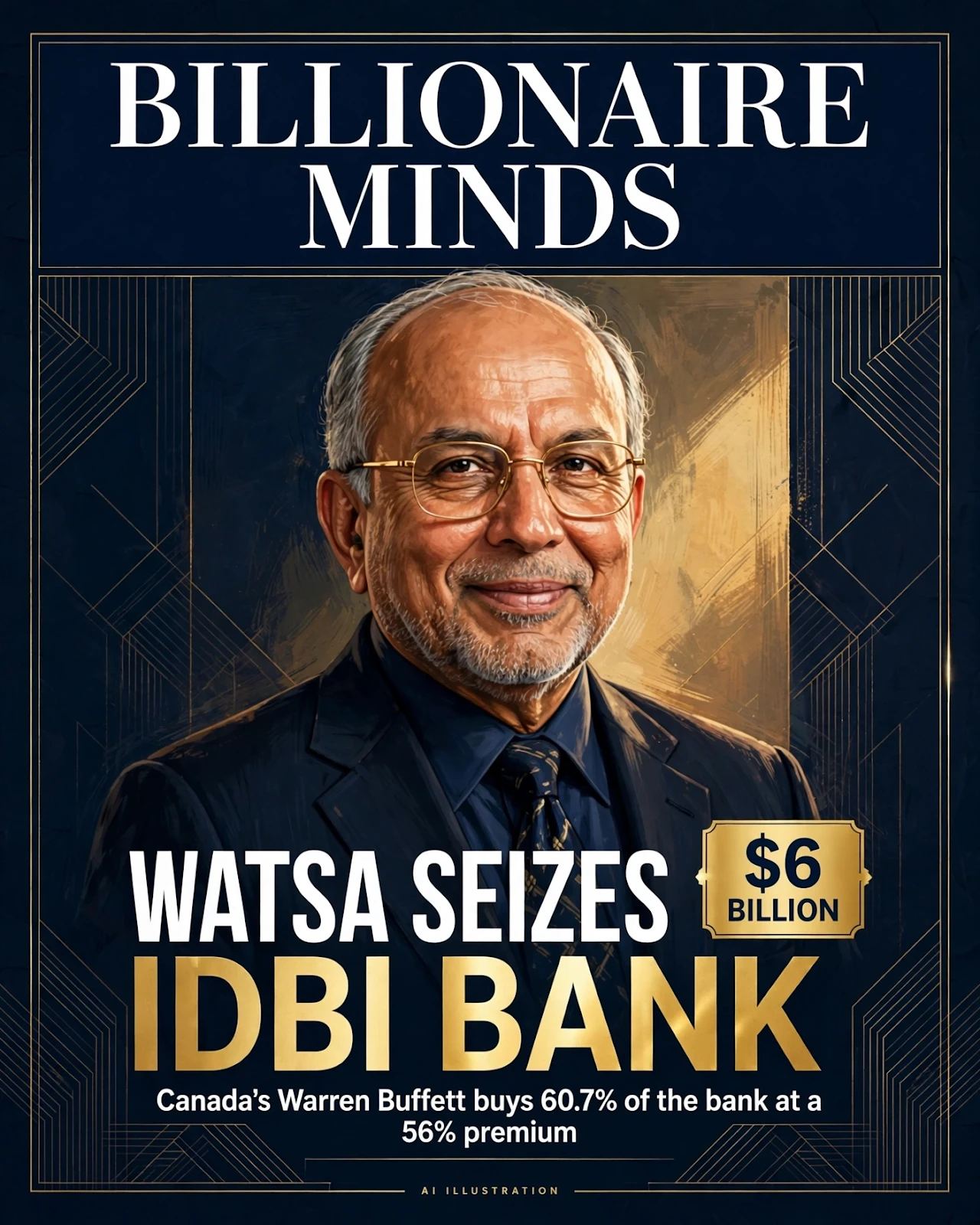
Billionaire Prem Watsa Just Seized Control of IDBI Bank — a $6 Billion Bet at a 56% Premium

Prem Watsa — billionaire investor whose Fairfax just seized control of IDBI Bank in a $6 billion deal at a 56% premium

Canada's Warren Buffett just pulled off one of the biggest bank takeovers in Indian history. Billionaire Prem Watsa's Fairfax Financial Holdings has clinched a landmark deal to buy a controlling 60.72% stake in IDBI Bank for Rs 52,878 crore — roughly $6 billion — beating rival bidders from around the world.

And he did not get it cheap. Fairfax offered Rs 81 per share, comfortably above the Indian government's own benchmark valuation of Rs 75.99 — and a full 56% premium over the bank's regulatory book value. When a value investor famous for never overpaying decides to pay up, the market pays attention.

A $6 Billion Bet on a Bank That Was Once on Life Support

IDBI Bank is a remarkable turnaround story in its own right. The lender spent four years — from 2017 to 2021 — under the Reserve Bank of India's Prompt Corrective Action framework, the regulator's intensive-care ward for struggling banks. Today it earns close to Rs 10,000 crore a year in profit.

Under the privatisation framework, the Indian government and the Life Insurance Corporation will keep a combined 34% stake, staying invested in the bank's future growth. Fairfax takes management control — and it has big plans for what comes next.

Fairfax Wants to Build a Financial Superstore

This is not just a bank purchase. Fairfax plans to fold its wider Indian financial portfolio into IDBI, bringing Go Digit General Insurance, Go Digit Life Insurance and IIFL Capital Services under the same roof. The goal: one integrated financial powerhouse offering banking, insurance, investment banking and wealth management — a challenger to giants like HDFC Bank and ICICI Bank.

Fairfax President and COO Peter Clarke said the lender "holds the potential to become a premier universal Indian bank with global reach." The deal still needs regulatory, shareholder and statutory approvals before it closes.

Why Watsa's Track Record Makes This One to Watch

Watsa, who built Fairfax from a small Canadian insurer into a global investment empire and earned the "Canada's Warren Buffett" nickname for his value-investing discipline, has done this before. Fairfax engineered successful turnarounds at CSB Bank and ICICI Lombard in India — buying unloved assets, fixing them, and holding them for the long term.

If IDBI follows the same playbook, the $6 billion cheque could look like a bargain in a decade. For now, one thing is clear: the quietest billionaire in the room just made the loudest banking move of the year.

Source: The Kolkata Mail (Nov 13, 2026); Lokmat Times. The portrait on this post is an AI-generated illustration.

James Murdoch Just Bet $180 Million on Dosas — His Firm Took Control of India's Famous A2B Chain

James Murdoch's Bodhi Tree is paying $180 million for control of Adyar Ananda Bhavan, the 50-year-old South Indian vegetarian chain

James Murdoch just placed his biggest bet yet outside media — on dosas. His investment firm Bodhi Tree Systems has agreed to pay $180 million for a majority stake in Adyar Ananda Bhavan, the 50-year-old South Indian vegetarian restaurant and sweet-shop chain known across India as A2B. The deal was announced in a joint statement on Thursday, and it is Bodhi Tree's first ever investment in the food business.

A 50-year-old sweet shop goes global

A2B began as a small sweet shop in Chennai, founded by brothers K.T. Srinivasa Raja and K.T. Venkatesan, and grew into one of South India's best-known food brands. Today it runs about 160 outlets across India and more than 30 overseas, in Singapore, the United States, Australia, Malaysia and Britain, selling dosas, idlis, sweets and packaged snacks. The money from Bodhi Tree will fund expansion at home and abroad, plus digital upgrades and modernised kitchens and manufacturing. Uday Shankar, Bodhi Tree's co-founder, will chair A2B's new board.

What $180 million buys

The companies did not disclose the exact size of the stake, but an industry source put the deal's valuation of A2B at roughly $350 million. The chain reported sales of 14.87 billion rupees — about $158.8 million — in the year to March 2025, with a net profit of 362 million rupees, or about $3.9 million, according to regulatory filings. Revenue is still growing: it was close to 1,600 crore rupees in the year to March 2026, up from 1,502 crore the year before. The deal is the latest bet by global investors on legacy Indian food brands as demand for Indian snacks and cuisine grows overseas.

The Murdoch family money, redeployed

James Murdoch, 53, is the younger son of Rupert Murdoch. He ran 21st Century Fox as chief executive until its entertainment assets were sold to Disney in 2019, then left the family business and set up Lupa Systems, his own investment firm. Bodhi Tree, which he co-founded with former Disney executive Uday Shankar in 2021, is his third big swing: it previously put $600 million into test-preparation company Allen Career Institute and became a strategic investor in the Reliance-Disney joint venture JioStar. In September 2025, Rupert Murdoch settled the long family-trust fight by handing control of News Corp. and Fox to eldest son Lachlan — and buying out James and his sisters Elisabeth and Prudence for about $1.1 billion each. James is now putting that money to work far from Hollywood: in dosas, idlis and sweets.

Source: Reuters (Nov 12, 2026); Economic Times (Nov 12, 2026); VCCircle (Nov 12, 2026); CNBC-TV18 (Nov 12, 2026); The Hindu (Nov 12, 2026); Business Standard (Nov 12, 2026); Billionaires.Africa (Nov 12, 2026). This is a fan/commentary summary of reported news. All figures are the sources' estimates. The portrait on this post is a stylised AI illustration, not a photograph of James Murdoch.

Sun Group Heiress Kavya Maran Weds Music Star Anirudh in Greece — Rajinikanth's Viral Dance Steals the Show

Stylized AI illustration of a glamorous Indian wedding celebration in Greece, under the headline 'Heiress Weds in Greece' with a '$2.6 Billion Empire' badge

India's most talked-about wedding of the year just happened in Greece — and it was not the bride and groom who stole the show. Music composer Anirudh Ravichander married Kavya Maran, heiress to the Sun Group media empire, in an intimate ceremony on November 11. Within hours, a video of superstar Rajinikanth dancing at the celebrations had gone viral across social media.

A union of music and media money

Kavya Maran is no ordinary bride. She is the CEO and co-owner of IPL franchise Sunrisers Hyderabad and an executive director at Sun TV Network — and the daughter of Sun Group chairman Kalanithi Maran, whose fortune Forbes puts at about $2.6 billion. The Sun Group empire spans 37 television channels reaching more than 140 million households, plus film production and the IPL team. Media reports estimate Kavya's own net worth at roughly Rs 400–500 crore, though that figure has never been officially confirmed. Anirudh, meanwhile, is one of India's most sought-after composers, the man behind the music of Shah Rukh Khan's 'Jawan' and the upcoming 'King'.

Rajinikanth steals the show

The viral clip shows Rajinikanth — Anirudh's uncle — dancing with abandon to 'Manasilaayo', the hit Anirudh composed for the actor's 2024 film 'Vettaiyan', and to 'Marana Mass' from 'Petta'. The superstar travelled to Greece with his wife Latha for the family occasion. Anirudh shared the first official wedding photograph on Instagram with the caption: "My once in a lifetime, for a lifetime 11.11". The celebrations began on November 10 with a traditional Tamil engagement ceremony, and guests included former Tamil Nadu chief minister M. K. Stalin and his son, deputy chief minister Udhayanidhi Stalin.

What happens next

The couple are expected to host a grand reception in Chennai on November 21, with invitations reportedly extended to Prime Minister Narendra Modi, Congress leader Sonia Gandhi and Tamil Nadu chief minister C. Joseph Vijay, among other leading names from film, politics and business. For now, though, the internet belongs to one dancing superstar — and a wedding that brought together two of South India's most powerful families.

Source: Gulf News (Nov 12, 2026), Times of India, Bollywood Hungama; net-worth figures are Forbes / media estimates. This is a fan/commentary summary of reported news. The portrait on this post is a stylised AI illustration, not a photograph of the couple.

Trump's Fortune Jumped $2 Billion Since Taking Office — and He Says He Doesn't Even Take a Salary

Donald Trump — his fortune surged $2 billion since taking office, Forbes says, with crypto earnings topping $1 billion in 2025

Donald Trump is $2 billion richer than he was the day he took office for his second term — and he insists he doesn't even take a salary for the job.

Forbes data released this week shows the US president's net worth climbed from $4.3 billion to $7.3 billion since January 2025, before settling at $6.5 billion in 2026. On Tuesday, Forbes put the figure at $6.3 billion.

From $4.3 Billion to $7.3 Billion

Most of the gain came from two places: real estate and cryptocurrency. Trump's licensing and management business alone added about $410 million to his net worth between 2024 and 2025, according to Forbes. Cash and other assets account for $1.9 billion of the total.

Crypto Did the Heavy Lifting

The president's annual financial disclosure shows he earned over $1 billion in 2025 through his family's cryptocurrency dealings — including World Liberty Financial and the memecoin business. Forbes senior editor Dan Alexander calculated that crypto activity generated about $1.425 billion in liquidity in a single year.

"You Should've Held Stocks"

Asked about the surge in his CBS 60 Minutes interview on Sunday, Trump brushed it off. "You should've held stocks," he told correspondent Ross Douthat, who pointed out his own wealth had not risen by $3 billion. Trump also defended his finances by noting he does not collect a presidential salary: "I've a lot of money; I don't take salary."

The Midterm Dip — and What Comes Next

The fortune has not only gone up. The midterm "blue tsunami" that handed Democrats both chambers of Congress cost Trump an estimated $238.1 million, and Truth Social traffic fell 30% year-on-year in September. Still, with nearly $8.5 million in India licensing fees from four projects and a $5 million Vietnam resort payout, the Trump business machine keeps minting money — even as the president heads to Asia on November 16 facing a transformed political landscape at home.

Source: NDTV, reporting Forbes data (November 12, 2026). The portrait on this post is a stylised AI illustration, not a photograph of Donald Trump.

Adani Unveils a $120 Billion Spending Spree — India's Biggest Private Bet Ever

Gautam Adani just raised the stakes on India's infrastructure race. His Adani Group plans to invest more than $120 billion in capital expenditure over the next five years — about $20 billion a year — in what would be one of the largest private-sector spending programmes ever announced in India.

The plan was outlined by senior group executives in an interview with Fortune India published on November 10. It is bigger than the $100 billion five-year investment the group had previously outlined, and it puts energy firmly at the centre of the build-out.

Where the $120 billion goes

About 70% of the money — roughly $84 billion — will go to energy: renewables, thermal power, data centres, transmission and distribution. Around 20% is earmarked for transport and logistics — ports, airports and roads — while the remaining 10% goes to adjacent businesses such as cement, copper and aluminium.

"Over the next five years, we plan to invest about $120 billion — over $20 billion a year — across all our businesses," Pranav Adani, a director at flagship firm Adani Enterprises and the chairman's nephew, told Fortune India. The group describes it as a rolling five-year plan, with the first year firm and the remaining four years flexible.

Doubling the empire

The group expects the spending to double its asset base to ₹18 trillion (about $189 billion) and generate core earnings of ₹2.6 trillion to ₹3 trillion ($27.3 billion to $31.5 billion) over the five-year period. Annual capex is set to jump to about ₹3.5 lakh crore in FY27, roughly 75% higher than the current plan.

The announcement comes days after Adani Ports agreed on November 5 to buy Netherlands-based Evos, Europe's second-largest independent liquid storage operator, for $2.87 billion — and after an Adani Enterprises joint venture completed the purchase of the Vizag Mega Data Center Park on November 8.

Adani, 64, who dropped out of college and started as a diamond sorter in Mumbai before founding his commodities trading business in 1988, built his empire around the Mundra port in Gujarat — now India's largest commercial port. Forbes ranks him among Asia's richest people, with a fortune built largely on his stakes in the group's listed companies.

Source: Billionaires.Africa (Nov 11, 2026), reporting Reuters / Fortune India (Nov 10, 2026). This is a fan/commentary summary of reported news; all figures are the sources' estimates.

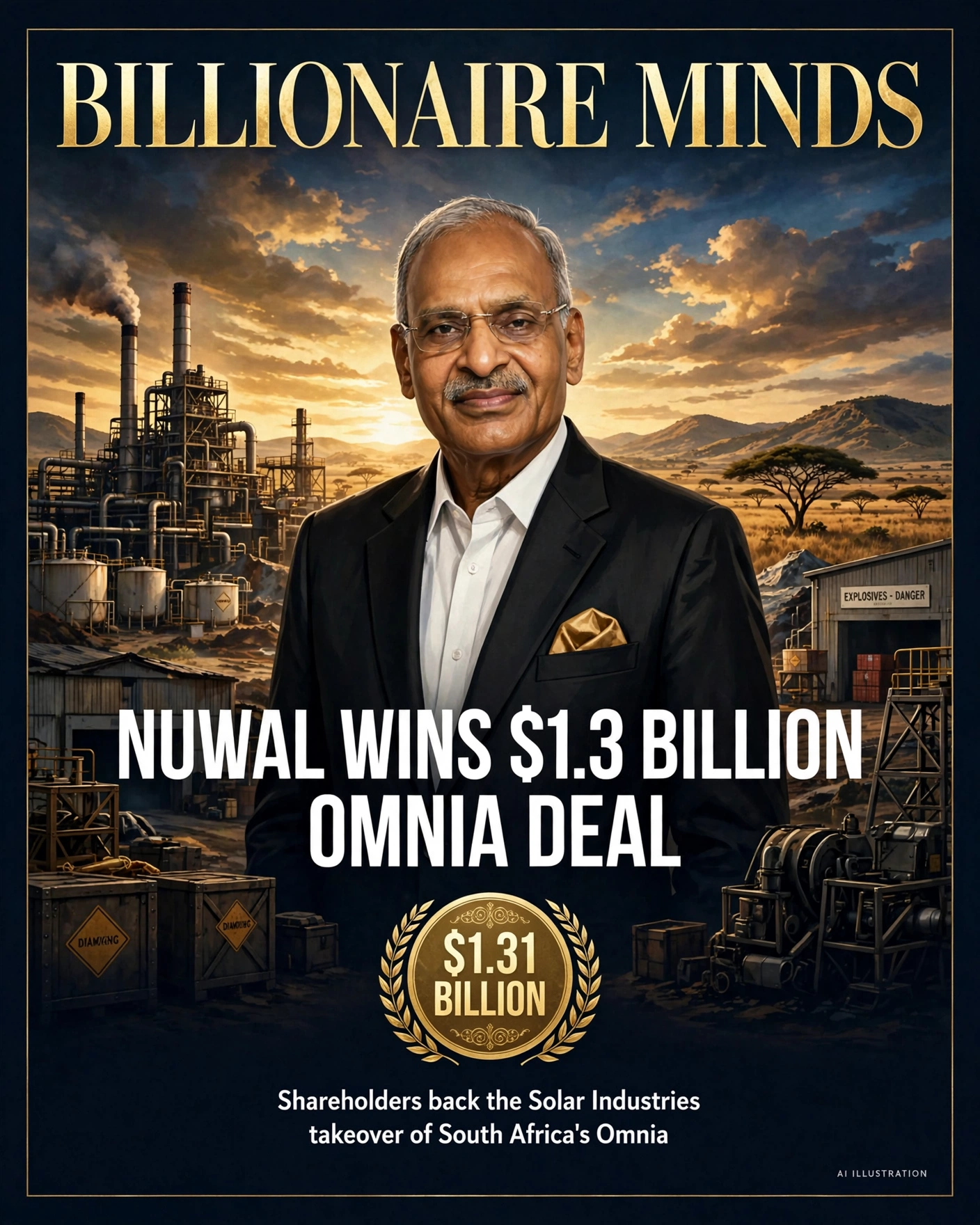
Billionaire Satyanarayan Nuwal Wins $1.3 Billion Omnia Buyout Vote — His Explosives Empire Goes Global

Indian billionaire Satyanarayan Nuwal in front of an industrial explosives plant at sunset — his Solar Industries just won backing for a $1.31 billion takeover of South Africa's Omnia

Image: AI illustration.

Indian billionaire Satyanarayan Nuwal just cleared the biggest hurdle in his boldest deal yet. Shareholders of South Africa's Omnia Holdings have backed a R21.8 billion ($1.31 billion) cash takeover by Nuwal's Solar Industries India, putting the 46-year-old explosives and fertilizer maker on course to leave the Johannesburg Stock Exchange. The vote, held online on Thursday, November 5, passed comfortably — holders of about 31.8 million shares, or 19.6% of the company, had already indicated their support before the meeting.

A premium price for a 46-year-old listing

Under the scheme of arrangement, Solar will pay R134.50 ($8.10) in cash for each of Omnia's roughly 162 million shares through its South African unit, Solar SA Investments, backed by an irrevocable bank guarantee. The price is 14.3% above Omnia's closing price on September 11, the last trading day before Solar made its firm offer, and about 71% above where the stock ended 2025. Once the scheme takes effect, Omnia will be delisted from the JSE and its secondary listing on the A2X exchange will end. "Omnia is a high-quality business we have long admired," said Manish Nuwal, Solar's managing director and chief executive and the founder's son, when the offer was announced in September. Omnia CEO Seelan Gobalsamy said the deal "accelerates the execution of our growth strategy."

From one explosives plant to a $21 billion empire

Nuwal founded Solar in 1995 with a single explosives plant. The Nagpur-based company has grown into India's largest maker and exporter of industrial explosives, and also makes ammunition and other defense products. It was worth about ₹2.02 trillion ($21.2 billion) in September, after its shares rose about 80% in a year, and the Nuwal family controls the company — the source of most of his fortune. Solar already has a footprint in Africa, with operations in Ghana, Nigeria, Tanzania and Zambia, and owns Problast, a South African mining explosives company. Omnia, which first listed on the JSE in 1980, would give it a much larger presence on the continent and beyond: it supplies explosives and blasting services to miners through its BME business and sells fertilizer to farmers, with revenue up 6% to R24 billion ($1.45 billion) in its most recent financial year and operating profit up 28%.

What still has to happen

The shareholder vote was only one of several hurdles. The deal still needs competition and regulatory approval in South Africa and from authorities covering the COMESA, East African Community and ECOWAS trade blocs, plus Botswana, Namibia, Mali and Nigeria. Four companies with material contracts with Omnia must also consent to the change of control, and the Takeover Regulation Panel must issue a compliance certificate. All conditions have to be met by July 31, 2027. If they are, one of Africa's oldest listed industrial names disappears from the market — and an Indian billionaire's explosives empire goes truly global.

Source: Billionaires.Africa, November 7, 2026. This is a fan/commentary summary of reported news; all figures are the source's estimates.