
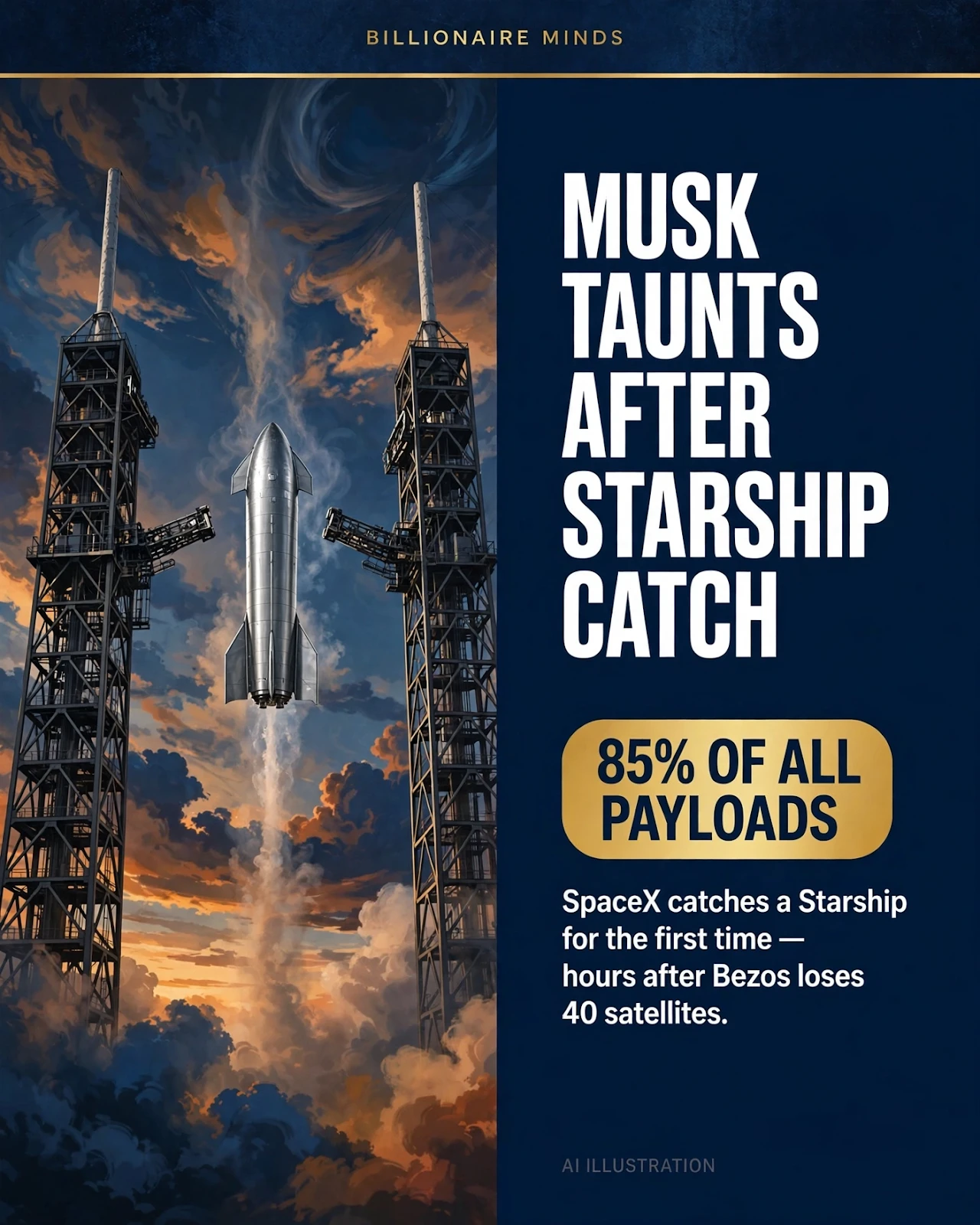
Elon Musk did not wait long to enjoy the moment. Hours after SpaceX caught a Starship returning from orbit for the first time, the world's richest man took to X to ask why his billionaire rivals — Jeff Bezos, Boeing and Lockheed Martin — still cannot match him, even with fortunes behind them.
It was the second act of a brutal weekend for Bezos. Hours before the catch, a Vulcan rocket failed 10 minutes after liftoff and destroyed 40 of Amazon's Leo internet satellites — the story this blog covered earlier today.
The Catch That Started It
On Saturday, two steel arms on SpaceX's launch tower in Texas caught Ship 42 as it returned from orbit — the first time a Starship has ever been caught. SpaceX had hoped to catch both halves of the rocket on Flight 15; the Super Heavy booster diverted to the Gulf after Friday's launch, but Ship 42 reached orbit, deployed 26 Starlink satellites, and about 22 and a half hours after liftoff descended through the clouds and settled between the tower's two arms.
Musk inspected the ship himself. "I hugged ship 42 upon its return," he posted, adding that it "could probably be reflown with a few weeks of refurbishment." He also teased the next version: "Starship V4 will be ~70m long, which is roughly a 40% length increase and allows >60% more propellant load."
"Anyone Can Throw Money at Rockets"
Soon after the catch, Musk challenged the idea that money alone buys a space program. "Let's take this gentleman's argument at face value that anyone can throw money at rockets and get something like Starship, Falcon or Dragon," he wrote on X.
He pointed at Bezos's Blue Origin, which started before SpaceX and had Bezos's fortune behind it, and asked why it still struggles to launch reliably when, by his estimate, SpaceX's Falcon rockets carry 85% of the world's payload to orbit by mass. United Launch Alliance, the Boeing and Lockheed Martin joint venture, carries less than 5% as much payload to orbit as SpaceX, he said.
When ULA confirmed the loss of the 40 Amazon satellites, Musk struck a different tone: "Sorry to hear this. Hope you are back to flight soon." He also questioned what Boeing had achieved with federal funding for its Starliner capsule: in 2014, NASA awarded Boeing up to $4.2 billion and SpaceX up to $2.6 billion to fly astronauts to the International Space Station. SpaceX now makes those trips regularly; Boeing's next Starliner flight, targeted for December or January, is set to carry cargo without a crew.
The Market Heard Him
Shares of SpaceX (SPCX) rose nearly 1% overnight after the catch, after climbing 3% last week — its strongest weekly gain in more than a month. Google CEO Sundar Pichai watched the catch live and posted: "Congrats @SpaceX for that starship catch, still feels like science fiction!" ARK's chief futurist Brett Winton noted the catch drops the cost per kilogram to orbit to roughly $100, from $1,000.
Walter Isaacson, Musk's biographer, recalled December 2020, when Musk first suggested the launchpad arms could catch a returning Starship: "I will always remember the looks on the engineers' faces in the Starbase conference room." Six years later, the arms caught one — and Musk made sure his rivals knew it.
Source: Stocktwits (November 16, 2026). This is a fan/commentary summary of reported news; all figures are the sources' estimates. Image: AI illustration.