Posts

Showing posts with the label Amazon

Jeff Bezos Personally Picked Robert Pattinson as the New James Bond — 'He Is James Bond'

Jeff Bezos in a tuxedo — the Amazon founder personally picked Robert Pattinson as the new James Bond

Amazon MGM Studios announced on Monday that Robert Pattinson, 40, will be the next James Bond — and on Tuesday, Amazon founder Jeff Bezos revealed he chose him personally. Speaking at Semafor's Silicon Valley & The World conference in California, the world's second-richest man said he was "heavily involved" in the casting of the world's most famous fictional spy.

"We ran a really tight process and we made the final decision on Friday," Bezos said on stage, a day after the announcement set Hollywood alight.

Too Famous for 007?

Bezos admitted he and director Denis Villeneuve were initially "slightly biased" against Pattinson — because he was already too famous. The Bond role has traditionally been star-making, and the team wondered whether they should pick somebody a little more unknown.

Then came the screen tests. Amazon narrowed a large group down to five finalists — Callum Turner, Josh O'Connor, Jack Lowden, Nicholas Hoult and Pattinson — and had each perform three scenes in full costume on sets. "But in the screen test, it was so obvious. He is James Bond," Bezos said.

Amazon's $1 Billion Bond Empire

The casting is the biggest move yet in Amazon's takeover of the 007 franchise. Amazon bought the storied studio MGM in 2022 for $8.5 billion, then spent roughly another $1 billion last year to secure creative control of Bond from longtime rights holders Michael Wilson and Barbara Broccoli.

Pattinson's film — directed by Villeneuve — will be the first Bond adventure under Amazon MGM Studios' creative stewardship, and it is not expected in cinemas before 2028.

A Billionaire's Hollywood Play

For Bezos, worth $376.6 billion on Forbes' real-time list, the Bond casting is the most personal flex yet of Amazon's Hollywood ambitions. At the same Semafor event, he also weighed in on the Nvidia succession drama, saying that if the board is not bringing Jensen Huang back, "I wouldn't hire an outsider" — an outside CEO at a complex company is a last resort.

The message from the world's second-richest man is clear: when Amazon spends billions on a franchise, its founder picks the star himself.

Source: AP via Rappler / Indian Express / Dawn; Business Today; Malay Mail (Nov 18, 2026). Portrait image is an AI illustration.

Musk Taunts Bezos After SpaceX's Historic Starship Flight — and a Rocket Failure Just Wrecked 40 of Amazon's Satellites

Elon Musk and Jeff Bezos in a stylized space-race face-off — Musk taunts Bezos after SpaceX's Starship flight while a rocket failure destroys 40 Amazon satellites

Elon Musk is not letting a historic weekend in space slide — and he used it to take a very public swipe at Jeff Bezos. Hours after SpaceX pulled off its most ambitious orbital feat yet, Musk went on X and asked the question no one at Blue Origin wanted to hear: if throwing money at rockets was all it took, why can't Bezos' billions buy a reliable launch?

The jab landed on Sunday, November 15, and it came with receipts. The same morning, a rival rocket carrying Amazon's own satellites failed minutes after liftoff — destroying 40 of them.

Starship's Historic Flight Set the Stage

On November 13, SpaceX's Starship flew its 15th test flight. Ship 42 entered orbit, deployed 26 next-generation Starlink V3 satellites, completed multiple orbits around Earth, and returned to its Texas launch site roughly 22.5 hours after liftoff on November 14 — an unprecedented orbital engineering feat, and arguably SpaceX's biggest accomplishment to date.

Musk wasted no time. When a critic on X argued that anyone could build reusable rockets simply by throwing enough money at the problem, Musk dismantled the argument by pointing straight at Bezos and Blue Origin.

"Let's take this gentleman's argument at face value that anyone can throw money at rockets and get something like Starship, Falcon, or Dragon," Musk wrote on Sunday. "Perhaps he can explain to everyone how SpaceX is able to catch giant starships from orbit with chopsticks and deliver 85% of all Earth payload to orbit with Falcon, while Blue Origin, which started before SpaceX and was funded by the immensely wealthy Jeff Bezos, is not yet able to launch reliably? I am genuinely curious."

Bezos Had a Head Start — and Billions More

The numbers back up Musk's taunt. Bezos founded Blue Origin in September 2000 — nearly two years before Musk established SpaceX in May 2002 — and has personally funnelled billions of dollars from Amazon stock sales into the venture. Despite the head start, SpaceX's Falcon fleet now hauls around 75% of global orbital tonnage, according to industry data cited by FourWeekMBA.

Musk didn't stop with Bezos. In the second half of his Sunday post, he aimed at Washington's legacy aerospace contractors: "And why is it that Boeing and Lockheed Martin, despite receiving several times more government funding than SpaceX, are so far behind?"

NASA's own numbers tell the story. In 2014, the agency awarded Boeing $4.2 billion to develop the Starliner crew capsule and SpaceX $2.6 billion to develop Crew Dragon. A decade later, SpaceX routinely ferries astronauts to the International Space Station, while Boeing has grappled with propulsion failures and more than $1.85 billion in Starliner charges, according to CNBC.

The Rocket Failure That Proved Musk's Point

Hours before Musk posted, a United Launch Alliance Vulcan Centaur rocket — the Boeing-Lockheed joint venture — malfunctioned within 10 minutes of liftoff on Sunday morning and failed to reach orbit, destroying all 40 commercial satellites aboard, according to Space.com.

Those 40 lost satellites belonged to Amazon's Leo network, previously known as Project Kuiper — Amazon's $10 billion-plus low-Earth-orbit broadband network designed to go head-to-head with SpaceX's Starlink, according to GeekWire.

Bezos is determined to diversify Amazon's launch options rather than rely solely on Musk's Falcon 9 rockets to deploy a planned 3,236-satellite constellation. That is why Amazon secured the largest commercial launch procurement in aerospace history, with contracts from ULA and Blue Origin — including 38 missions on ULA's Vulcan rocket. Sunday's mishap happened on the very first of those 38 contracted Vulcan flights.

What This Means for the Billionaire Space Race

The failure leaves Amazon's satellite broadband rollout bottlenecked by the exact launch struggles Musk just called out. SpaceX, meanwhile, keeps expanding its commercial grip on low Earth orbit — a dominance that underpins the company's roughly $1.9 trillion valuation and Musk's position as the world's richest person, worth around $890 billion by Forbes' real-time estimates, with Bezos second at about $377 billion.

For Bezos, the weekend was a brutal reminder that in the space race, billions in capital no longer buy a technological moat. For Musk, it was the perfect stage to say so out loud.

Image: AI illustration. This article is commentary on publicly reported events.

Source: TheStreet — "Elon Musk calls out Jeff Bezos over SpaceX rivals"

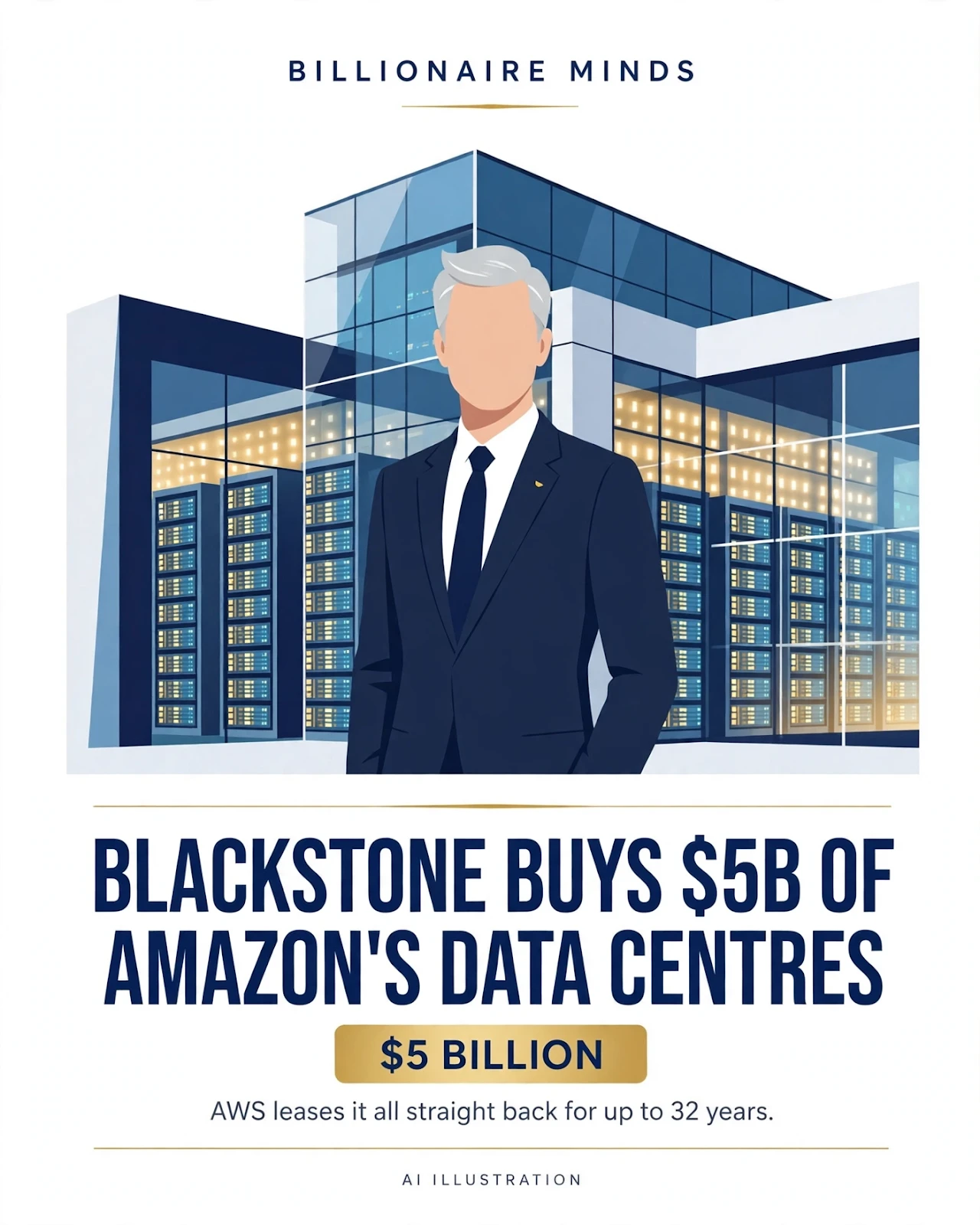
Schwarzman's Blackstone Just Bought $5 Billion of Amazon's Data Centres — and AWS Is Leasing Them Straight Back

Stephen Schwarzman's Blackstone buys $5 billion of Amazon's data centres — AWS leases them straight back

Stephen Schwarzman's Blackstone has just pulled off one of the biggest data centre deals of the year — buying a controlling stake in Amazon's own data centres, then renting the buildings straight back to Amazon. Blackstone Digital Infrastructure Trust (BXDC), the firm's newly listed data centre fund, announced on Monday that it is acquiring a 75.1% stake in two Amazon Web Services joint ventures in a transaction valued at roughly $5 billion.

The deal covers 13 newly constructed "powered shells" across two AWS campuses in northern Indiana and Mississippi, with 647 megawatts of total IT capacity. It is BXDC's first investment since listing in May — and it puts Blackstone on both sides of the AI infrastructure boom: landlord to the world's biggest cloud provider, and owner of the buildings that power it.

AWS leases it all straight back

Amazon is not walking away from the buildings. AWS keeps a 24.9% stake and will lease back the entire portfolio on a triple-net basis — meaning it covers taxes, insurance and maintenance — for an initial 12-year term that can stretch to 32 years. The deal carries a 7% initial capitalisation rate, and BXDC shares jumped 6.1% on the news.

How the $5 billion is funded

BXDC plans to put in about $1.9 billion of cash raised in its IPO, while the joint venture will borrow roughly $2.5 billion through non-recourse mortgages secured by the properties — about half the purchase price. The transaction is expected to close in the fourth quarter of 2026. Morgan Stanley, CBRE Capital Markets, Citi, Goldman Sachs, JPMorgan and Wells Fargo are advising on the deal.

Why it matters

Blackstone, the nearly $1.4 trillion alternative asset manager Schwarzman co-founded in 1985, has already amassed a $200 billion data centre portfolio including QTS Realty Trust. BXDC's pitch is to buy stabilised, hyperscaler-leased data centres valued between $250 million and $1.5 billion — a market it estimates at $1 trillion over the next five years. The timing is no accident: AWS's order backlog hit $578 billion after third-quarter results, according to CEO Andy Jassy, as demand for cloud and AI infrastructure keeps climbing. Schwarzman is worth about $42.5 billion on Forbes' real-time list; Amazon founder Jeff Bezos sits at $384.6 billion. Two of the world's richest men just did a $5 billion deal — and Amazon is now Blackstone's tenant.

Source: The Business Times (Bloomberg), November 16, 2026. This is a fan/commentary summary of reported news; all figures are the sources' estimates. Image: AI illustration.

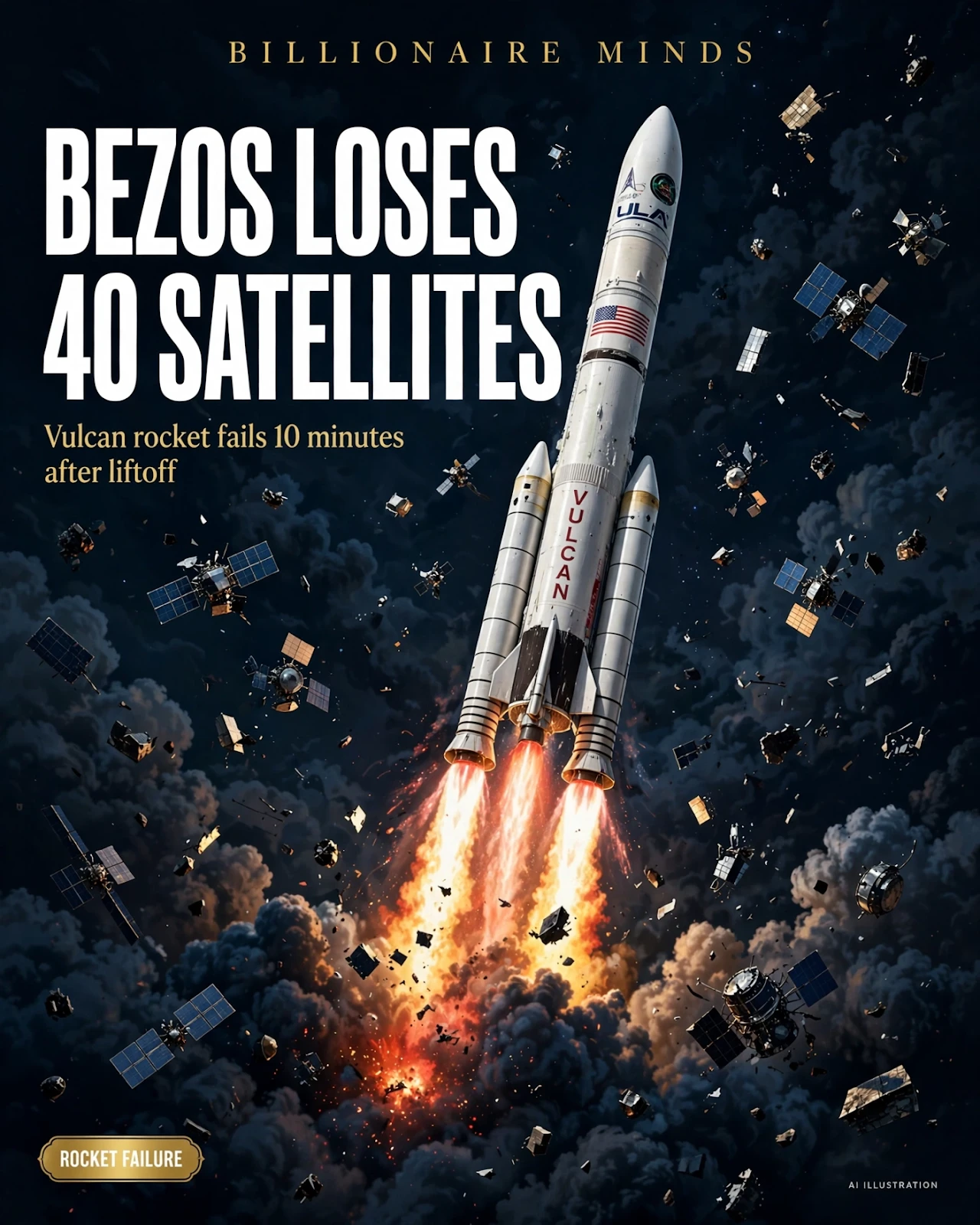
Jeff Bezos Loses 40 Satellites as Amazon's Vulcan Rocket Fails 10 Minutes After Liftoff

AI illustration of Amazon's Vulcan rocket failing after liftoff, with 40 Leo satellites scattered — Jeff Bezos loses 40 satellites in rocket failure

Jeff Bezos just watched 40 of his satellites burn up in the sky. A Vulcan rocket carrying Amazon's Leo internet satellites failed roughly 10 minutes after liftoff from Florida on Sunday, destroying its entire payload in the launch company's first-ever mission failure.

It is a brutal setback for the Amazon founder's long-running bid to build a satellite internet network to rival Elon Musk's Starlink — and the rocket that failed runs on engines built by Bezos's own space company.

Ten Minutes In, the Mission Was Over

The Vulcan rocket, owned by United Launch Alliance — the Boeing and Lockheed Martin joint venture — lifted off from Space Launch Complex 41 at Cape Canaveral Space Force Station carrying 40 satellites for Amazon's Leo network. About 10 minutes into the flight, it suffered an anomaly and failed to deliver the mission to orbit.

"Based on data received by our Launch Director, we confirm that the Vulcan vehicle launched from Space Launch Complex 41 suffered an anomaly 10 minutes into the flight and failed to deliver the Amazon mission to orbit," ULA said in a statement. "Every flight generates data, and every flight teaches us something. Since the anomaly just occurred, we don't have any specific data yet to understand what occurred today."

The failure is expected to trigger a lengthy technical investigation that would keep the rocket grounded for months. It was Vulcan's fifth flight since its 2024 debut and its first in nine months, after a launch hiatus drawn out by separate technical investigations into its solid rocket boosters and its core BE-4 engines.

Bezos's Own Engines Are Under the Microscope

The BE-4 engines that power Vulcan's first stage are supplied by Blue Origin, the space company founded by Bezos. It is not yet clear whether the engines played a role in Sunday's failure — the anomaly appeared to occur after the second stage, carrying the Amazon satellites, separated from the first-stage booster powered by the BE-4 engines. Blue Origin is working with ULA on the investigation, according to a person familiar with the matter.

The engines already carry baggage: Blue Origin's New Glenn rocket suffered a launchpad explosion in May, and its investigation determined the engine was the cause. That led the company to modify the engines delivered to ULA for Vulcan, ULA spokesperson Jessica Rye told Reuters in August.

Amazon struck a measured tone. "There is risk with any launch, and that's especially true for inaugural missions like LV-01," the company said in a statement. "ULA has been a trusted partner for Amazon, and we believe they'll learn from this mission and deliver on their long-term plans for Vulcan."

The Race Against Starlink Just Got Harder

The failure is another blow to Amazon's slow climb into orbit. Since 2025, only 398 Leo satellites have been deployed across 14 launches — about 12% of the 3,236 satellites Amazon needs for global service coverage. The company had hoped to start initial internet service this year.

Meanwhile, Musk's Starlink already has more than 11,000 satellites in orbit and millions of customers worldwide. SpaceX's wide lead comes in part from having its own rocket to launch its satellites, while rivals like Amazon spend billions on external launches — and now, on launches that fail.

ULA, formed in 2006 from the merger of Boeing's Delta and Lockheed Martin's Atlas rocket programs, had held a 100% mission success record ever since. Sunday ended that run — and with Falcon 9, the world's most active rocket, nearing retirement and no longer accepting bookings, the failure could deepen a US launch bottleneck just as Amazon needs launches most.

Source: Indian Express (November 16, 2026), reporting Reuters. This is a fan/commentary summary of reported news; all figures are the sources' estimates. Image: AI illustration.

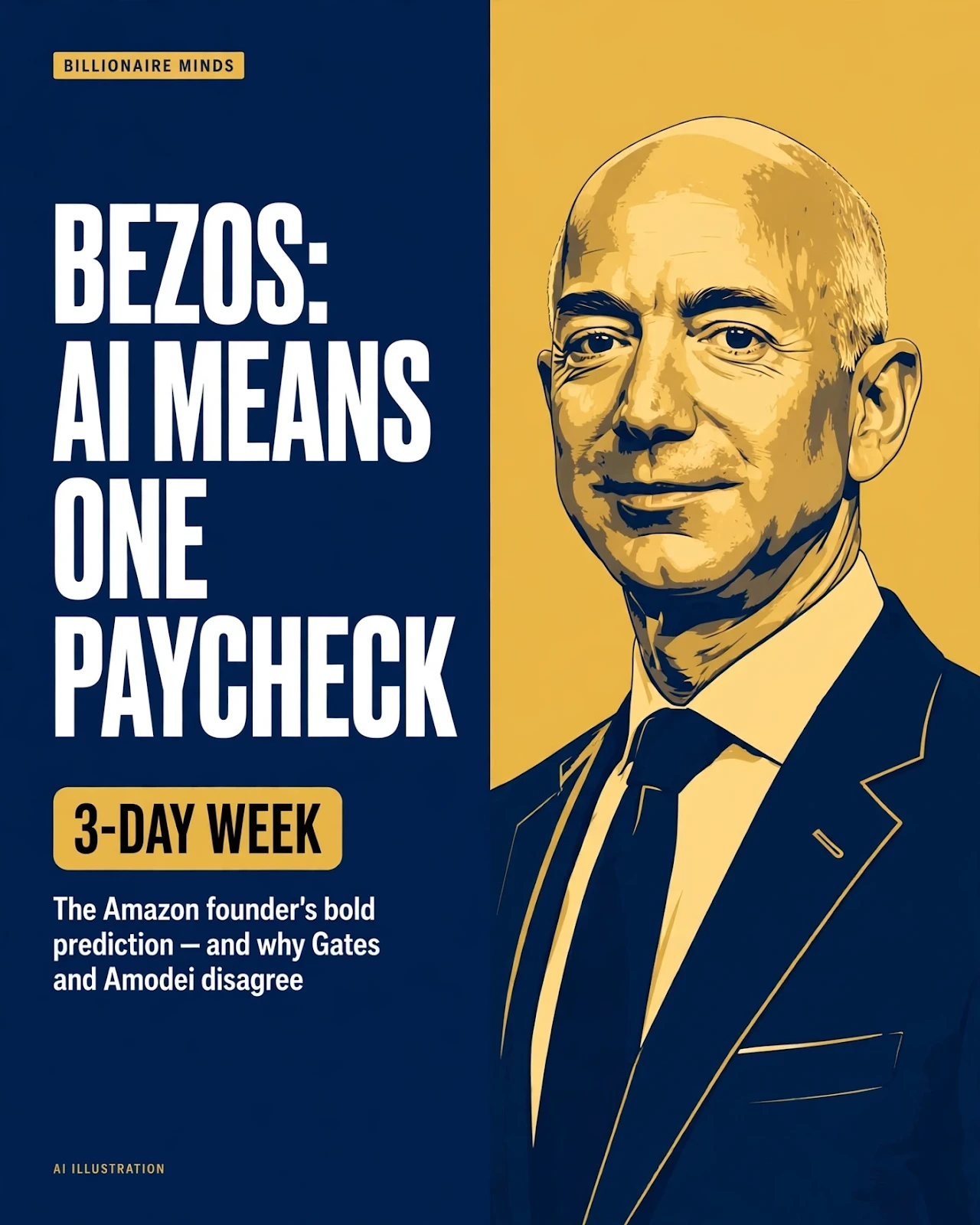
Jeff Bezos Says AI Will Let Families Live on One Paycheck — and Work Just 3 Days a Week

Stylized AI illustration of Amazon founder Jeff Bezos in a dark suit, under the headline 'Bezos: AI Means One Paycheck' with a 3-Day Week badge

Jeff Bezos thinks artificial intelligence is about to change the way American families live — not by taking jobs, but by making one income enough. Speaking with Fox News' Bret Baier on the factory floor of his rocket company Blue Origin in Cape Canaveral, Florida, the Amazon founder predicted AI-driven productivity gains could let two-income households live on a single paycheck — or let workers support a family on a three-day week.

"You're not going to need to have a two-earner household. If you want it, fine. If you don't want to have it, one of the people might drop out," Bezos said. Instead of mass unemployment, he expects a labor shortage, with employers competing for people who can afford to work less. "It's going to actually be difficult to hire people," he said.

A prediction he's made before

Bezos made a similar argument in June at VivaTech in Paris, where he said AI will create more jobs, not fewer. The stakes are large: in 2025, both parents worked full-time in 52% of U.S. different-sex couples with children under 18, up from 31% in 1975, according to Pew Research Center. A one-paycheck norm would reverse a half-century shift in how American families earn and spend.

The skeptics: Amodei and Gates

Not every AI leader shares Bezos' optimism. Anthropic CEO Dario Amodei warned in May 2025 that AI could eliminate roughly half of all entry-level white-collar jobs within five years and push unemployment to 10% to 20%. Microsoft co-founder Bill Gates has floated a two-day workweek, but in an August essay he warned the AI shift will be "one of the most turbulent times in human history" and that world leaders are unprepared for its risks.

Bezos has $6.2 billion behind the bet

Bezos is co-founder and co-CEO of Project Prometheus, an AI startup that launched with $6.2 billion in funding to apply AI to engineering and manufacturing in computing, aerospace and automobiles. "We're going to make the tools so easy to use that anyone will be able to be an engineer," he told Baier. But skeptics note a basic condition: productivity gains become shorter hours only if the savings reach employees. Amazon itself — No. 1 on the 2026 Fortune 500 with more than $700 billion in revenue — has cut about 30,000 corporate roles since late 2025 while planning more than $200 billion in capital spending this year, mostly on data centers.

Source: Fortune (November 12, 2026), reporting Bezos' Fox News interview with Bret Baier. The portrait on this post is a stylised AI illustration, not a photograph of Jeff Bezos.

Jeff Bezos's $1,450 Astro Flopped — Now Amazon Is Building a New Home Robot

Stylized illustration of a friendly humanoid home robot in a living room, with Amazon's Astro robot faded behind it — Amazon is building a new home robot after Astro flopped

Jeff Bezos made a bold bet in 2017: he told Amazon's top device executives to build a robot for the home. The result was Astro, a $1,450 Alexa-powered tablet on wheels that could roam the house, recognise faces and act as a roving security monitor. It rolled on stage at Amazon's fall 2021 event — and then quietly stalled. Astro never left its invite-only list, shipping to just a few thousand customers, and its business version was shut down less than a year after launch. Now, Amazon is trying again.

Astro: the $1,450 bet that never left the invite list

For the people who did buy one, Astro became a mixed blessing. One owner in North Carolina told CNBC she still uses it to check on pets and appliances, but mostly it has become "a party trick and a trip hazard" that gets sent back to its charging dock most days. Amazon executives had discussed giving Astro an arm to pick things up, and former consumer robotics chief Ken Washington said he pushed for a bipedal robot — but leadership disagreed. Bezos himself sat in on show-and-tells: Washington recalls the founder was "disappointed with the lack of functionality" but impressed by Astro's ability to map and navigate an undefined space under any lighting.

The second attempt: Fauna, Sprout and a new robotics group

According to a CNBC analysis of job posts published November 8, Amazon has spent the past several months assembling a new team to build a "new-to-world robot product." One since-removed engineering listing promised that "robots are about to step out of the movies and into our homes," describing a machine that navigates "dynamic home environments" and operates "autonomously alongside family members." Earlier this year Amazon redeployed much of the Astro team and hired an MIT roboticist, and in March it acquired New York-based Fauna Robotics — maker of Sprout, a 3.5-foot-tall humanoid with expressive yellow eyebrows — folding it into a new division called the Personal Robotics Group. A June job posting hinted at the goal: "create robots that are not just functional, but delightful."

A $40 billion race for the living room

Amazon is not alone. Tesla has been developing its Optimus humanoid since 2021, Apple is reportedly working on home robots, and venture capital poured $33.4 billion into robotics and physical AI companies in the first half of 2026 alone — more than all of 2025, according to PitchBook. Barclays forecasts the humanoid market, worth $2–3 billion today, could reach roughly $40 billion by 2035. Amazon spokesperson Brad Glasser told CNBC the company acquired Fauna because it is "committed to tackling the challenges that can unlock the personal robotics category." No product name, price or launch date has been disclosed — but after Astro, Bezos's robot dream is officially back on.

Source: CNBC, November 8, 2026. This is a fan/commentary summary of reported news; all figures are the sources' estimates. Portrait: AI illustration.

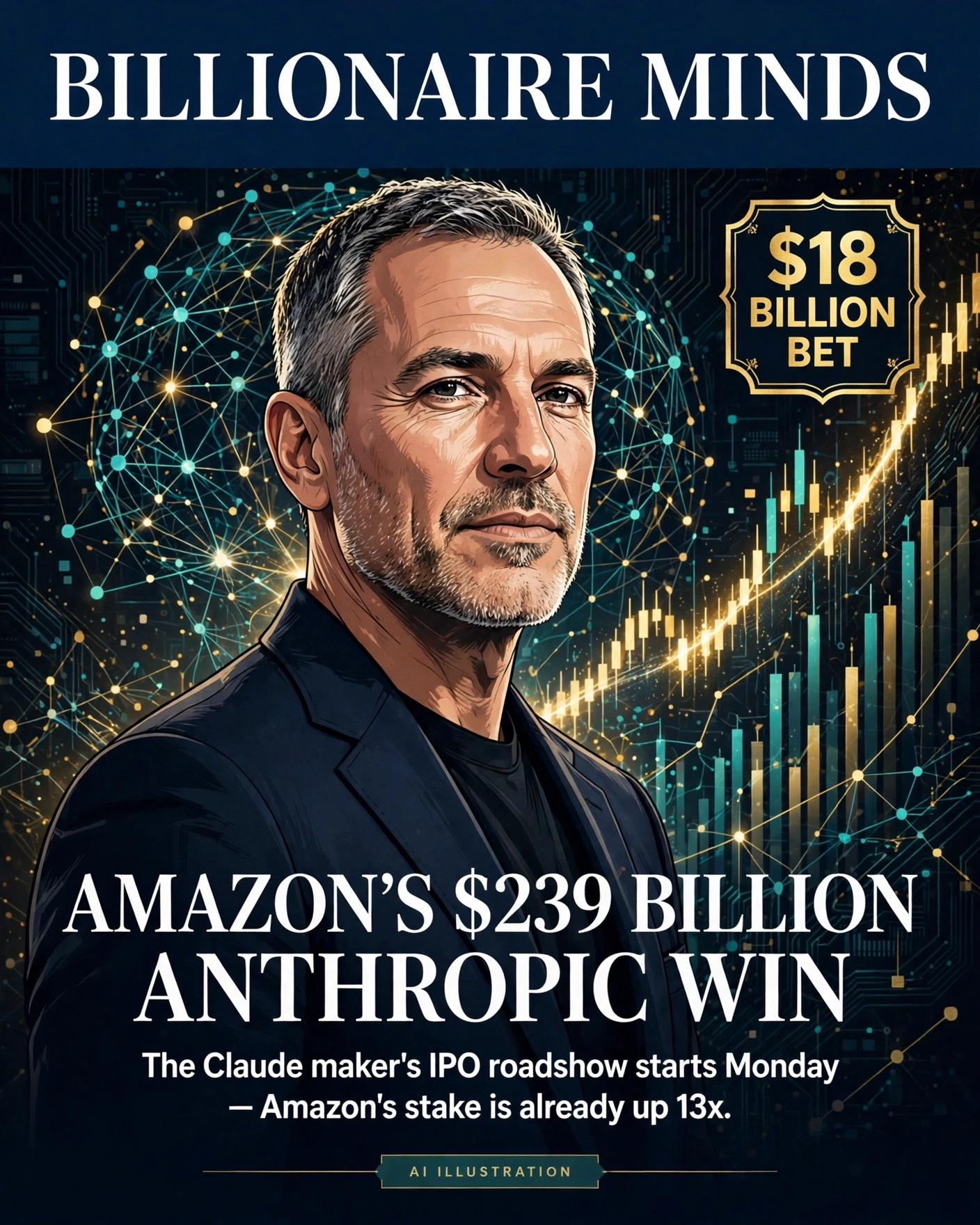
Amazon's $18 Billion Anthropic Bet Is Now Worth $239 Billion — and the IPO Roadshow Starts Monday

Amazon's $239 billion Anthropic win — stylized magazine-cover illustration of a tech CEO before a glowing stock chart

Jeff Bezos's Amazon put $18 billion into Anthropic since 2023 — and that bet is now carried at about $239 billion on Amazon's own balance sheet, roughly 8% of the company's entire market value. With the Claude maker's IPO roadshow set to begin on Monday, November 9, the market is about to put a real price on the stake Amazon bought cheap.

From $18 Billion to $239 Billion

The stake has two parts. Amazon bought $8 billion of convertible notes between 2023 and 2025, and $5 billion of preferred stock in Anthropic's Series G round in the second quarter of 2026 — plus up to $20 billion more as it delivers computing capacity, of which $5 billion went into the Series H round. All told, Amazon owned 164 million preferred shares on September 30, each converting into 10 shares of common stock at the IPO. The notes are capped so Amazon owns no more than 12% of Anthropic unless it waives the limit. On the books, the preferred stock climbed from $14.8 billion at the end of 2025 to $92.5 billion on September 30, while the notes rose from $45.8 billion to $146.2 billion — together, about $239 billion, nearly four times the year-end figure.

The IPO Roadshow Starts Monday

Anthropic has applied to list on the Nasdaq under the ticker "ANT", with an amended filing lodged on November 2 that still gives no price range. Financial news service IFR reports the roadshow — the pitch to big investors — begins November 9, with pricing expected the following week. The numbers behind the listing are striking: Anthropic's revenue hit $33.2 billion in the first nine months of 2026, up from $2.5 billion a year earlier — a 13-fold jump. The same filing commits Anthropic to at least $276 billion of cloud spending, including $121.3 billion with Google, $110 billion with Amazon and $44.9 billion with Microsoft.

What It Means for Amazon

The stake has already transformed Amazon's earnings. The company's other income reached $68.4 billion in the first nine months of 2026, up from $14.1 billion a year before — mainly from Anthropic — and earnings per share almost doubled to $10.42. Every $10 on Anthropic's share price would be worth around $16 billion on the 1.64 billion common shares Amazon's preferred stock converts into, and up to about $35 billion including all the notes. Once Anthropic trades, Amazon will carry the stake at market value, so its share price will start moving Amazon's reported profits every quarter. The listing will finally show what Bezos's $18 billion bet is really worth — and whether the $239 billion on Amazon's books was too low.

Source: The Motley Fool (Nov 7, 2026; Anthropic S-1/A filing, IFR); SOTKN (Nov 2 S-1/A cloud commitments). Image: AI illustration.

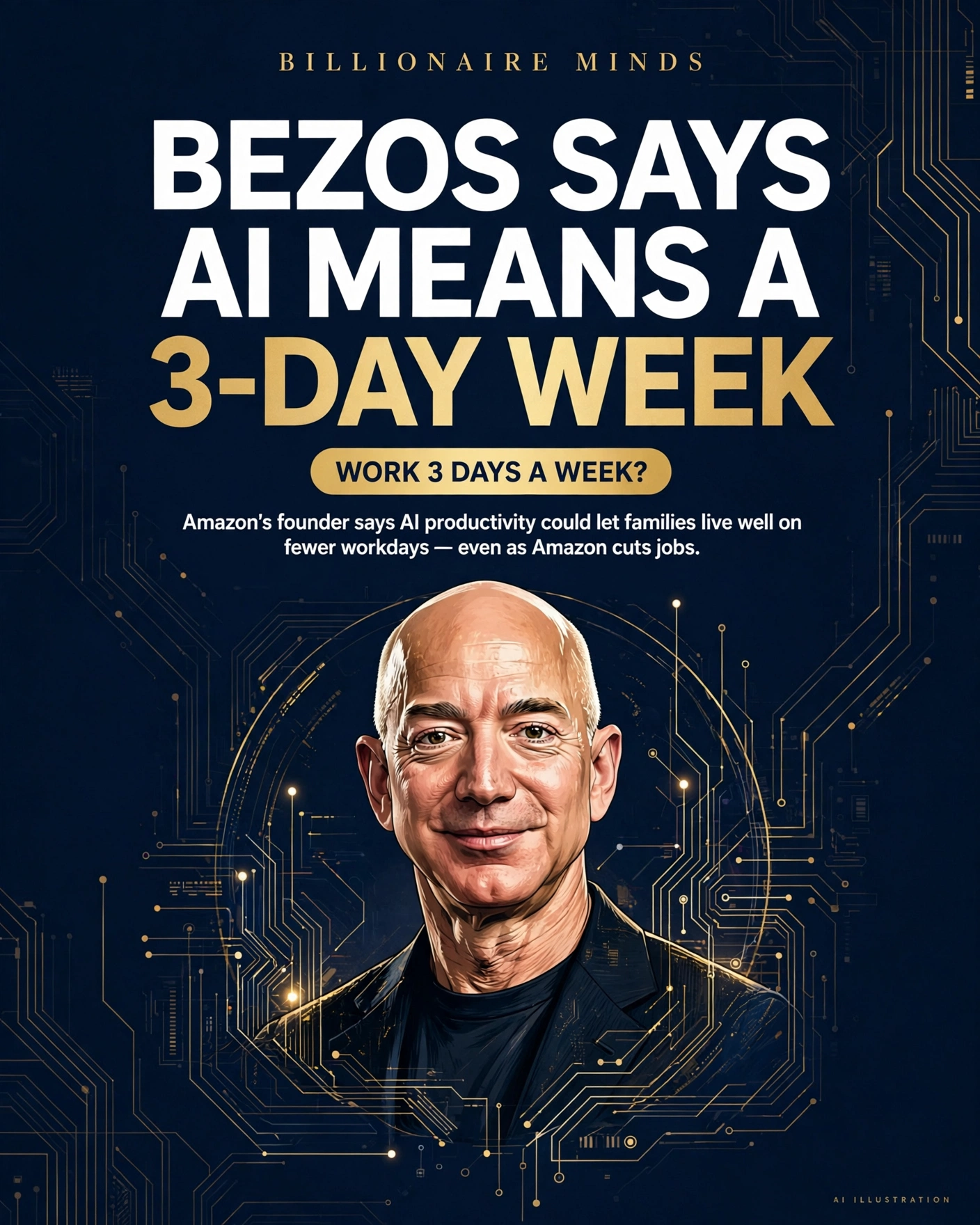
Jeff Bezos Says AI Could Give Us a 3-Day Work Week — While Amazon Keeps Cutting Jobs

Stylized illustration of Amazon founder Jeff Bezos against a navy background with golden circuit lines, headline Bezos says AI means a 3-day week

Jeff Bezos thinks artificial intelligence could soon let you work three days a week and still support your family. The Amazon founder made the prediction in a recent Fox News interview, arguing that rapid AI productivity gains could fundamentally reshape how much people need to work — and how much they earn for it.

"Some people will decide, 'I can support my family working three days a week.' That's what productivity in the economy means," Bezos said.

One earner could be enough

Bezos painted an optimistic picture of an AI-powered economy in which higher productivity generates greater wealth and gives people more choice over how much they work. He suggested that if productivity rises far enough, many families may no longer need two earners to maintain their standard of living. "You're not going to need to have a two-earner household. If you want it, fine. If you don't want to have it, one of the people might drop out," he said — adding that employers could even find it harder to recruit workers if people can meet their financial needs with less work. He even suggested AI advances could create labour shortages rather than mass unemployment.

The awkward timing

There is an irony Bezos did not dwell on. While he talks about working less, Amazon has been cutting thousands of corporate roles over the past year — even as the company spends billions on AI data centres and cloud capacity. Bezos could also benefit from the AI boom through space company Blue Origin, which has outlined plans involving space-based infrastructure, including concepts for data centres operating beyond Earth.

He is not the only billionaire betting on shorter weeks

Bezos joins a growing list of tech leaders who believe AI will shrink the working week. Nvidia CEO Jensen Huang has suggested AI could make a four-day workweek commonplace, JPMorgan chief Jamie Dimon has floated around three-and-a-half days, and Bill Gates has talked about a two-day workweek. Elon Musk goes further still, arguing AI and robotics could eventually create a world of "universal high income" where work becomes optional. Bezos, for his part, also sounded a note of caution for investors: asked whether the AI boom resembles a bubble, he said it was hard to tell. "What I do know is the technology is real. I think this is a good thing for society," he said — while warning that heavy investment periods fund weak businesses as well as strong ones.

Sources: The Times of India, Fox News. Image: AI illustration.

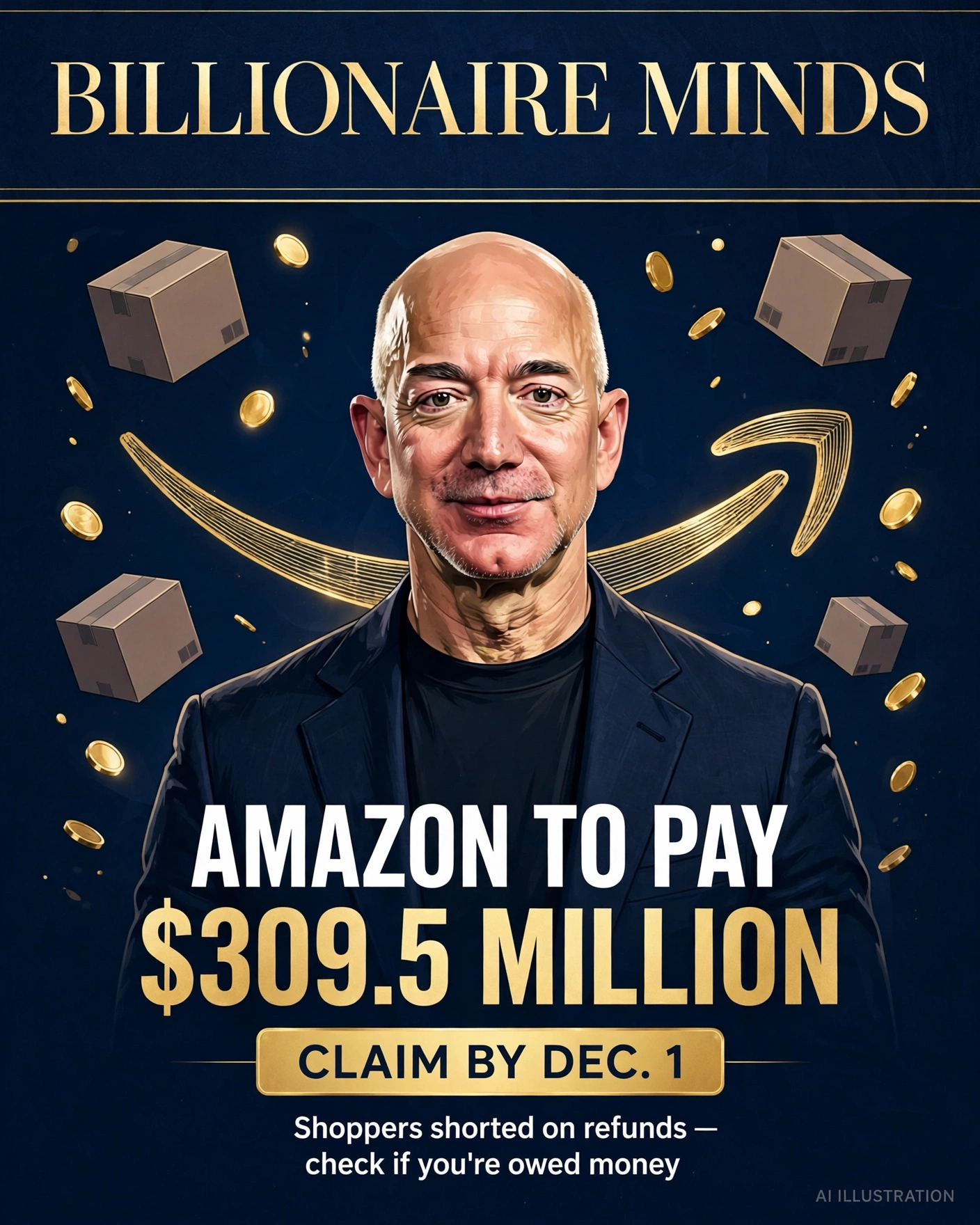
Amazon Will Pay $309.5 Million to Shoppers It Shorted on Refunds — Claim Yours Before Dec. 1

Jeff Bezos — Amazon agreed to a $309.5 million settlement over refunds it failed to pay U.S. shoppers

Image: AI illustration.

Jeff Bezos's Amazon is about to pay hundreds of millions of dollars back to its own customers. A Washington judge has approved a $309.5 million settlement of a class-action lawsuit that accused Amazon of failing to properly refund shoppers — in some cases never sending the money at all, in others charging customers again after a refund had already gone through. The settlement covers anyone who bought a physical item on Amazon between September 5, 2017 and February 12, 2026 and asked for a refund that never arrived or was clawed back.

Two groups — and only one has to file a claim

The settlement splits shoppers into two classes, and which one you are in decides what you have to do. Subclass A — about 92.7% of claimants, the people Amazon's own records already identify as being owed money — will be paid automatically, with interest, and does not need to file anything; they only have to pick a payment method within 105 days after the settlement is approved. Subclass B is everyone else: shoppers Amazon's records did not flag. They must file a claim on the official settlement site, ReturnSettlement.com, before December 1, 2026, providing the order number, product description, refund request date, amount sought and the Notice ID from their settlement email. Miss the deadline and the money is gone.

The real bill is closer to $1 billion

The $309.5 million fund is only part of what this case has cost Amazon. Since the lawsuit was filed in 2023, the company has already paid out roughly $570 million in refunds it had not issued, bringing the total to about $913.5 million — and the plaintiffs' lawyers may seek up to $100 million in fees on top. Amazon denies any wrongdoing and says it agreed to settle to avoid further court action. The final approval hearing is scheduled for March 16, 2027. If you ever returned something to Amazon and the refund never showed up, check your email — including spam — for a settlement notice, or call the administrator at 1-888-553-4246.

Source: Economic Times, November 7, 2026; Moneywise, November 6, 2026; SettleSignal, checked against the official settlement site. This is a fan/commentary summary of reported news; all figures are the sources' estimates.