Posts

Showing posts with the label Humanoid Robots

Jeff Bezos's $1,450 Astro Flopped — Now Amazon Is Building a New Home Robot

Stylized illustration of a friendly humanoid home robot in a living room, with Amazon's Astro robot faded behind it — Amazon is building a new home robot after Astro flopped

Jeff Bezos made a bold bet in 2017: he told Amazon's top device executives to build a robot for the home. The result was Astro, a $1,450 Alexa-powered tablet on wheels that could roam the house, recognise faces and act as a roving security monitor. It rolled on stage at Amazon's fall 2021 event — and then quietly stalled. Astro never left its invite-only list, shipping to just a few thousand customers, and its business version was shut down less than a year after launch. Now, Amazon is trying again.

Astro: the $1,450 bet that never left the invite list

For the people who did buy one, Astro became a mixed blessing. One owner in North Carolina told CNBC she still uses it to check on pets and appliances, but mostly it has become "a party trick and a trip hazard" that gets sent back to its charging dock most days. Amazon executives had discussed giving Astro an arm to pick things up, and former consumer robotics chief Ken Washington said he pushed for a bipedal robot — but leadership disagreed. Bezos himself sat in on show-and-tells: Washington recalls the founder was "disappointed with the lack of functionality" but impressed by Astro's ability to map and navigate an undefined space under any lighting.

The second attempt: Fauna, Sprout and a new robotics group

According to a CNBC analysis of job posts published November 8, Amazon has spent the past several months assembling a new team to build a "new-to-world robot product." One since-removed engineering listing promised that "robots are about to step out of the movies and into our homes," describing a machine that navigates "dynamic home environments" and operates "autonomously alongside family members." Earlier this year Amazon redeployed much of the Astro team and hired an MIT roboticist, and in March it acquired New York-based Fauna Robotics — maker of Sprout, a 3.5-foot-tall humanoid with expressive yellow eyebrows — folding it into a new division called the Personal Robotics Group. A June job posting hinted at the goal: "create robots that are not just functional, but delightful."

A $40 billion race for the living room

Amazon is not alone. Tesla has been developing its Optimus humanoid since 2021, Apple is reportedly working on home robots, and venture capital poured $33.4 billion into robotics and physical AI companies in the first half of 2026 alone — more than all of 2025, according to PitchBook. Barclays forecasts the humanoid market, worth $2–3 billion today, could reach roughly $40 billion by 2035. Amazon spokesperson Brad Glasser told CNBC the company acquired Fauna because it is "committed to tackling the challenges that can unlock the personal robotics category." No product name, price or launch date has been disclosed — but after Astro, Bezos's robot dream is officially back on.

Source: CNBC, November 8, 2026. This is a fan/commentary summary of reported news; all figures are the sources' estimates. Portrait: AI illustration.

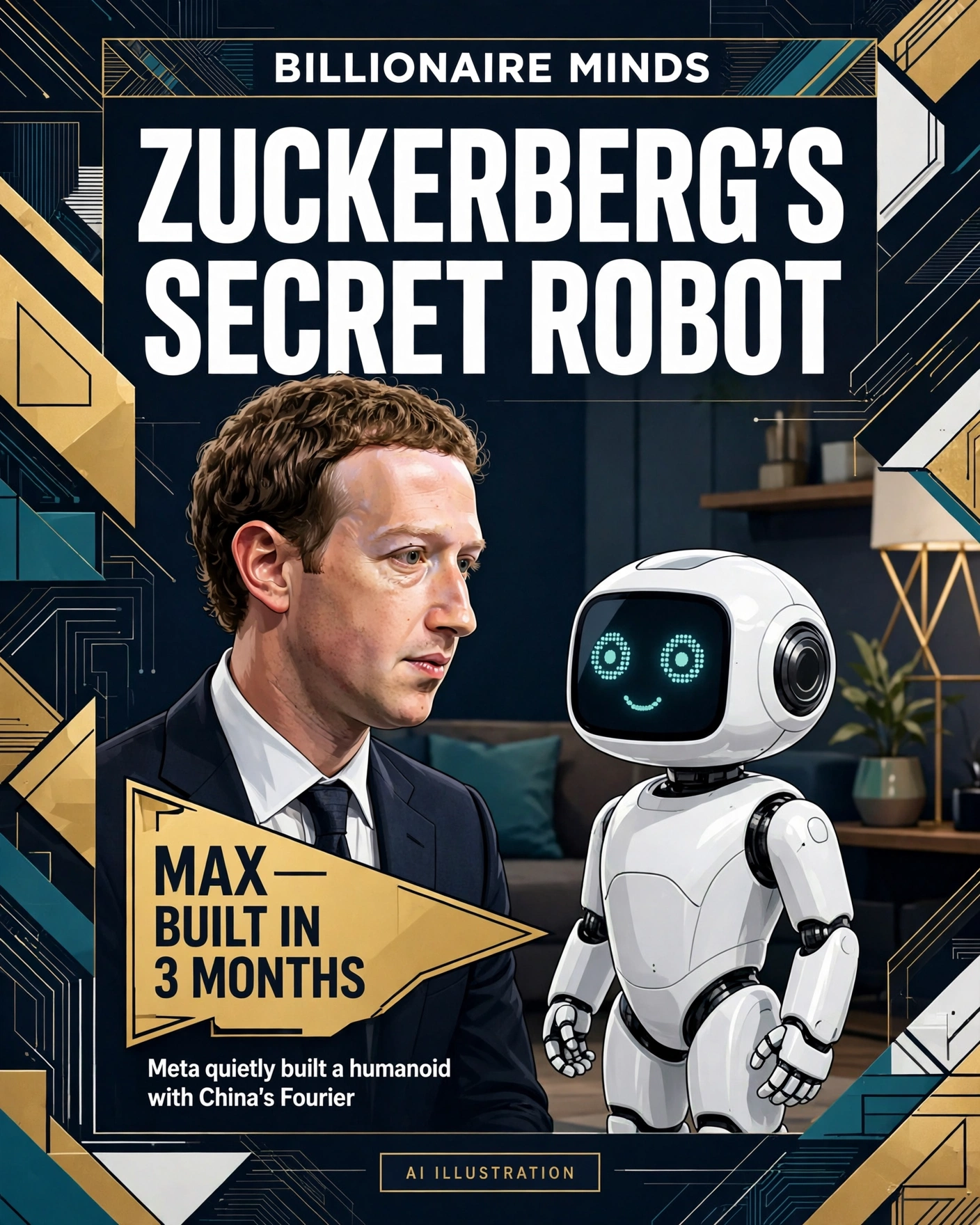
Zuckerberg's Secret Robot Max: Meta Quietly Built a Humanoid for Your Home — With China's Help

Mark Zuckerberg beside Meta's humanoid robot Max — AI illustration

Mark Zuckerberg wants artificial intelligence walking around your home — literally. Meta has quietly built a humanoid robot called Max, a five-foot-tall machine designed to see, hear and move through a living room, according to a report by The Information, picked up by Reuters and featured on the BBC's AI Decoded programme on November 8.

Built in three months — with China's help

Max was assembled in about three months in partnership with Fourier, a Chinese robotics company based in Shanghai. The prototype stands about 1.5 metres tall, weighs roughly 48 kilograms, and runs on Nvidia's Jetson Thor chip. Its five-fingered hands can grip small, light objects like bottles and toys, and it is designed to hear a voice from five metres away, spot a wave from three, and hold eye contact — the very human skills a home robot needs.

Research only — for now

Meta has confirmed the collaboration but says the project is research only, with no plans to sell the robots. Max was shown to employees at an internal event in late August, and a second-generation model, Max 2, is already in development — with more dexterous hands, a projector, and extra sensors to handle stairs, the obstacle that stops most legged robots in a real home. Meta is also hiring in Shanghai and Shenzhen, including for large-scale manufacturing.

The timing is no accident. Silicon Valley is now racing to give AI a body, and Zuckerberg — worth more than $200 billion as Meta's chief executive — is betting that the next frontier for artificial intelligence is not on a screen, but standing in your living room.

Source: The Information, October 31, 2026, via Reuters and Interesting Engineering, November 7, 2026; BBC News AI Decoded, November 8, 2026. This is a fan/commentary summary of reported news; all figures are the sources' estimates. Portrait: AI illustration.

Two Brothers Just Became Billionaires Building the Joints of Humanoid Robots

Two brothers in suits beside a white humanoid robot on a navy blueprint background — Zuo Yuyu and Zuo Jing, each worth $1 billion from robot joints

Image: AI illustration.

Two brothers from China just joined the billionaire club — not by building robots, but by building the tiny joints that let robots move. Zuo Yuyu, 56, and his older brother Zuo Jing, 61, are each worth $1 billion after shares of their company, Leader Harmonious Drive Systems, jumped 40% in the past year, according to Forbes.

The joint that powers the humanoid boom

Leaderdrive, based in Suzhou, is China's largest maker of harmonic reducers — the precision joints that act as a robot's elbows and shoulders. J.P. Morgan estimates the company holds 30% to 40% of China's harmonic reducer market, and its customers include humanoid heavyweights UBTech Robotics and Agibot. It has even fulfilled small-batch research orders from Tesla and Nvidia-backed Figure AI.

From side project to a $1 billion fortune each

Yuyu, a physics graduate from Nanjing University, started working on harmonic reducers on the side in 2003. The core technology was locked up by Japanese firms, and he has said there was "no blueprint but only a process of constant trial and error." The first product launched in 2011, when he founded Leaderdrive. His brother Jing, who had been working in the government's tax bureau, joined in 2014. The company went public on Shanghai's Star market in 2020, raising around 1.1 billion yuan.

The numbers explain the surge. In 2025, Leaderdrive's net profit more than doubled to 124.4 million yuan ($18.2 million) on a 47% jump in revenue to 570.7 million yuan — and components for industrial robots and humanoids made up 74% of its sales. Based on Thursday's closing price of 203.8 yuan, each brother's 17% stake is worth $1 billion.

Tesla, Figure AI — and a move into the U.S.

Leaderdrive still earns 90% of its revenue in China, but it is pushing overseas. In February it formed a joint venture with Taiwanese billionaire Chin Jong Hwa's auto-parts supplier Minth Group to develop joint modules for humanoids in the United States — a venture J.P. Morgan says is "well positioned to serve major customers such as Tesla, Figure AI, and Boston Dynamics."

The Zuo brothers are the latest Chinese billionaires minted by the robotics supply chain, joining Wang Xinyang of image-sensor maker Gpixel and Howard Huang of 3D-vision company Orbbec. As humanoid robots move from demo videos to factory floors, the people selling the parts are getting rich first.

Source: Forbes, November 7, 2026. This is a fan/commentary summary of reported news; all figures are Forbes' estimates.