Posts

Jay-Z's Duetti Just Raised $665 Million to Buy Up Independent Music — Roc Nation's Catalog Bet Hits $1.3 Billion

Stylized illustration of hip-hop mogul Jay-Z in a tailored suit before a wall of vinyl records — Jay-Z's Roc Nation-backed Duetti raised $665 million

Duetti Inc., the music investment company backed by Jay-Z's Roc Nation, has secured $665 million in fresh financing to buy up more independent music catalogs — the latest sign that song royalties have become one of Wall Street's favourite alternative assets.

The deal, announced on Tuesday, takes Duetti's total funding past $1.3 billion since the company was founded in 2022, and it is the biggest music-rights financing of its kind this year.

A $450 million securitization anchored by Carlyle

The centrepiece of the package is a $450 million asset-backed securitization anchored by global investment firm Carlyle. Viola Credit added $165 million of credit capacity, and a $50 million side facility came from Flexpoint Ford and Truist Bank. Barclays arranged the deal alongside Truist.

It is Duetti's third asset-backed securitization in two years — and more than five times the size of its first deal in 2024, a sign of how fast institutional money is moving into music royalties.

From $1.3 billion raised to 50,000 songs

Duetti has now made more than 1,600 catalog investments and owns over 50,000 masters and compositions representing the works of more than 3,000 recording artists. The company says it has partnered with artists, songwriters and other rights owners from over 50 countries.

Unlike the big catalog buyers chasing superstar estates, Duetti focuses on independent artists, buying portions of catalogs rather than full ownership, then managing and marketing the rights and earning from streaming and licensing.

Why billionaires and Wall Street want song rights

Music royalties pay out every time a song is streamed, licensed or played — steady, recurring income that does not move with the stock market. Carlyle's head of asset-backed finance, Akhil Bansal, said independent music royalties can generate "recurring, diversified cash flows" that suit asset-backed financing.

Jay-Z, hip-hop's first billionaire with a Forbes-estimated $2.8 billion fortune, founded Roc Nation in 2008 and has built a business portfolio spanning music, sports, entertainment and investments. Duetti, backed by Roc Nation and investment firm The Raine Group, is his latest bet on music as an asset class.

What happens next

Duetti says the new capital will "significantly accelerate the pace and breadth" of its investments across genres, geographies and types of music rights — as competition for valuable song catalogs intensifies, with private equity groups including Carlyle, Blackstone and Apollo all increasing their exposure to music royalties.

Source: Music Business Worldwide / PRNewswire, November 17, 2026. Image: AI illustration.

After Huang's Shock Exit, Investors Ask the $1 Trillion Question: Who Replaces Musk and Zuckerberg?

Stylized illustration of two tech founders back to back under a neon question mark — who replaces Elon Musk and Mark Zuckerberg after Jensen Huang's Nvidia exit

Jensen Huang's shock departure from Nvidia has done more than wipe billions off the chipmaker's value. It has forced investors to ask a question Silicon Valley's most powerful companies have spent years avoiding: what happens if Elon Musk or Mark Zuckerberg suddenly aren't there?

Huang built Nvidia into the world's most valuable company and then walked away after an investigation into his relationships with employees and a suspected Chinese intelligence asset. His exit has put a spotlight on a problem facing every founder-led giant — succession planning.

The question nobody at Tesla or Meta wants to answer

Tesla, SpaceX and Meta remain heavily dependent on their founders, and their own financial disclosures admit it. SpaceX warned investors in its filing ahead of its public listing that losing Musk — through death, disability or another circumstance — could disrupt its management structure and affect its ability to execute its business strategy. The company cautioned that finding a replacement with Musk's combination of skills and experience could be a lengthy and uncertain process, with no assurance it could find a suitable successor in time, or at all.

Ross Gerber, an investor in SpaceX who has previously raised concerns about Tesla's succession planning, believes the Nvidia episode could be particularly unsettling for Musk. "This Jensen thing is probably the biggest fear that Elon has," Gerber told The Washington Post.

Musk's $1 trillion pay deal has a succession clause

There is another twist. Tesla's massive compensation package for Musk — potentially worth $1 trillion and designed to keep him involved through the middle of the next decade — requires him to develop a succession planning framework to qualify for its final two award tranches. But a requirement to plan is not the same as having a ready replacement, and Tesla has not publicly demonstrated a clear succession framework.

Zuckerberg holds the votes — and no public plan

Meta faces the same problem. Its filings warn that Zuckerberg becoming unavailable could have a materially adverse impact on operations, and he holds a majority of the company's voting power — giving him decisive influence over shareholder decisions, including the appointment of directors. Yet Meta's filings do not disclose a succession plan for the chief executive position.

The other side: Apple proved founders can be replaced

A founder's departure does not automatically mean collapse. Apple continued to expand after Steve Jobs died in 2011, with Tim Cook leading it through a period of substantial growth, and Microsoft, Amazon and Alphabet have all moved beyond their founders as chief executives. As Dipal Dutta, CEO at RedoQ, told NDTV: "Technology companies are often driven by the vision of their founders. For long-term success, this inspiration must be sustainable."

The stakes are enormous. Tesla, Meta and Nvidia collectively employ at least 200,000 people and account for almost 10 per cent of the S&P 500's market value, while SpaceX is valued at nearly $1.9 trillion. For investors, the question is no longer hypothetical — it is the $1 trillion question.

Source: NDTV, reporting The Washington Post. Image: AI illustration.

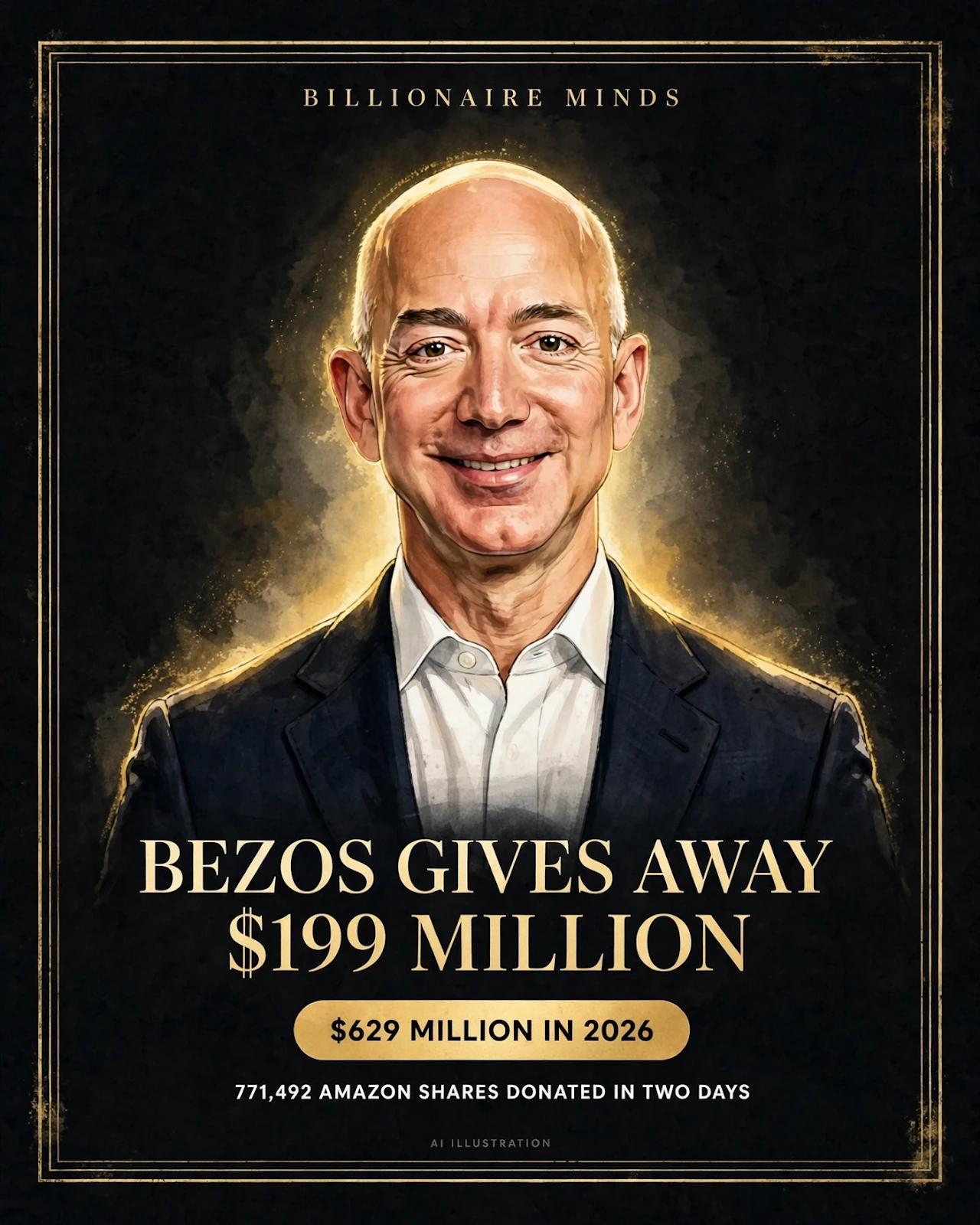
Jeff Bezos Donates $199 Million in Amazon Shares — His 2026 Giving Now Tops $629 Million

Jeff Bezos — the Amazon founder donated $199 million in Amazon shares, taking his 2026 charitable giving past $629 million

Jeff Bezos just gave away another fortune — and barely dented his own. The Amazon founder donated 771,492 Amazon shares worth roughly $199 million to non-profit organisations this week, according to documents filed with the US Securities and Exchange Commission on Monday.

It is the third round of stock donations from the world's second-richest person this year — and it takes his 2026 charitable giving past $629 million.

$199 Million in Two Days

The filings show Bezos transferred 674,088 shares on Thursday, November 12, and another 97,404 shares the following day. The shares were valued at approximately $198.9 million, based on Amazon's closing share price of $257.75 on Monday.

An SEC Form 144 confirmed that the Bezos Earth Fund Foundation received the 97,404 shares transferred on Friday. The foundation supports projects that tackle climate change and protect the environment.

$629 Million Given Away in 2026 Alone

The latest contribution follows two earlier rounds of charitable donations from Bezos this year. In May, he donated 1,253,797 Amazon shares, while another 415,580 shares were transferred to non-profit organisations in August.

Combined with the November transactions, the donations total at least 2.44 million shares, valued at approximately $629.1 million at Monday's closing share price.

Forbes reported Tuesday that the latest donations represented about 0.09 per cent of the Amazon shares Bezos directly owned before the transfers. Despite the donations, he retained 878.55 million Amazon shares, valued at approximately $226.4 billion at Monday's closing price.

Still the World's Second-Richest Person

Forbes estimated his net worth at $376.7 billion as of Monday evening, making him the world's second-richest person behind Tesla chief executive Elon Musk.

Bezos has made several major commitments to charitable causes, particularly environmental protection, education and support for homeless families. In 2020, he pledged $10 billion through the Bezos Earth Fund to tackle climate change and protect nature by 2030. The fund has awarded approximately $2.4 billion in grants so far.

He also established the Day One Fund in 2018 to support homeless families and provide early childhood education in underserved communities. In 2025, its Day 1 Families Fund awarded $102.5 million to 32 organisations.

According to Forbes, Bezos and his wife, Lauren Sánchez Bezos, had donated an estimated $4.7 billion to charitable causes by the end of 2025.

Source: GazetteNGR, reporting SEC filings and Forbes. The portrait image on this post is an AI-generated illustration.

Ramaphosa Tells Musk to 'Give Back' to South Africa — the R12 vs R1 Schooling Gap Behind the Starlink Standoff

South African President Cyril Ramaphosa challenges billionaire Elon Musk to give back to South Africa — apartheid spent R12 on Musk's schooling for every R1 on his own, while Starlink stays locked out

South Africa's president has a message for the world's richest man: remember where you came from — and give something back. Speaking in California on Monday, Cyril Ramaphosa told ABC News that Elon Musk owes much of his success to the education he received growing up in South Africa, and that the billionaire should help develop the country he left at 17.

The R12 vs R1 line

Ramaphosa put it in stark numbers. "When the apartheid government spent R12 on his education, it spent R1 on my education," he said, arguing Musk has never fully grasped what apartheid did to Black South Africans. "I have met Elon Musk in the past, and I've been awed by his brilliance, but also I would like to chat to him about him remembering his country, because even as one is a citizen of a new country, you should still be loyal to your old country." His message to Musk in the room: "What you've become today is from your own origins, where you were initially educated... he should be one of those who would say, I would like to contribute to the development of South Africa and give back to this country."

Why Starlink still can't launch in South Africa

The clash sits on top of a long-running business standoff. Starlink still has no licence to operate in South Africa: the law requires individual licence-holders to have at least 30% ownership by historically disadvantaged groups, and SpaceX has refused to give up a 30% stake in its local operation. Musk has called the ownership rules "openly racist ownership laws." Communications minister Solly Malatsi has pushed an alternative — equity-equivalent investment instead of a share transfer — and Starlink has offered to connect 5,000 rural schools, but the regulator says changing the rules needs an act of parliament, and a business lobby group took the dispute to court on November 9. A meeting between Ramaphosa and Musk was discussed during the president's Silicon Valley visit — but their diaries did not line up.

Source: ITWeb. The portrait image above is a stylized AI illustration, not a photograph of Cyril Ramaphosa or Elon Musk.

Billionaire Tony Elumelu Just Bought $70 Million More of Seplat Energy — His Stake Is Now Worth $1.6 Billion

Tony Elumelu — the Nigerian billionaire just bought $70 million more of Seplat Energy, lifting his stake to 22.05%, now worth $1.6 billion

Nigerian billionaire Tony Elumelu is doubling down on the company at the heart of his oil empire. His investment vehicle, Heirs Energies, has bought another 5,888,341 shares in Seplat Energy Plc for about N98 billion — roughly $70 million — taking the Heirs Holdings Group's total holding to 22.05% of Nigeria's biggest listed oil producer.

A $1.6 Billion Bet on Nigerian Oil

The purchase lifts Elumelu's total Seplat holding to a value of about $1.6 billion. It is the second major top-up in two months: Heirs Energies bought a similar tranche of around $70 million on September 30. Seplat's shares have been on a tear — closing at N16,241.90 on Monday, nearly triple the N5,809 they traded at the end of 2025.

From Largest Shareholder to Chairman

Elumelu's Seplat journey began on December 31, 2025, when Heirs Energies agreed to buy the entire 20.07% stake held by French oil group Maurel & Prom for about $500 million, making Heirs the company's largest single shareholder. He joined Seplat's board as a non-executive director in January 2026, and in June the company announced he will become Chairman on January 1, 2027.

Why It Matters

With the stake now above 22% and the chairmanship weeks away, Elumelu is moving from investor to operator-in-chief of one of Africa's most valuable energy companies — a bet that Nigeria's oil story still has a long way to run.

Sources: Billionaires.Africa and Nairametrics (November 17, 2026). Image: AI illustration.

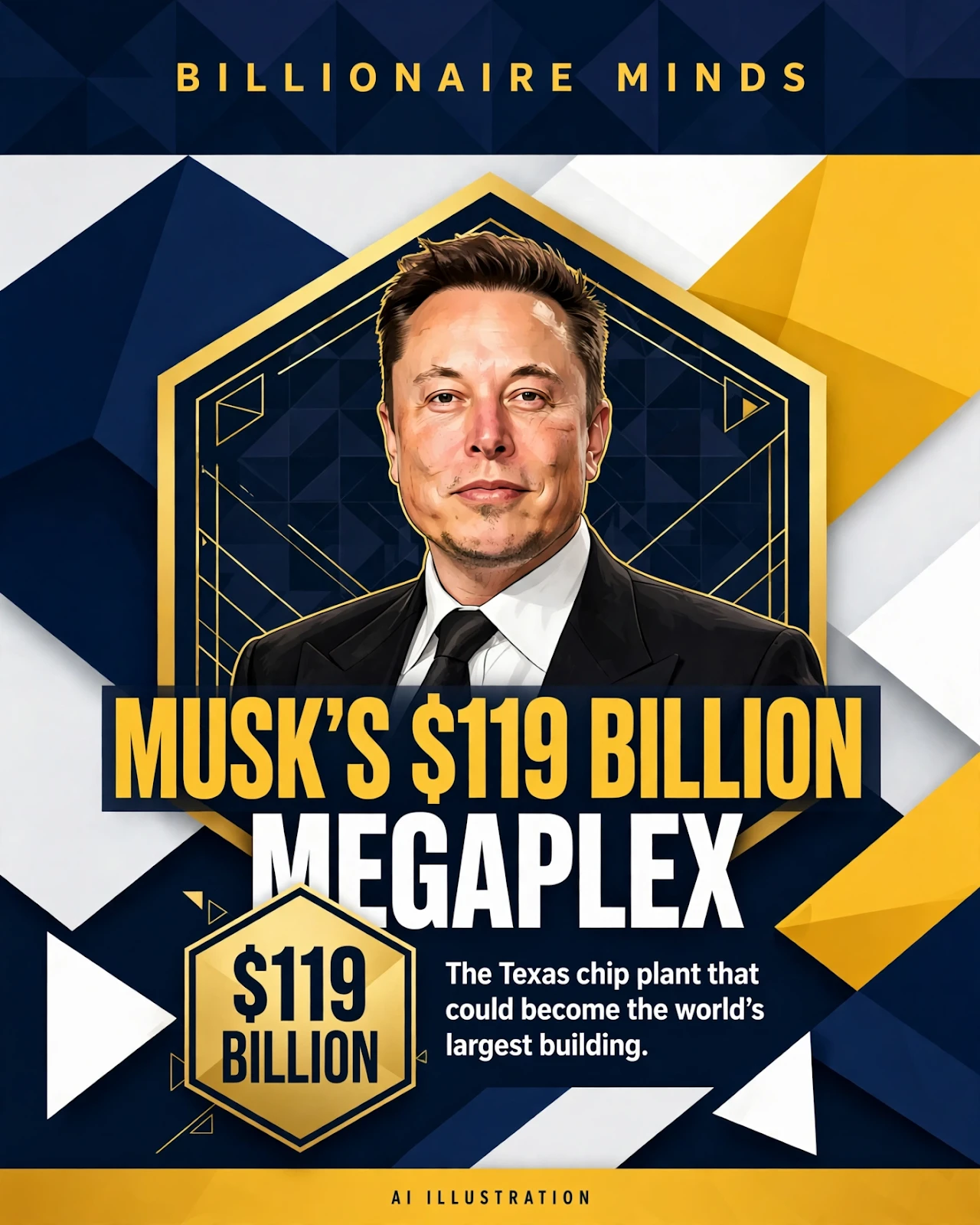
Elon Musk's $119 Billion Texas Megafactory Could Become the World's Largest Building

Elon Musk — his $119 billion Terafab chip plant in Texas could become the world's largest building

Elon Musk is building something so big it could dwarf the largest building on Earth. The project is called Terafab — a joint venture between SpaceX and Tesla — and it is rising in a quiet corner of rural Texas, about 70 miles northwest of Houston.

If it is finished as planned, the industrial complex would cover 100 million square feet. Architectural Digest has reported that would make it more than five times larger than China's New Century Global Centre, one of the largest buildings in the world.

A $119 Billion Bet on Chips

The goal is to make the advanced chips that artificial intelligence, self-driving cars, humanoid robots and space technology will need in the years ahead — all under one roof, including logic chips, memory and advanced packaging. The chips would supply Tesla's autonomous vehicles, its Optimus robots and SpaceX's space programmes.

Texas Governor Greg Abbott's office announced on August 6 that the first phase alone would involve more than $16.8 billion of investment and create about 3,000 jobs. The full ambition is far larger: tax incentive filings reported by local broadcaster KBTX put total investment at about $119 billion across four phases, with construction running until 2036 and more than 4,000 direct jobs. Those figures are projections — not money already spent.

Why Texas, Why Now

Reuters reported in October that Musk is aiming for volume production by the third quarter of 2028. Musk himself called that timeline highly ambitious and said it was uncertain whether it could be met.

Land acquisition has moved fast. KBTX reported on November 10 that WIT TECH LLC, a company linked to the project, now holds more than 10,000 acres in the county, up from about 7,700 acres in August. A Musk-linked company has also bought a water pumping station on the Navasota River.

The public incentives behind the project have drawn close scrutiny. The Houston Chronicle reported that two local school districts gave preliminary approval in July to property tax deals worth an estimated $1.66 billion in future tax relief, phased in through 2046. A separate agreement with Grimes County requires SpaceX to invest at least $5 billion by 2030 and create 1,800 permanent jobs by 2035 — though the company can walk away at any time with 30 days' written notice, with a maximum penalty of $60 million.

The Pushback

Hopes for jobs have come with local concerns about water, power, roads, the environment and the rural way of life. County Judge Joe Fauth has said the plant will not draw on groundwater, instead using recycled surface water from the Gibbons Creek Reservoir and generating its own power, separate from the state grid. Some community groups are still pressing for stronger safeguards and greater transparency.

The fight over transparency has reached the courts. In September, SpaceX sued the Texas attorney general and Grimes County to block the release of certain records, and on November 9 it amended its petition to also challenge the release of documents requested by KBTX.

Texas politics adds a new layer of uncertainty. In the November 3 election, Democrat Gina Hinojosa defeated Abbott and will take office in January as the state's first Democratic governor since 1995. She campaigned against corporate incentives, but has since struck a more conciliatory tone, saying she could have a strong working relationship with Musk "on our terms" — while calling for strict rules on water, power and community rights for data centres.

Whether Terafab ends up the world's largest building or not, one thing is clear: the world's richest man is betting $119 billion that the future of AI will be built in rural Texas.

Source: Geo TV. Image: AI illustration.

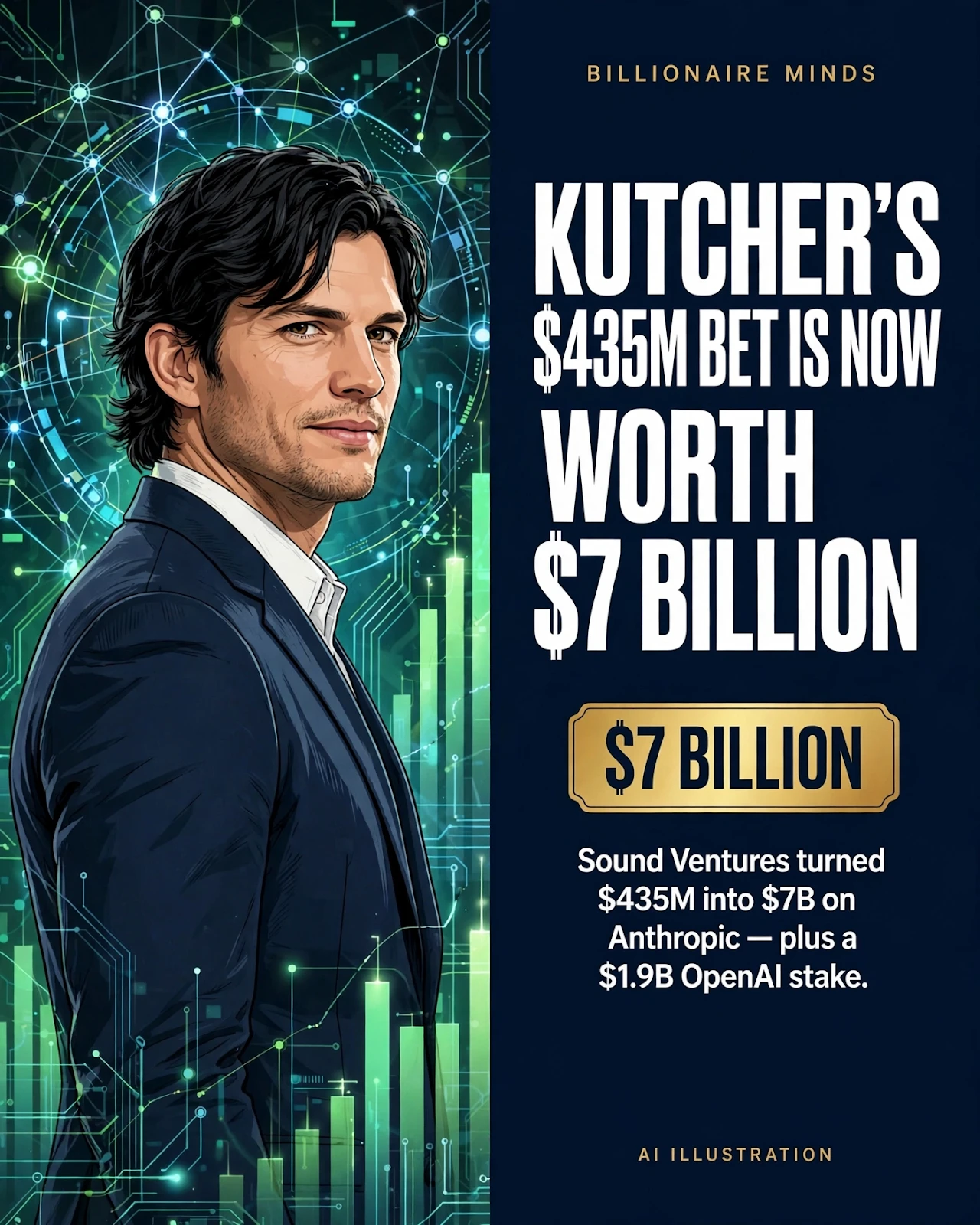
Ashton Kutcher's $435 Million Anthropic Bet Is Now Worth $7 Billion — and He Also Owns a Piece of OpenAI

Ashton Kutcher — Sound Ventures turned a $435 million Anthropic bet into a $7 billion stake

The internet is calling Ashton Kutcher one of the biggest winners of this week's historic Anthropic IPO — and the numbers behind the celebration are very real. On Monday, a Polymarket post announcing that the venture firm Kutcher co-founded had turned a $435 million investment into a position worth roughly $7 billion racked up more than half a million views within hours.

The $435 Million Bet That Became $7 Billion

According to Bloomberg, Sound Ventures — the firm Kutcher launched in 2015 with Madonna's longtime manager Guy Oseary — owns roughly 0.5% of Anthropic. At the AI company's proposed $1.4 trillion IPO valuation, that stake would be worth an astonishing $7 billion. The firm first invested $35 million in Anthropic's 2023 Series C round, when the company was valued at roughly $5 billion, and later added another $400 million across further rounds — $435 million in total, for a paper gain of about $6.565 billion.

He Also Owns a Piece of OpenAI

Anthropic isn't Sound Ventures' only enormous AI holding. The firm also owns a roughly 0.15% stake in OpenAI, worth about $1.875 billion at OpenAI's $1.25 trillion valuation after its $11 billion raise on November 6. Combined, Sound Ventures' Anthropic and OpenAI holdings could be worth nearly $9 billion — on a combined investment of more than $835 million.

But Kutcher Won't Pocket $7 Billion Himself

Here's the catch the viral posts skip: Sound Ventures manages money for outside investors, so the $7 billion belongs to the firm's funds, not to Kutcher personally. Under a standard 20% carried-interest arrangement, the general partners' share of the profits would be roughly $1.6 billion across both holdings — and Kutcher's personal slice could be anywhere from about $161 million to $536 million, depending on his share of that pool. There's one more twist: Kutcher left his general partner role in May 2026 to start a separate deep-tech investment business, so what he actually keeps depends on the exit deal he struck. Even so, with a net worth already estimated at around $500 million — built on early Uber, Airbnb and Spotify bets that turned $30 million into $250 million — the actor-turned-investor has pulled off one of Hollywood's greatest second acts.

Source: Celebrity Net Worth, reporting Bloomberg figures on Sound Ventures' Anthropic and OpenAI stakes. Figures are paper valuations at proposed IPO prices, not cash in hand.

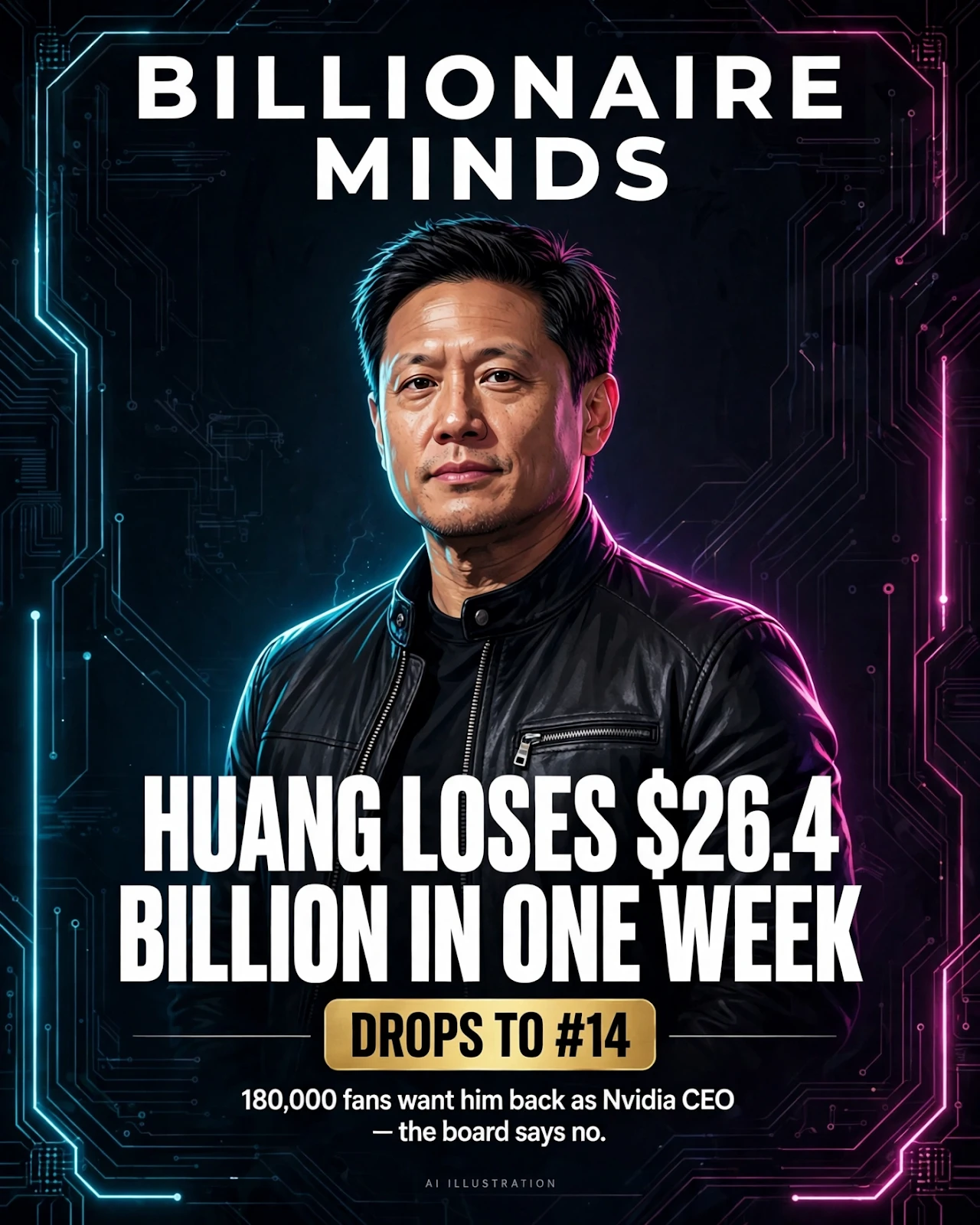
Jensen Huang Just Lost $26.4 Billion in a Week — Now 180,000 People Want Him Back as Nvidia CEO

Jensen Huang — the former Nvidia chief lost $26.4 billion in a week, dropping to No. 14 on Forbes' list, while 180,000 fans petition for his return as CEO.

Jensen Huang's fortune took another hit on Monday. The former Nvidia chief lost $6.1 billion in a single day as the chipmaker's shares slid about 4%, taking his net worth to $135.8 billion — down $26.4 billion in a week. Huang stepped down as CEO last Thursday after an investigation into his relationships with employees and a suspected Chinese intelligence asset.

A Brutal Week on the Forbes List

The slide has been relentless: minus $7.4 billion last Monday, minus $8.4 billion on Tuesday, a $5.9 billion recovery on Wednesday, then minus $8.2 billion on Thursday and minus $3.1 billion on Friday. His fortune is down 16.3% from $162.2 billion on November 9, and he has slipped six places on Forbes' ranking, landing at No. 14, behind Walmart heiress Alice Walton.

180,000 People Want Him Back

Yet while the market keeps punishing him, a campaign is demanding his return. The "Stand With Jensen" petition had attracted more than 180,200 signatures by Monday, with Elon Musk, Replit CEO Amjad Masad and Epic Games CEO Tim Sweeney listed among its supporters. It also claims more than 8,800 signatories as Nvidia employees and over 94,000 as shareholders — though those affiliations are self-reported and unverified.

The Board Says No — for Now

The campaign has not changed the board's position. Three people familiar with the matter told Reuters that Nvidia is not considering bringing Huang back. Nvidia reports its third-quarter earnings today — its first under new CEO Colette Kress, after guiding to revenue of about $108 billion.

Sources: The Economic Times, The Sunday Guardian Live. The portrait image above is a stylized AI illustration, not a photograph of Jensen Huang.

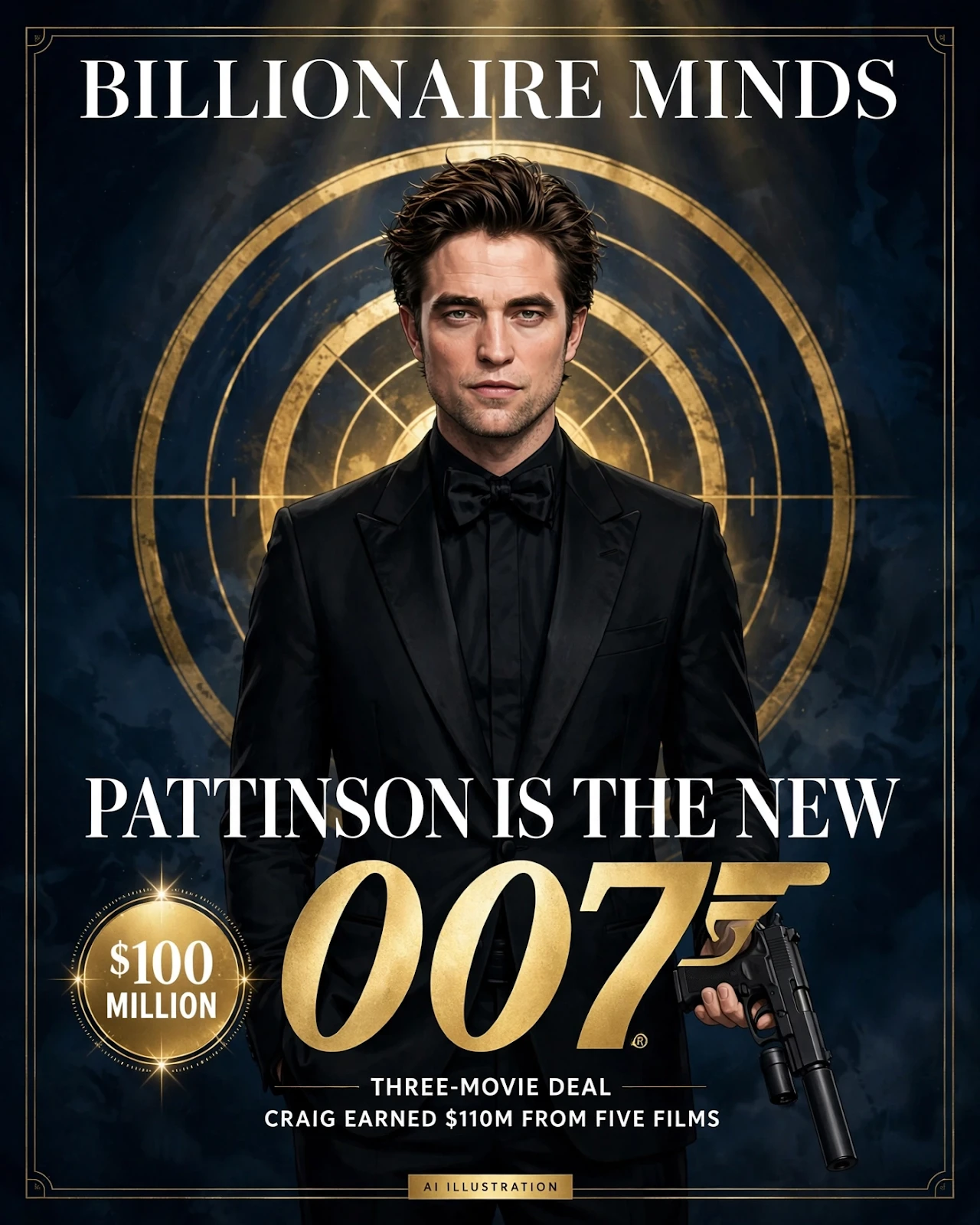
Robert Pattinson Is the New James Bond — the $100 Million Star Takes Over 007 in a Three-Movie Deal

Robert Pattinson — the $100 million star is the new James Bond, taking over 007 from Daniel Craig in a three-movie deal.

The search for the next James Bond is over. Amazon MGM Studios announced on Monday, November 16, that Robert Pattinson will be the new 007, succeeding Daniel Craig in the 26th official Bond film. The 40-year-old Twilight and The Batman star will headline the first Bond adventure under Amazon MGM's creative control, directed by Dune filmmaker Denis Villeneuve, with a script by Peaky Blinders creator Steven Knight and producers Amy Pascal, David Heyman and Tanya Lapointe.

A Three-Movie Deal — and a $100 Million Payday in Waiting

Pattinson did not just land one film. Puck's Matthew Belloni reported on November 13 that the actor had signed a deal to star as 007 in three movies if he was chosen — and his payday is expected to be higher than his predecessors'. Celebrity Net Worth estimates Pattinson's fortune at about $100 million in 2026, built on Twilight, The Batman and a reported $12 million Dior deal. For comparison, Daniel Craig earned an estimated $85–110 million across his five Bond films. No release date has been set, though a 2028 debut is the earliest plausible target.

What Pattinson Said

"James Bond is one of the most legendary characters in cinema, and to be entrusted with 007 is the honor of a lifetime," Pattinson said in a statement, adding he was "deeply grateful" to Villeneuve and Amazon MGM. Villeneuve said: "We were surrounded by extraordinary talent, but there can only be one 007. I am overjoyed to welcome Robert Pattinson as our new James Bond." Pattinson beat out four other finalists — Callum Turner, Nicholas Hoult, Josh O'Connor and Jack Lowden. The casting even fulfils his own prediction: at 26, back in 2012, Pattinson said he would be "definitely" interested in playing Bond "in 20 years." Fourteen years later, the tuxedo fits.

Why This Bond Matters for the Money

This is the first Bond film since Amazon MGM took creative control of the franchise in 2025, in a new joint venture with longtime rights holders Michael Wilson and Barbara Broccoli. Pattinson arrives with a packed slate — December's Dune: Part Three with Villeneuve, then The Fix in January — before stepping into the most lucrative leading-man role in Hollywood. Craig's five films turned the spy into a billion-dollar box-office machine; now the franchise bets its next decade on a star who has already proved he can carry one.

Sources: Reuters via GMA News, USA Today, People, Economic Times. The portrait image above is a stylized AI illustration, not a photograph of Robert Pattinson.

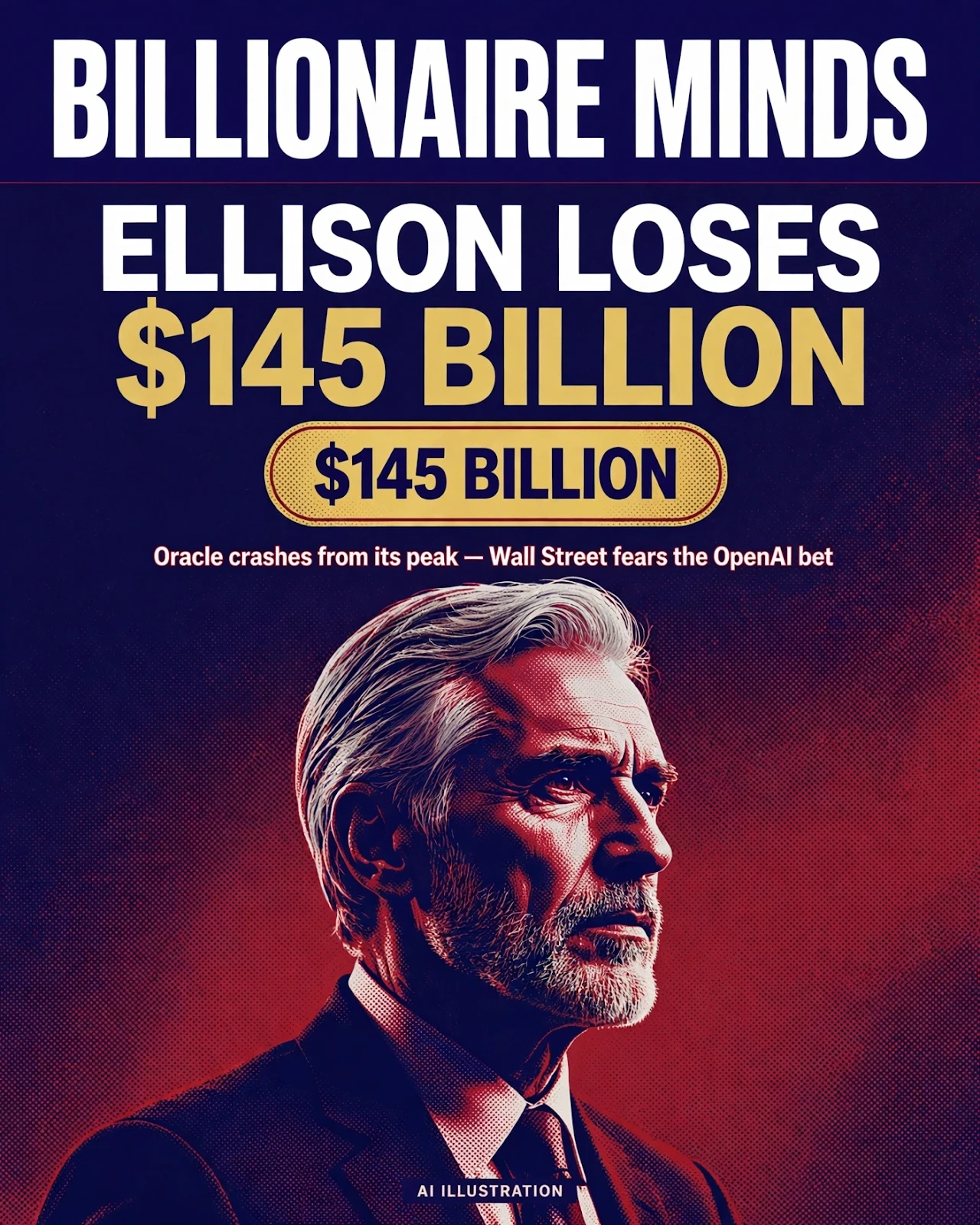
Larry Ellison Has Lost $145 Billion as Oracle Crashes From Its Peak — Wall Street Fears the OpenAI Bet

Larry Ellison — Oracle's co-founder has lost about $145 billion as Oracle stock crashes from its peak, with Wall Street worried about its OpenAI bet.

Larry Ellison, the co-founder of Oracle, has watched roughly $145 billion of his fortune evaporate as Oracle's stock crashes from its peak. The Motley Fool reports the wipeout is tied directly to Ellison's enormous stake in the company — about 1.16 billion shares, roughly 40% of Oracle, making him its largest shareholder by far.

Oracle's Slide Keeps Getting Worse

Oracle's shares are down roughly 44% over the past year and about 50% from their high, and the slide is still going — the stock fell another 4.99% on Monday, November 16, closing at $119.09. Just two weeks ago, Forbes had Ellison at $153.3 billion and ranked 11th richest in the world after Oracle dropped 7% in a day. Since then, the sell-off has only deepened.

The $300 Billion OpenAI Question

Wall Street's worry is not just the share price — it is what Oracle is betting on. The company reported a backlog of roughly $664 billion at the end of last quarter, and at least $300 billion of it is widely estimated to come from a single customer: OpenAI, the maker of ChatGPT. That means around half of Oracle's contracted future business depends on one company. If OpenAI ever scaled back or walked away, much of that backlog could be voided — cancellation fees would help, but there is no guarantee the contracts are ever fulfilled.

Growth Is Real — So Is the Spending

Oracle's business is still growing fast: revenue rose 30% to $19.3 billion in its latest quarter, cloud sales jumped 62% to $11.6 billion, and earnings per share climbed 30%. But the AI build-out is burning cash — Oracle spent $28 billion on data centres last quarter against $23 billion of operating cash flow, leaving free cash flow of roughly negative $5 million. The company expects $90–95 billion of capital spending this year, carries about $125 billion of debt, and will likely keep posting negative free cash flow in the near term. For Ellison, whose fortune is tied to Oracle's shares, that spending spree is the price of the AI bet — and the reason $145 billion has already vanished.

Source: Motley Fool. The portrait image above is a stylized AI illustration, not a photograph of Larry Ellison.

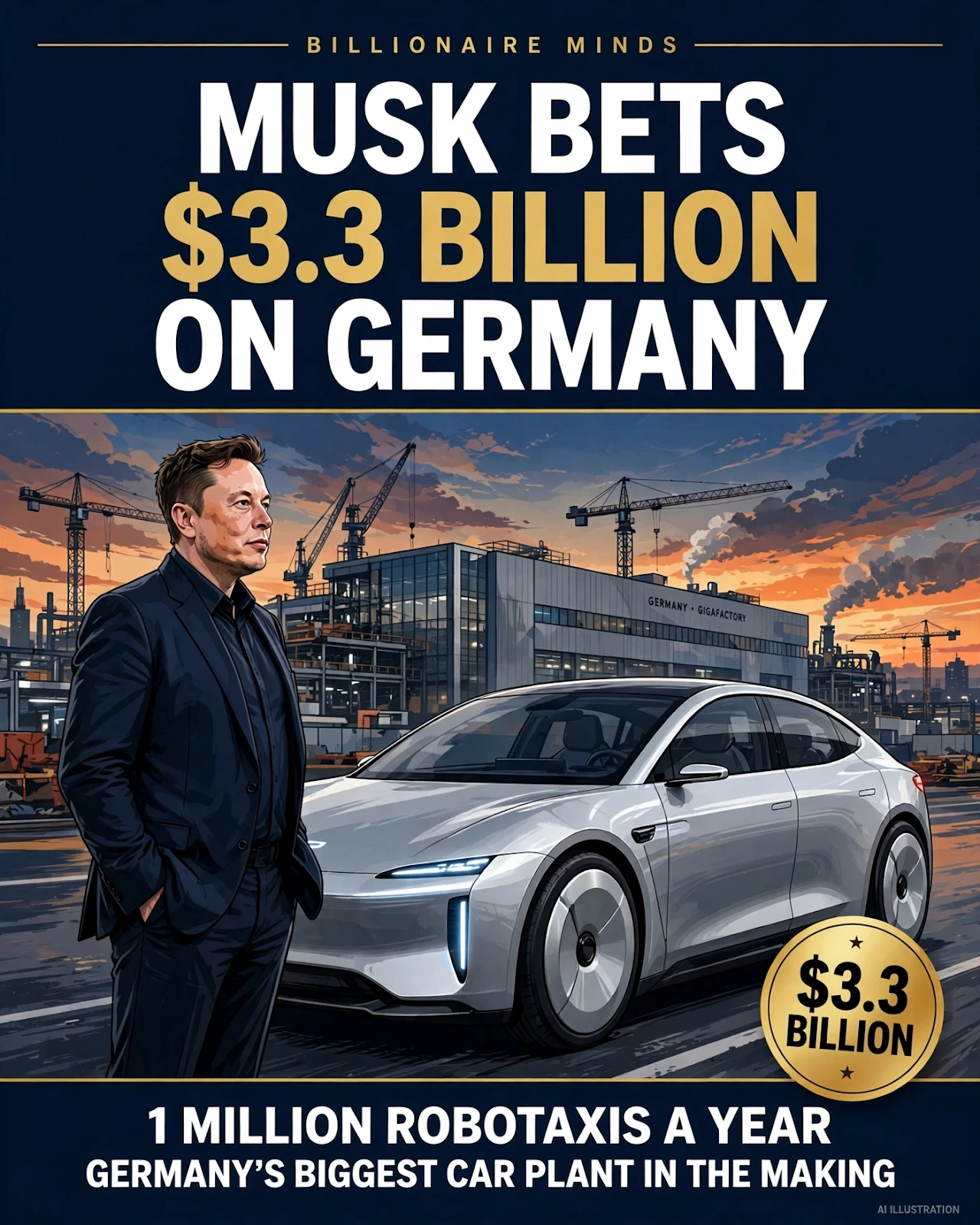
Elon Musk Bets $3.3 Billion on Germany — Tesla's Cybercab Factory Could Become Europe's Biggest Car Plant

Elon Musk beside a futuristic silver Cybercab robotaxi in front of Tesla's German gigafactory — Tesla is investing $3.3 billion to build up to 1 million robotaxis a year in Germany

Elon Musk is doubling down on the robotaxi — and betting $3.3 billion that Germany is where it gets built. Tesla said on Monday it will invest €3 billion in its German gigafactory at Gruenheide, outside Berlin, pressing ahead with its Cybercab model even as Volkswagen, Mercedes-Benz and BMW cut jobs and weigh plant closures. The new facility could make Tesla's only European site Germany's largest auto plant by capacity, overtaking Volkswagen's Wolfsburg headquarters.

Tesla aims to produce up to 1 million Cybercabs a year at Gruenheide. The company said it will submit a building permit application before the end of the year, start construction in the first half of 2027, and begin production in 2029. Several hundred new workers are being sought for the first step of construction and production planning. The plant has already ramped up Model Y production and hired more than 2,000 new employees in recent months, and Tesla aims to start battery cell production there from the middle of next year.

A Bet on the Robotaxi — Before It Has Sold One at Scale

The scale of the bet is striking because the Cybercab has yet to be sold anywhere at scale commercially. The two-seater has no steering wheel, pedals or mirrors, and US safety regulators have opened an investigation into whether early vehicles were properly certified. Automotive analyst Matthias Schmidt welcomed the investment as much-needed good news for Germany's car industry, but asked the question Berlin will be asking too: how much of it becomes sustainable, long-term employment, and how much is automated, low-labour work? Tesla has also faced environmental protests at Gruenheide and repeated clashes with the powerful IG Metall union.

Cybertruck Makes Way for the Robotaxi

The Germany expansion is the other half of a factory reshuffle Musk has already announced in Texas. Tesla will wind down Cybertruck production at its Austin plant at the end of summer 2027 — extended by a few months to clear the order backlog — so the factory can make way for more Cybercabs. Only about 63,000 Cybertrucks have been sold worldwide since the 2023 launch, far below expectations. Musk has admitted the extension is not the most profitable move, but said there must be room for sentimentality. The message from both announcements is the same: the Cybertruck era is ending, and the robotaxi era is where Musk is putting the money.

Source: Reuters, November 17, 2026. This is a fan/commentary summary of reported news; all figures are the sources' estimates. Image is an AI illustration.