Posts

Nvidia's Board Just Said No to Jensen Huang — Even Trump Couldn't Bring Him Back

Jensen Huang — Nvidia's board rejected the billionaire founder's offer to return as CEO

Jensen Huang offered to come back. Nvidia's board said no — unanimously, in public, and on the company's biggest earnings call of the year.

Hours after Huang posted on X that he would be "honoured" to return as CEO if the board decided it served shareholders, employees, the company and America, board chairman Harvey Jones opened Nvidia's third-quarter earnings call on Tuesday with a blunt verdict: "The Nvidia board unanimously accepted his resignation and does not intend to reinstate Jensen as CEO."

It was a stunning rebuke — not just of Huang, but of the campaign to bring him back. President Donald Trump had backed his return. Elon Musk, Epic Games founder Tim Sweeney and Y Combinator's Garry Tan had signed an open letter urging reinstatement. A petition demanding his comeback had gathered 180,000 signatures. None of it moved the board.

The $136 Billion Founder Who Offered to Return

Huang, 63, resigned on November 12 after admitting to extramarital affairs, including one with a Chinese businesswoman reported to be a suspected intelligence asset. The board launched an independent investigation, and the fallout erased roughly $751 billion in Nvidia's market value in days. Huang's own fortune fell $26.4 billion in a week to about $136 billion, dropping him to 14th on Forbes' real-time rich list.

In his first public comment since resigning, Huang acknowledged "serious mistakes" in his personal life and pledged to cooperate with the board's investigation. He has also agreed to testify before congressional committees on December 1, with Nvidia general counsel Tim Teter scheduled to appear the next day.

"We've Got This" — Nvidia Moves On Without Its Founder

Interim CEO Colette Kress, Nvidia's chief financial officer of 13 years, used the same earnings call to insist the company is not standing still. "Our roadmap is on track, and our ambition has never been greater," she told investors, closing with a rallying call: "We've got this."

The numbers backed her up. Nvidia reported third-quarter revenue of $115.8 billion — up 103% from a year earlier — and Kress raised the growth outlook for the 2028 financial year to around 75%, up from about 70%. The board has hired executive search firm Heidrick & Struggles to find a permanent successor, and set up a new national security and export control oversight committee.

Jones said the board wants to install a permanent CEO "as quickly as possible, but we won't expedite the CEO before finding exactly the right person." For now, the message from Nvidia's boardroom is clear: the company that Huang built over 33 years will go forward without him — and it is in no hurry to look back.

Source: CNN (Nov 17, 2026); The Business Times; South China Morning Post. Portrait image is an AI illustration.

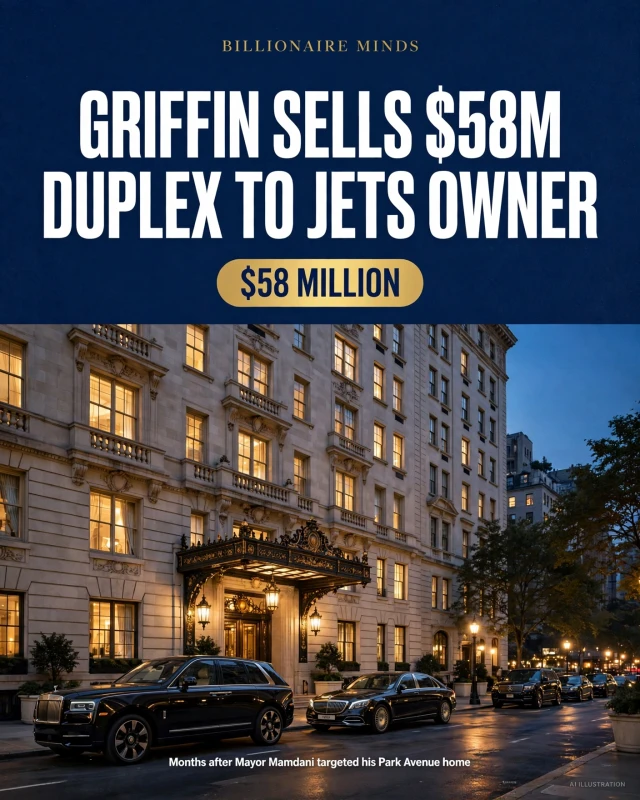
Ken Griffin Sells His $58 Million Park Avenue Duplex to Jets Owner Woody Johnson — Months After Mayor Mamdani Targeted Him

Ken Griffin sells his $58 million Park Avenue duplex to New York Jets owner Woody Johnson, months after Mayor Mamdani targeted his home

One billionaire's Park Avenue duplex just changed hands — to another billionaire. Hedge fund titan Ken Griffin has sold his sprawling duplex at 740 Park Avenue to New York Jets owner Woody Johnson for $58 million, in an off-market deal first reported by the Wall Street Journal on November 17.

One Billionaire to Another

The roughly 8,500-square-foot residence spans two floors in one of the Upper East Side's most exclusive cooperative buildings, with five bedrooms, three fireplaces and a grand staircase foyer. The buyer is no ordinary house-hunter: Johnson is the Johnson & Johnson heir whose net worth stands at $13.5 billion, according to the Bloomberg Billionaires Index. The limestone building at 740 Park Avenue, developed around 1930 by James T. Lee — the grandfather of Jacqueline Kennedy Onassis — holds only about 30 apartments.

A $13 Million Profit in One Year

Griffin bought the same duplex in 2025 for $45 million from Julia Koch, the widow of billionaire industrialist David Koch. The $58 million sale price is roughly 29% higher — a $13 million gain in about a year, before transaction costs or improvements. Griffin wished the buyer well in a statement to the New York Post: "I wish Woody and his family many happy years in one of New York's great residences."

The Mamdani Factor

The timing is hard to ignore. In April 2026, New York Mayor Zohran Mamdani posted a video outside Griffin's Manhattan penthouse promoting a new tax on luxury second homes — a measure described as raising about $500 million a year. Mamdani had made taxing the city's wealthiest property owners a signature issue, singling out Griffin, the Citadel founder, by name. The sale comes just months after that very public targeting.

Griffin Isn't Leaving New York

Despite the sale, Griffin has not exited the city. He still owns the apartment Mamdani featured in his video, and he retains an adjacent unit at 740 Park Avenue that he bought earlier this year for $38 million. His planned $6 billion Manhattan office tower, however, has given way to a bigger bet on Citadel's Miami expansion. For Johnson, the purchase caps a billionaire property shuffle of his own — he recently sold his duplex at 834 Fifth Avenue to billionaire Leonard Blavatnik.

Source: Wall Street Journal, New York Post and Bloomberg Law, November 17, 2026. Image: AI illustration.

Billionaire Leo KoGuan's $1.3 Billion Ultimatum — No Huang, No More Nvidia Money

Stylized illustration of billionaire Leo KoGuan before a glowing microchip and city skyline — his $1.3 billion ultimatum to Nvidia's board over Jensen Huang's return

One of Nvidia's biggest individual shareholders just drew a line in the sand. Singapore-based billionaire Leo KoGuan — who has about $1.3 billion invested in the chipmaker — says he will not buy another share of Nvidia while Jensen Huang is out as CEO. "No further investment without Jensen," the 71-year-old told Bloomberg in a text message.

The Letter Demanding Huang's Return

KoGuan has been defending Huang publicly on X, calling him "the supreme creator" and arguing that his contributions to artificial intelligence should carry more weight than his personal mistakes. He has now joined Tesla CEO Elon Musk and Epic Games founder Tim Sweeney in signing an open letter urging Nvidia's board to reinstate Huang. Huang stepped down on November 12 following revelations about extramarital relationships, including one involving a suspected Chinese spy. The board, however, has said it does not intend to bring him back — even as Nvidia just posted a $115.8 billion quarter without him.

Who Is Leo KoGuan?

KoGuan is the founder and chairman of SHI International, one of the world's largest privately held IT solutions providers, with around 7,000 employees, more than 17,000 customers and $16 billion in gross sales. He and his then-wife Thai Lee bought a struggling New Jersey software reseller for less than $1 million in 1989 and built it into SHI; Lee is now president and CEO, with an estimated $8 billion fortune of her own. KoGuan first appeared on Forbes' Singapore rich list in 2022 and ranked ninth in September 2026 with an estimated net worth of $8.2 billion. Beyond SHI, he became one of Tesla's largest individual shareholders, holding 6.3 million shares plus options on another 1.8 million by September 2021 — a stake worth more than $7 billion at the time. In March 2026 he disclosed buying 2 million Nvidia shares in two transactions. His wealth has also funded major Singapore real estate, including a S$62 million penthouse bought from British billionaire James Dyson in 2020 and a roughly S$100 million boutique hotel acquired in 2025.

A Shareholder Standoff

KoGuan's ultimatum sets up a direct clash between Nvidia's board and one of its most prominent backers. The board has closed the door on Huang's return, yet a billionaire who has poured $1.3 billion into the company is now publicly refusing to invest another dollar until the man he calls "the supreme creator" is back in charge. With Musk and Sweeney also pressing for reinstatement, the pressure on the board is only growing — and the next move belongs to the shareholders.

Source: VnExpress International, November 18, 2026, reporting Bloomberg. Image: AI illustration.

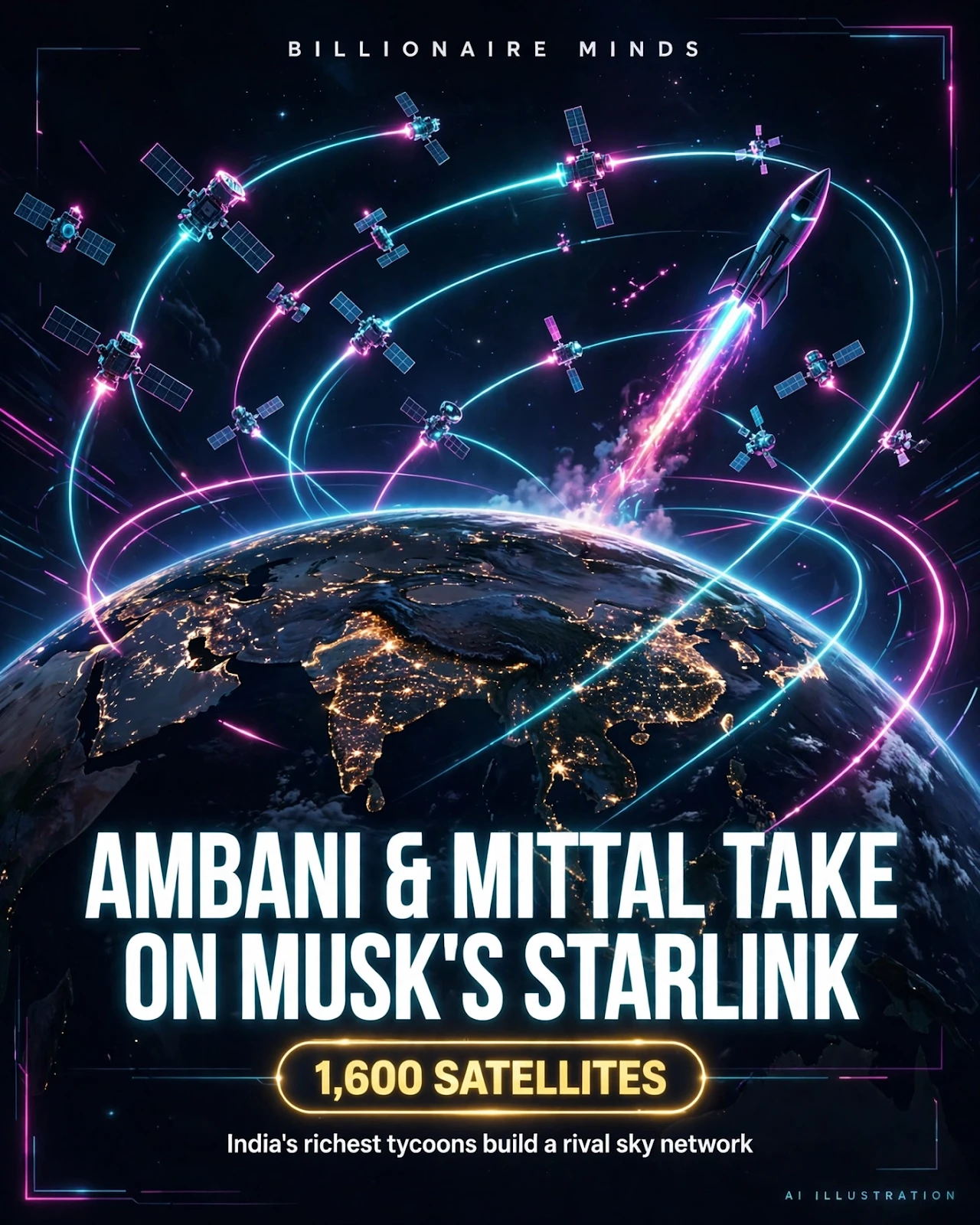
Ambani and Mittal Just Declared War on Musk's Starlink — a 1,600-Satellite Rival

Stylized illustration of satellites orbiting Earth — Ambani and Mittal take on Musk's Starlink with a 1,600-satellite rival network

Two of India's richest men are taking the fight to Elon Musk — in orbit. Mukesh Ambani's Reliance Industries is planning a 1,600-satellite low Earth orbit constellation to rival Starlink, while telecom tycoon Sunil Mittal is backing Eutelsat's OneWeb as the independent alternative. The billionaire space race just got a lot more crowded.

Ambani's 1,600-Satellite Plan

Reliance is in talks with Indian satellite manufacturers, technology startups and larger industrial groups, offering to fund the infrastructure needed to scale up production. India currently produces fewer than 15 satellites a year — the constellation would need output of around 200 a year. The plan combines domestic manufacturing with imports, including at least 400 satellites from the US. Reliance is discussing procurement with two US companies and evaluating suppliers in Europe, while ruling out China as a source. A test mission is targeted for September 2027, with wider deployment from early 2028; completion has slipped from 2030 to 2035.

Mittal's OneWeb Bet

Meanwhile, Sunil Mittal is backing Eutelsat Communications' OneWeb, which is building a global satellite-internet network independent of both the US and China. "Countries can't rely on another country," Mittal told Bloomberg TV. OneWeb has around 650 satellites — far fewer than Starlink — and Bharti Airtel, India's second-largest telecom operator, was an early investor in 2015, joining the UK government in a $1 billion rescue in 2020 and investing another $500 million since.

The Gap They Have to Close

The commercial gap remains substantial. Starlink serves at least 13.6 million customers worldwide and generated more than $5 billion in connectivity revenue in the three months ended September. Eutelsat's LEO business, including OneWeb, generated just €70.9 million ($81.5 million) in the same period. Amazon is also developing a network of thousands of satellites. For Ambani and Mittal, the stakes go beyond broadband — satellite networks are increasingly vital for remote connectivity, communications and military operations, making control a matter of strategic autonomy. Starlink's planned India entry remains subject to regulatory and security scrutiny, strengthening the case for homegrown alternatives.

Source: BusinessToday, November 18, 2026. Image: AI illustration.

Billionaire Ray Dalio's Bridgewater Dumps Union Pacific and Slashes Its Biggest Bet — the $4 Billion S&P 500 Stake

Ray Dalio's Bridgewater dumps Union Pacific — the fund exits railroads and trucks and slashes its $4 billion S&P 500 bet

Ray Dalio's Bridgewater Associates just made one of its boldest portfolio moves in years — and the filing tells the whole story. The hedge fund founded by the billionaire sold its entire stake in railroad giant Union Pacific, walked away from truckmaker Paccar, and slashed the biggest single bet in its portfolio: a nearly $4 billion position in the S&P 500 itself.

The Railroad Exit

Bridgewater's quarterly 13F filing with the US Securities and Exchange Commission shows the firm held about 514,300 Union Pacific shares — worth roughly $139.9 million — at the end of June. By September 30, the position was gone entirely. Paccar went the same way: about 946,100 shares worth $113.6 million at the end of June, zero by the end of the quarter. Together, the two fully exited positions were worth around $253.5 million.

The Biggest Cut of All

The largest change in the filing was not a single stock at all. Bridgewater cut its holding in the SPDR S&P 500 ETF Trust — the fund that tracks the benchmark US index — sharply enough to reduce the portfolio's weighting by about 5.9 percentage points. The ETF had been Bridgewater's largest US equity holding: about 5.3 million shares worth $3.97 billion, or 16.3% of a stock portfolio valued at roughly $24.4 billion. At the same time, the firm opened new positions in utility Dominion Energy and oil producer Occidental Petroleum, and added to its chipmaker Qualcomm stake.

Dalio Steps Back

Dalio, 77, started Bridgewater from his New York apartment in 1975 and built it into the world's largest hedge fund. He handed control to the firm's board in 2022 and has since sold down his stake and left the board, leaving him with no formal role. He remains one of the most widely followed voices in finance — and he has spent recent weeks warning about the size of US government debt, comparing it to plaque building up in an artery, while promoting gold as a hedge against it. Forbes lists him among the world's billionaires.

The filing is a snapshot, not a diary: it shows what Bridgewater held on September 30, not when it traded or why. But the direction is unmistakable — Dalio's fund is pulling back from the index and from America's railroads at the same time.

Source: Billionaires.Africa, reporting Bridgewater Associates' Q3 2026 Form 13F filing with the SEC.

Image: AI illustration. This is a commentary post based on public reporting.

Nvidia Doubles Sales Without Huang — $115.8 Billion Quarter and a $130 Billion Guide as the Board Closes the Door on His Return

Nvidia doubles sales without Jensen Huang — $115.8 billion revenue in its first quarter under interim CEO Colette Kress

Nvidia just delivered its first earnings report without Jensen Huang — and the numbers barely noticed he was gone. Revenue for the quarter ended October 25 more than doubled to $115.8 billion, up 103% from a year ago and roughly $6.7 billion above what Wall Street expected. Adjusted earnings hit $2.68 a share against a $2.47 forecast, and net income more than doubled to $65.3 billion.

The data-center business did the heavy lifting: $107.6 billion, up 110%, with sales to AI clouds and enterprise customers up 195%. New Vera Rubin systems began shipping in the quarter and added nearly $20 billion of revenue on their own. Shares rose about 2.4% in after-hours trading after the release.

A $130 Billion Guide — and No Way Back for Huang

The outlook was even louder than the quarter. Nvidia guided fourth-quarter revenue to $130 billion, comfortably above the roughly $125 billion analysts expected, in a quarter that includes an extra week. Interim CEO Colette Kress — who is also chief financial officer — told investors "the momentum is real" and raised the fiscal 2028 growth outlook to about 75%.

Then came the line that closed the book on the saga of the past week. Board chair Harvey Jones told the earnings call the board does not intend to reinstate Huang, ending the campaign to bring the founder back after his November 12 resignation. The message from Nvidia's first post-Huang quarter is blunt: the machine prints money with or without him.

Source: Motley Fool / MLQ.ai / Zacks / BeInCrypto

Image: AI illustration. This is a commentary post based on public reporting.

Billionaire Stanley Druckenmiller Dumps Google for SpaceX — Sells Every Alphabet Share in a $120 Million Exit

Stanley Druckenmiller — billionaire sells every Alphabet share and buys into SpaceX

One of Wall Street's most closely watched billionaires just swapped one AI giant for another. Stanley Druckenmiller's Duquesne Family Office sold every single Alphabet share it owned in the third quarter — all 336,300 of them, worth more than $120 million — and used the moment to buy into Elon Musk's SpaceX instead.

The moves surfaced in Duquesne's Form 13F, filed with the SEC on Monday, November 16. The Alphabet exit is striking because Druckenmiller had only bought the Google parent's stock one quarter earlier. Three months in, the whole position was gone.

The SpaceX Bet

On the other side of the trade, Duquesne opened a new position of 202,125 SpaceX shares, worth about $30.5 million at the end of September. SpaceX went public in June at $135 a share with a valuation of roughly $1.77 trillion, and Druckenmiller's move puts the legendary investor on the same side of the AI trade as Musk — just in a different company.

Druckenmiller has said artificial intelligence "might be a little overhyped now, but underhyped long term" — a view that fits a portfolio rotating toward the companies he believes will win the long game.

Gold, Chips and a 94% Cut

The Alphabet exit was not the filing's only surprise. Duquesne slashed its Taiwan Semiconductor stake by 94%, from 589,680 shares to just 32,700, and opened three new gold-miner positions totalling about $129 million in Newmont, Barrick and Agnico Eagle. It also nearly tripled its Seagate holding and added first-time stakes in Palantir and AppLovin.

The filing is a snapshot, not a diary: it shows what Duquesne held on September 30, not when it traded or why. But the direction is unmistakable — out of Google, into SpaceX, gold and data storage, with the biggest bet still on molecular diagnostics firm Natera at about $1.3 billion.

Source: Motley Fool / TradingView / Benzinga / MLQ.ai

Image: AI illustration. This is a commentary post based on public reporting.

Billionaire David Hoffmann Offers Just $37 Million for 342 Radio Stations — Townsquare's Board Is Expected to Say No

David Hoffmann — billionaire offers $37 million for Townsquare Media's 342 radio stations

Missouri-born billionaire David Hoffmann has made one of the boldest lowball offers in media history: just $37 million in cash for all of Townsquare Media — the company behind 342 radio stations across 74 American markets.

Hoffmann's family company sent an unsolicited letter to Townsquare's board on Monday, offering $2.03 per share. That is roughly a 50% premium over the stock's $1.35 intraday price — but the shares have lost about two-thirds of their value in the past month, closing at just $1.28 on Monday and leaving the whole company worth only around $25 million on the market.

The $467 Million Problem

The headline price is not the real price. Townsquare carries $467.5 million in debt against just $4.6 million in cash, so any buyer would be taking on close to half a billion dollars of obligations. Hoffmann's letter puts the enterprise value at roughly $490 million and warns the company could face insolvency without a restructuring.

Hoffmann already owns 112,941 Townsquare shares bought on the open market. His letter says he has stopped buying shares in favour of bidding for the whole company.

The Board Is Expected to Say No

Townsquare chief executive Bill Wilson told trade publications the board "feels that it does not reflect the underlying value of the company" and expects to reject the offer once its review is complete.

The bid is Hoffmann's second big radio move this year. In June he agreed to pay $20 million for six Audacy stations in St. Louis, including the legendary news-talk station KMOX. If the Townsquare deal ever closed, his media empire would stretch to 193 newspapers and 360 radio stations.

Source: Radio & Television Business Report / Radio Ink

Image: AI illustration. This is a commentary post based on public reporting.

Musk Taunts Bezos After SpaceX's Historic Starship Flight — and a Rocket Failure Just Wrecked 40 of Amazon's Satellites

Elon Musk and Jeff Bezos in a stylized space-race face-off — Musk taunts Bezos after SpaceX's Starship flight while a rocket failure destroys 40 Amazon satellites

Elon Musk is not letting a historic weekend in space slide — and he used it to take a very public swipe at Jeff Bezos. Hours after SpaceX pulled off its most ambitious orbital feat yet, Musk went on X and asked the question no one at Blue Origin wanted to hear: if throwing money at rockets was all it took, why can't Bezos' billions buy a reliable launch?

The jab landed on Sunday, November 15, and it came with receipts. The same morning, a rival rocket carrying Amazon's own satellites failed minutes after liftoff — destroying 40 of them.

Starship's Historic Flight Set the Stage

On November 13, SpaceX's Starship flew its 15th test flight. Ship 42 entered orbit, deployed 26 next-generation Starlink V3 satellites, completed multiple orbits around Earth, and returned to its Texas launch site roughly 22.5 hours after liftoff on November 14 — an unprecedented orbital engineering feat, and arguably SpaceX's biggest accomplishment to date.

Musk wasted no time. When a critic on X argued that anyone could build reusable rockets simply by throwing enough money at the problem, Musk dismantled the argument by pointing straight at Bezos and Blue Origin.

"Let's take this gentleman's argument at face value that anyone can throw money at rockets and get something like Starship, Falcon, or Dragon," Musk wrote on Sunday. "Perhaps he can explain to everyone how SpaceX is able to catch giant starships from orbit with chopsticks and deliver 85% of all Earth payload to orbit with Falcon, while Blue Origin, which started before SpaceX and was funded by the immensely wealthy Jeff Bezos, is not yet able to launch reliably? I am genuinely curious."

Bezos Had a Head Start — and Billions More

The numbers back up Musk's taunt. Bezos founded Blue Origin in September 2000 — nearly two years before Musk established SpaceX in May 2002 — and has personally funnelled billions of dollars from Amazon stock sales into the venture. Despite the head start, SpaceX's Falcon fleet now hauls around 75% of global orbital tonnage, according to industry data cited by FourWeekMBA.

Musk didn't stop with Bezos. In the second half of his Sunday post, he aimed at Washington's legacy aerospace contractors: "And why is it that Boeing and Lockheed Martin, despite receiving several times more government funding than SpaceX, are so far behind?"

NASA's own numbers tell the story. In 2014, the agency awarded Boeing $4.2 billion to develop the Starliner crew capsule and SpaceX $2.6 billion to develop Crew Dragon. A decade later, SpaceX routinely ferries astronauts to the International Space Station, while Boeing has grappled with propulsion failures and more than $1.85 billion in Starliner charges, according to CNBC.

The Rocket Failure That Proved Musk's Point

Hours before Musk posted, a United Launch Alliance Vulcan Centaur rocket — the Boeing-Lockheed joint venture — malfunctioned within 10 minutes of liftoff on Sunday morning and failed to reach orbit, destroying all 40 commercial satellites aboard, according to Space.com.

Those 40 lost satellites belonged to Amazon's Leo network, previously known as Project Kuiper — Amazon's $10 billion-plus low-Earth-orbit broadband network designed to go head-to-head with SpaceX's Starlink, according to GeekWire.

Bezos is determined to diversify Amazon's launch options rather than rely solely on Musk's Falcon 9 rockets to deploy a planned 3,236-satellite constellation. That is why Amazon secured the largest commercial launch procurement in aerospace history, with contracts from ULA and Blue Origin — including 38 missions on ULA's Vulcan rocket. Sunday's mishap happened on the very first of those 38 contracted Vulcan flights.

What This Means for the Billionaire Space Race

The failure leaves Amazon's satellite broadband rollout bottlenecked by the exact launch struggles Musk just called out. SpaceX, meanwhile, keeps expanding its commercial grip on low Earth orbit — a dominance that underpins the company's roughly $1.9 trillion valuation and Musk's position as the world's richest person, worth around $890 billion by Forbes' real-time estimates, with Bezos second at about $377 billion.

For Bezos, the weekend was a brutal reminder that in the space race, billions in capital no longer buy a technological moat. For Musk, it was the perfect stage to say so out loud.

Image: AI illustration. This article is commentary on publicly reported events.

Source: TheStreet — "Elon Musk calls out Jeff Bezos over SpaceX rivals"

Australia's Richest Woman Keeps Buying Musk's SpaceX — Even as Her Fortune Drops $19 Billion

Gina Rinehart, Australia's richest woman, keeps buying Elon Musk's SpaceX even as her fortune falls $19 billion to $28 billion

Gina Rinehart is not flinching. Australia's richest person just added to her company's holdings in Elon Musk's SpaceX and in US defense stocks — even as her own fortune has fallen about $19 billion from its February peak to roughly $28 billion.

Hancock Prospecting, the closely held iron ore company Rinehart chairs, increased both positions in the three months to September 30, Bloomberg reported on November 16. The purchases extend a steady shift by Hancock this year toward space, defense, mining and energy companies in the United States.

The Musk Bet Keeps Growing

SpaceX is already Hancock's biggest US holding. Rinehart backed the rocket and satellite company at its June 12 initial public offering, calling it "a significant investment" without giving a figure. Hancock's filing for the second quarter later showed 8 million SpaceX shares worth $1.37 billion at the end of June.

That filing showed Hancock's US-listed portfolio at $5.71 billion on June 30, up 72% from three months earlier and spread across 42 securities. The company also doubled its holding in Trump Media & Technology Group during that quarter.

A Bigger Push Into US Defense

Hancock moved into US defense shares in the first quarter, buying stakes in Lockheed Martin, Northrop Grumman, RTX and L3Harris Technologies, along with cybersecurity company CrowdStrike and gold producer Newmont. Those purchases were worth about $133 million together. It sold its entire holding in Chilean lithium producer SQM in the same period.

Rinehart, 72, inherited Hancock Prospecting from her father, Lang Hancock, in 1992, when it was heavily indebted. She rebuilt it into one of Australia's most profitable private companies, largely through the Roy Hill iron ore mine in Western Australia's Pilbara region. Her US portfolio is a small part of a fortune that rests mainly on iron ore — but it is the part she is growing fastest.

Source: Billionaires.Africa, reporting Bloomberg

Sam Bankman-Fried's $500 Million Bet Would Be Worth $35 Billion This Week — But He's in Prison

Stylized illustration of Sam Bankman-Fried behind prison bars — his $500 million Anthropic bet would be worth $35 billion at this week's IPO

This Thursday, Anthropic — the AI company behind the Claude chatbot — is expected to start trading on the Nasdaq at a valuation approaching $1.4 trillion. It would be one of the biggest IPOs in Wall Street history. And one early investor should have been heading into the greatest Thanksgiving of his life.

His name is Sam Bankman-Fried. In late 2021, his trading firm Alameda Research put $500 million into a little-known AI research startup, buying roughly a 13.5% stake. Had those shares survived the collapse of FTX, they would be worth about $35 billion at the top of Anthropic's IPO price range. Instead, Bankman-Fried is serving a 25-year prison sentence in California — and the shares are long gone.

The $35 Billion That Slipped Away

The math is stark. FTX's bankruptcy estate sold the entire Anthropic position in 2024 for a combined $1.34 billion — roughly two-thirds of the stake went for $884 million in March 2024, with the rest following later. After Anthropic's 10-for-1 stock split in September 2026, that same position would equal about 445.4 million shares. At the IPO range of $70 to $78 a share, it would be worth $31.2 billion to $34.7 billion — a 70-fold return on the original $500 million.

The New York Times reported on November 16 that Bankman-Fried has repeatedly expressed frustration with the administrators who sold the stake, and he even cited the Anthropic investment in a long-shot appeal to the Supreme Court in September. The Financial Times puts the missed value even higher, at roughly $37 billion.

Who Got the Bargain Instead

The buyers of the bankruptcy sale got one of the great bargains in investing history. Quant trading giant Jane Street — fittingly, the first place Bankman-Fried ever worked — was among the firms that picked up the shares at what Fortune called firesale prices. Amazon, which has poured $18 billion into Anthropic since 2023, and Google, with a $33 billion commitment, are among the giants riding the IPO to a windfall.

Anthropic is set to price its shares on Wednesday, November 18, and begin trading Thursday, November 19, under the ticker ANT. The deal is already oversubscribed, with orders several times the 825 million shares on offer.

The Fine Print on the $35 Billion

One honest caveat: the $35 billion is a thought experiment, not money that was ever Bankman-Fried's to keep. The stake belonged to FTX and Alameda entities, and any value would have gone to the bankruptcy estate and creditors — and Bankman-Fried was convicted in March 2024 on seven counts of fraud and conspiracy, with a roughly $11 billion forfeiture order standing. His convictions were upheld by a federal appeals court in June 2026.

Still, the irony is hard to beat: the man once called crypto's golden boy made what may be the single greatest venture bet of the decade — and the only person who will not see a cent of it is the man who made it.

Source: Celebrity Net Worth, reporting The New York Times and Anthropic's IPO filings. The portrait image on this post is an AI-generated illustration.