
Bill Gates Says a Billionaire Tax Is Coming — and AI Is Why
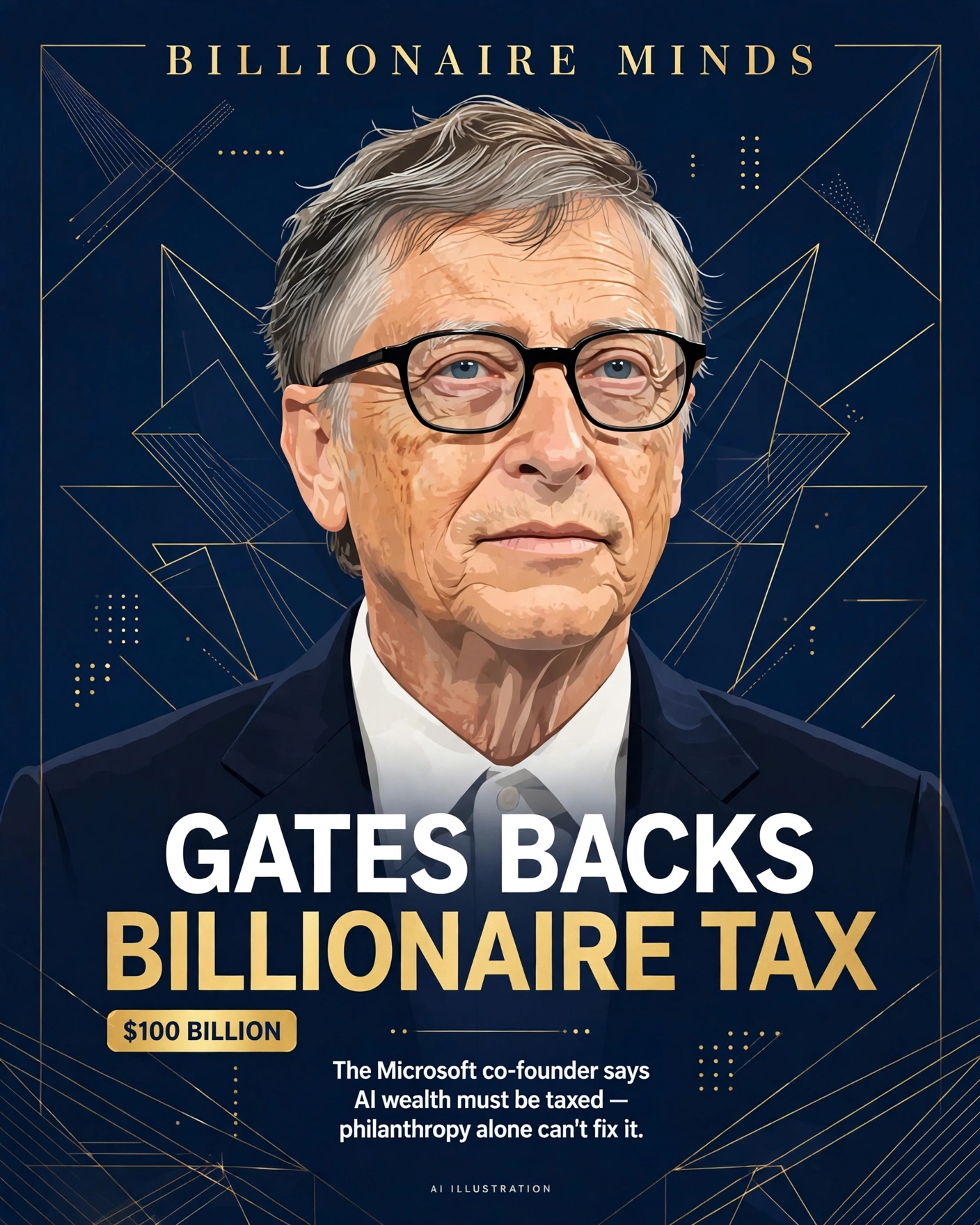
Bill Gates just said the quiet part out loud: in the age of AI, governments will have to tax billionaires — and charity alone won't cut it.
In a new interview with The Financial Times, reported by Fortune, the Microsoft co-founder argued that artificial intelligence is about to concentrate wealth faster than ever before, and that philanthropy cannot be the answer. His message was blunt: taxing the ultra-rich is no longer a debate for the future. It is a policy the AI era will force.
"Philanthropy can't be the safety net"
"The primary responsibility of dealing with inequality will always rest with governments," Gates said. "We can't expect philanthropy, which is voluntary in nature, to be the safety net."
Gates speaks from experience. He has already given "virtually all my wealth" — about $100 billion — to the Gates Foundation, which must spend it within the next 20 years. Even that, he says, won't be enough to offset the inequality AI is likely to cause.
The AI wealth machine
Gates's warning lands as AI-driven stock gains pour overwhelmingly to the top. According to Federal Reserve data, the richest 1% of Americans now own more than 50% of the nation's stock market — so every AI rally flows disproportionately to them. Economists call it the K-shaped economy: the wealthy pull away while everyone else stalls.
"So, in a world of AI, there will have to be changes in tax systems, including the ability to tax people with huge wealth, the ability to tax billionaires," Gates added.
The token tax — and the Silicon Valley split
Gates went further, reviving his proposal for an AI "token tax" — a levy on the text and data AI models process — plus a tax on robots, to pay for retraining workers and strengthening the safety net. He first set the idea out in his August 2026 essay, "A turbulent AI era — and critical choices to make." By his own count, he has paid about $14 billion in taxes in his lifetime and says he would have accepted about $40 billion under a fairer system.
Not every tech founder agrees. Nvidia chief Jensen Huang has said he understands why he may need to be taxed more, but disagrees with Gates on taxing robots and AI tokens. Google co-founder Sergey Brin and former CEO Eric Schmidt have both moved to tax-friendly states.
The debate is only heating up — and with AI fortunes growing by the day, Gates is betting the taxman is coming for billionaires next.
Source: TradersUnion, reporting Fortune / The Financial Times (Nov 6–7, 2026). Image: AI illustration.


Comments
Post a Comment